Каскад SDE
Двухступенчатый каскад извлечения структурированных данных (mini → проверка → рассуждение) даёт большую часть качества большой модели рассуждений за малую долю стоимости.
- Обзор
- большие модели рассуждений хорошо извлекают структурированные данные, но медленны и дороги
- маленькие модели дёшевы, но ошибаются
- каскад даёт большую часть качества за малую долю стоимости
- используемые нами модели и их цена ($ за 1M токенов, вход / выход; стандартные
тарифы проверены 15 сентября 2026 года):
- ступень 0 (mini):
gpt-5.4-miniпо $0.75 / $4.50 - ступень 1 (рассуждение):
gpt-5.5по $5.00 / $30.00 (примерно в 7 раз дороже mini) - верификатор: TypeSafe
jev-1.12по $0.042 / $0.00 (выходные токены бесплатны; опубликованные цены Jev)
- ступень 0 (mini):
- Алгоритм
- Извлечение дешёвой/маленькой моделью.
- Проверка примитивами TypeSafe: вопрос «да/нет» на каждое поле
(«Noul-вопрос»)
- (например, «отсутствует ли это значение в источнике?», «взято ли оно из постороннего текста?»), каждый возвращает P(что-то не так).
- Эскалация к дорогой модели рассуждений, если сработал сигнал верификатора; иначе сохраняется дешёвый ответ.
- Этот cookbook
- проходит один реальный пример от начала до конца, затем показывает компромисс на 100 промптах
- замечание: обе ступени извлечения используют OpenAI в текстовом режиме
- мы не используем structured outputs, вызовы инструментов или json-режим, потому что:
- ошибка следования схеме — не та ошибка, которую мы ожидаем от LLM (для неё легко сделать синтетические данные)
- если LLM всё же не следует схеме, она почти всегда сильно запутана, поэтому constrained decoding не решает основную проблему
- впрочем, советуем вам их попробовать!
Установка
- установите зависимости (клиент-верификатор TypeSafe поставляется из индекса пакетов TypeSafe):
pip install openai datasets jsonschema ipython 'cooksafe>=0.2.0,<0.3.0'- затем задайте
OPENAI_API_KEYиTYPESAFE_API_KEYв своём окружении
import json
import os
from pathlib import Path

import jsonschema
from cooksafe import JsonCache, make_playground_link
from datasets import load_dataset
from IPython.display import Markdown, display
from openai import OpenAI
from typesafe_sdk import Noul, NoulCriteria, TypeSafeClient

MINI = "gpt-5.4-mini"  # rung 0: cheap + fast
REASONING = "gpt-5.5"  # rung 1: strong, run with reasoning_effort="high"
TS_MODEL = "jev-1.12"  # the TypeSafe verifier model
FIRE_T = 0.7  # escalate if any per-field P(wrong) exceeds this; also the "<== FIRES" display marker

oai = OpenAI()

ts = TypeSafeClient(api_key=os.environ["TYPESAFE_API_KEY"], timeout=30.0)
Шаг 1: данные
Мы берём датасет на huggingface под названием scrapegraphai
SCRAPEGRAPHAI_REVISION = "4bb9fba1dff9181c5acdb60a5a26fea62fa54fe9"
row = load_dataset(
    "scrapegraphai/scrapegraphai-100k",
    revision=SCRAPEGRAPHAI_REVISION,
    split="train",
)[516]
schema = json.loads(row["schema"])
prompt = row["prompt"]
content = row["content"]

print(
    f"""
PROMPT
===========
{prompt}

SCHEMA
===========
{json.dumps(schema, indent=2)}

CONTENT
===========
{content}
""".strip()
)
PROMPT
===========
Find registration open date fall semester for New York University in New York, NY for the 2024-2025 school year.
SCHEMA
===========
{
"properties": {
"registration_open_date": {
"description": "The date that registration opens for the fall semester. MUST be in the format mm/dd/yyyy. For example, for a college in the 2024-2025 school year, it might be something like 09/05/2024. Return a blank string if you are unsure.",
"title": "Registration Open Date",
"type": "string"
},
"description": {
"description": "A brief description of the registration open date. For example, 'Registration opens for the fall semester'.",
"title": "Description",
"type": "string"
}
},
"required": [
"registration_open_date",
"description"
],
"title": "RegistrationOpen",
"type": "object"
}
CONTENT
===========
Skip to content Skip to current page navigation
[ ](https://www.nyu.edu/)
Search Site
[ ](https://www.nyu.edu/)
* [ Academics](https://www.nyu.edu/academics.html)
* [ Admissions](https://www.nyu.edu/admissions.html)
* [ Research](https://www.nyu.edu/research.html)
* [ University Life](https://www.nyu.edu/life.html)
* [ About](https://www.nyu.edu/about.html)
All NYU
# Mobile Navigation
[ ](https://www.nyu.edu/)
Search Site
* [Academics](https://www.nyu.edu/academics.html)
* [Admissions](https://www.nyu.edu/admissions.html)
* [Research](https://www.nyu.edu/research.html)
* [University Life](https://www.nyu.edu/life.html)
* [About](https://www.nyu.edu/about.html)
All NYU
Info for
* Back to main menu
* Info for
* [Students](https://www.nyu.edu/students.html)
* [Faculty](https://www.nyu.edu/faculty.html)
* [Alumni](https://www.nyu.edu/alumni.html)
* [Employees](https://www.nyu.edu/employees.html)
* [Community](https://www.nyu.edu/community.html)
[Log In](http://home.nyu.edu/)
Info for
* [Students](https://www.nyu.edu/students.html)
* [Faculty](https://www.nyu.edu/faculty.html)
* [Alumni](https://www.nyu.edu/alumni.html)
* [Employees](https://www.nyu.edu/employees.html)
* [Community](https://www.nyu.edu/community.html)
[Log In](https://home.nyu.edu/)
Search Site Search
# Events Calendar
Search Events
Apply Reset
* [About the Events Calendar ](https://www.nyu.edu/employees/resources-and-services/media-and-communications/digital-communications/university-events-calendar.html)
* [Events Calendar Tutorial ](https://www.nyu.edu/employees/resources-and-services/media-and-communications/digital-communications/university-events-calendar/tutorials.html)
* [Report issue or provide feedback ](https://nyu.service-now.com/sp?id=sc_cat_item&sys_id=7698dd2a98bcf4004c8c03063d84e274)
Search Filters Calendar
New York University
Equal Opportunity and Non-Discrimination at NYU - New York University is committed to maintaining an environment that encourages and fosters respect for individual values and appropriate conduct among all persons. In all University spaces--physical and digital--programming, activities, and events are carried out in accordance with applicable law as well as University policy, which includes but is not limited to its Non-Discrimination and Anti-Harassment Policy.
Unless otherwise noted, all content copyright New York University. All rights reserved.
* [Search](https://search.nyu.edu/)
* [Campus Map](https://www.nyu.edu/map.html)
* [Events](https://events.nyu.edu/)
* [Contact Us](https://www.nyu.edu/contact-us.html)
* [Give](https://www.nyu.edu/about/giving.html)
* [Copyright & Fair Use](https://www.nyu.edu/copyright-and-fair-use.html)
* [Privacy](https://www.nyu.edu/privacy.html)
* [Accessibility](https://www.nyu.edu/accessibility.html)
* [Feedback](https://www.nyu.edu/#feedback.html)
* [New York Campus](https://www.nyu.edu/)
* [Abu Dhabi Campus](https://nyuad.nyu.edu/)
* [Shanghai Campus](https://shanghai.nyu.edu/)
* [](https://facebook.com/)
* [](https://linkedin.com/)
* [](https://x.com/)
* [](https://instagram.com/)
* [](https://youtube.com/)- Эта строка — страница календаря событий NYU («Fall 2024 Census Date»):
- схема запрашивает всего два поля:
registration_open_dateиdescription - скрейп промпта захватил только навигацию календаря и обвязку: даты регистрации или описания здесь нет
- обратите внимание, что поле
descriptionв схеме даже несёт в собственном описании поля пример значения («Registration opens for the fall semester»)
- схема запрашивает всего два поля:
- поэтому благоразумный экстрактор должен отказаться выдумывать поля, которых на странице нет
- посмотрим, сделает ли маленькая модель правильную вещь!
Шаг 2: извлечение моделью mini (текстовый режим)
- замечание:
gpt-5.4-miniочень стохастична на этом входе — даже приtemperature=0она выдумывает другоеdescriptionпочти при каждом запуске. Для воспроизводимого разбора мы жёстко задаём одну каноническую фабрикацию, которую объясняет остальная часть этого блокнота (и которую верификатор помечает при P(wrong) > 0.8). Настоящий конвейер просто взял быextract(MINI, prompt, schema, content, temperature=0)напрямую.
EXTRACT_SYSTEM = (
    "You extract structured data from documents. Return only values supported by the text. "
    "Follow any value format specified by the schema or its field descriptions."
)

# LLM and TypeSafe calls are cached to ``json_cache.json``, which ships with the cookbook, so
# re-rendering reproduces the published results with no API spend; delete the file to re-run live.
json_cache = JsonCache(Path("json_cache.json"))

@json_cache
def extract(
    model: str,
    prompt: str,
    schema: dict,
    content: str,
    *,
    reasoning_effort: str | None = None,
    temperature: float | None = None,
) -> dict:
    user = (
        f"{prompt}\n\nReturn ONLY a JSON object matching this JSON Schema:\n"
        f"{json.dumps(schema, indent=2)}\n\nDocument:\n{content}"
    )
    kwargs = {
        "model": model,
        "messages": [
            {"role": "system", "content": EXTRACT_SYSTEM},
            {"role": "user", "content": user},
        ],
    }
    if reasoning_effort:
        kwargs["reasoning_effort"] = reasoning_effort
    if temperature is not None:
        kwargs["temperature"] = temperature
    text = oai.chat.completions.create(**kwargs).choices[0].message.content
    # The prompt asks for ONLY a JSON object, so parse the reply as-is -- no regex fishing a
    # substring out of a malformed reply. If ``json.loads`` fails, treat it as an empty extraction
    # (the record-level analog of NaN): every field reads as absent, which the verifier flags and the
    # gate escalates -- the safe direction. Schema-following errors are rare here (see the overview).
    try:
        return json.loads(text)
    except (ValueError, json.JSONDecodeError):
        return {}

# Hard-coded canonical fabrication (see note above); a real pipeline would use extract(MINI, prompt, schema, content, temperature=0).
mini_record = {
    "registration_open_date": "",
    "description": "Registration opens for the fall semester",
}
print("mini extraction:\n", json.dumps(mini_record, indent=2))

# The record is a perfect fit for the JSON Schema -- and still wrong. Schema validation is necessary
# but not sufficient: it catches structural errors, never semantic ones. That gap is the whole point.
print("\nschema-valid:", jsonschema.Draft202012Validator(schema).is_valid(mini_record))
mini extraction:
{
"registration_open_date": "",
"description": "Registration opens for the fall semester"
}
schema-valid: True- Запись валидна по схеме (строка выше печатает
True), и всё же она неверна:registration_open_dateоставлено пустым, что соответствует странице: она не сообщает дату- но
descriptionсфабриковано: страница никогда не описывает дату регистрации, поэтому mini выдумывает правдоподобную. Она может повторить собственный пример схемы «Registration opens for the fall semester» или рассказать «…was not found in the document» - проверка по JSON Schema этого не видит. Дешёвая модель порождает уверенные, удовлетворяющие схеме фабрикации такого рода, и ловить их — задача семантического верификатора
Шаг 3: проверка с помощью TypeSafe
- верификатор — TypeSafe; для каждого поля мы строим вопрос
Noul:- узкое «да/нет», сформулированное так, что
true= что-то не так (эскалировать)
- узкое «да/нет», сформулированное так, что
- TypeSafe возвращает калиброванный
noul=P(true)на вопрос, за один вызов system_one - набор вопросов:
- одна целостная голова
__overall__::judge(«следует ли эскалировать эту запись?»). Мы вычисляем и показываем её, чтобы противопоставить суждение обо всей записи головам по отдельным полям, но gating на шаге 4 её не использует — эскалация определяется батареей по полям. - батарея по полям
- непустые поля получают полный набор голов
- пустые поля (null / “” / []) получают только голову
absence_wrong
- (в полном конвейере есть ещё голова
spuriousдля целых контейнеров и общая оценкаdifficulty; здесь они не показаны, чтобы свести этот разбор к двум gating-головам)
- одна целостная голова
- Путь TypeSafe: декомпозиция
- Обратите внимание, как всё программно декомпозируется — это и есть путь TypeSafe.
- Декомпозиция максимизирует интеллект каждого промпта и делает алгоритм настраиваемым и интерпретируемым.
-

# metric -> (question, NoulCriteria)
MAIN_QUESTIONS = {
    "name_desc_mismatch": (
        "Does the `extracted_field` fail to match the field at `path` or the `description` in the "
        "`field_spec`? If the `description` is empty, judge against the `path` alone.",
        NoulCriteria(
            true="the `extracted_field` does not match the field name or its `description`",
            false="the `extracted_field` matches the field name and `description`",
        ),
    ),
    "type_mismatch": (
        "Does the `extracted_field` violate the `type` declared in the `field_spec`?",
        NoulCriteria(
            true="the `extracted_field` violates the declared `type`",
            false="the `extracted_field` conforms to the declared `type`",
        ),
    ),
    "unreasonable": (
        "Is the `extracted_field` one that a reasonable person would not have extracted for this "
        "`field_spec`?",
        NoulCriteria(
            true="a reasonable person would not have extracted this value",
            false="the extraction is reasonable",
        ),
    ),
    "hallucinated": (
        "Is the `extracted_field` unsupported by, or absent from, the source text?",
        NoulCriteria(
            true="the `extracted_field` is a hallucination -- not supported by, or absent "
            "from, the source text",
            false="the `extracted_field` is supported by the source text",
        ),
    ),
    "off_target": (
        "Does the source text fail to genuinely report the thing the `field_spec` describes, so the "
        "value was pulled from incidental text?",
        NoulCriteria(
            true="the source does not genuinely provide this field -- the value was pulled "
            "from incidental text",
            false="the source genuinely reports this field",
        ),
    ),
    "incomplete": (
        "Does the `extracted_field` fail to capture a value the source supports (note whether the "
        "`field_spec` is `required`)?",
        NoulCriteria(
            true="the field is wrongly empty, null, or missing a value the source supports",
            false="the field captures the value the source supports",
        ),
    ),
    "format_violation": (
        "Does the `extracted_field` violate the format or constraints implied by the `description`, "
        "the schema `type`, and the extraction instructions (e.g. date format, units, enum membership)?",
        NoulCriteria(
            true="the `extracted_field` violates the implied format or constraints",
            false="the `extracted_field` satisfies the format and constraints",
        ),
    ),
}
ABSENCE_QUESTION = (
    "The `extracted_field` is empty, null, or an empty collection. Does the source text contain the "
    "information the `field_spec` describes, making the empty result wrong?"
)
ABSENCE_CRITERIA = NoulCriteria(
    true="a value was wrongly omitted", false="returning nothing is correct"
)

# The pipeline also asks one holistic, whole-record head: "should this be escalated?"
OVERALL_JUDGE = (
    "Is this extracted record an incorrect extraction -- some value unsupported by the source or "
    "not conforming to the schema, required information missing or wrong, or some field hallucinated -- "
    "so it should be escalated to a smarter model?"
)
OVERALL_JUDGE_CRITERIA = NoulCriteria(
    true="the record is an incorrect extraction",
    false="the record is a correct extraction",
)

def is_empty(v) -> bool:
    return v is None or (isinstance(v, (str, list, dict)) and len(v) == 0)

def field_spec(name: str) -> dict:
    """Minimal spec pulled from the schema (unwrapping anyOf/null for optional fields)."""
    p = schema["properties"][name]
    branches = p.get("anyOf") or []
    typ = p.get("type") or next(
        (b["type"] for b in branches if b.get("type") != "null"), "unknown"
    )
    return {
        "path": name,
        "type": typ,
        "description": p.get("description", ""),
        "required": name in schema.get("required", []),
    }

def build_questions(record: dict) -> dict[str, Noul]:
    """The verify question set: one holistic ``__overall__::judge`` head plus a per-field battery,
    keyed ``field::metric`` (mirrors build_verify_prompts)."""
    questions: dict[str, Noul] = {
        "__overall__::judge": Noul(
            instructions=OVERALL_JUDGE, criteria=OVERALL_JUDGE_CRITERIA
        ),
    }
    for name, value in record.items():
        spec = field_spec(name)
        if is_empty(value):
            questions[f"{name}::absence_wrong"] = Noul(
                instructions={
                    "field_spec": spec,
                    "extracted_field": value,
                    "main_question": ABSENCE_QUESTION,
                },
                criteria=ABSENCE_CRITERIA,
            )
            continue
        for metric, (question, criteria) in MAIN_QUESTIONS.items():
            if metric == "type_mismatch" and spec["type"] == "unknown":
                continue
            questions[f"{name}::{metric}"] = Noul(
                instructions={
                    "field_spec": spec,
                    "extracted_field": value,
                    "main_question": question,
                },
                criteria=criteria,
            )
    return questions

@json_cache
def verify(record: dict) -> dict[str, float | str]:
    """Run the whole Noul battery over a record in one TypeSafe call; return ``{field::metric: P(true)}``."""
    state = {
        "system_message": EXTRACT_SYSTEM,
        "instruction": "Extract the structured record from this document",
        "source_text": row["content"],
        "schema": schema,
        "extraction": record,
    }
    questions = build_questions(record)
    answers = ts.system_one(state=state, questions=questions, model=TS_MODEL).answers
    return {qid: ans.noul for qid, ans in answers.items()} | {
        "playground_link": make_playground_link(state, questions)
    }
Прогоните всю батарею по извлечению mini
checks = verify(mini_record)
playground_link = checks.pop("playground_link")
display(
    Markdown(
        f"🔗 [Open this verification in the TypeSafe playground]({playground_link})"
    )
)

print(f"{'qid':<40}{'P(wrong)':>9}")
print("-" * 50)
for fld, p in sorted(checks.items(), key=lambda c: -c[-1]):
    flag = "  <== FIRES" if p > FIRE_T else ""
    print(f"{fld:<40}{p:>9.2f}{flag}")
qid P(wrong)
--------------------------------------------------
description::hallucinated 0.95 <== FIRES
description::off_target 0.85 <== FIRES
description::unreasonable 0.58
__overall__::judge 0.56
description::incomplete 0.16
registration_open_date::absence_wrong 0.14
description::format_violation 0.10
description::name_desc_mismatch 0.08
description::type_mismatch 0.02- TypeSafe концентрирует сигнал на полях, которые действительно неверны.
- Наши результаты калиброваны: высоко на неверном поле, низко на верном, средне на поле, которое выглядит подозрительно, не будучи явно неверным
- Это то, что верификатор typesafe даёт вам по сравнению с грубым судьёй «хорошо ли всё это целиком?»
Шаг 4: gating эскалации
- теперь мы делаем gating по
any_flag: эскалировать, если любой флаг поля превышаетFIRE_T(0.7, задан выше и общий с маркером<== FIRESна шаге 3) - это gating в стиле
max(эскалировать, если сработает любое поле), а не среднее, поэтому одного уверенного красного флага достаточно, вместо того чтобы усредниться в молчание
# any_flag is a per-field gate: the holistic __overall__ head is shown above but not part of it
fired = {
    qid: p
    for qid, p in checks.items()
    if not qid.startswith("__overall__") and p > FIRE_T
}
escalate = bool(fired)

print(
    f"any_flag gate (threshold {FIRE_T}): {'ESCALATE' if escalate else 'ACCEPT cheap result'}"
)
for qid, p in sorted(fired.items(), key=lambda c: -c[1]):
    print(f"  fired: {qid}  (P={p:.2f})")
any_flag gate (threshold 0.7): ESCALATE
fired: description::hallucinated (P=0.95)
fired: description::off_target (P=0.85)Шаг 5: эскалация к модели рассуждений
Раз сигнал сработал, мы платим за сильную модель (gpt-5.5, reasoning_effort="high")
final_record = (
    extract(REASONING, prompt, schema, content, reasoning_effort="high")
    if escalate
    else mini_record
)

print("mini      :", json.dumps(mini_record))
print("reasoning :", json.dumps(final_record))
print("\nfield-level diff (mini -> final):")
for name in mini_record:
    if mini_record[name] != final_record.get(name):
        print(f"  {name}: {mini_record[name]!r}  ->  {final_record.get(name)!r}")
mini : {"registration_open_date": "", "description": "Registration opens for the fall semester"}
reasoning : {"description": "", "registration_open_date": ""}
field-level diff (mini -> final):
description: 'Registration opens for the fall semester' -> ''- Улучшение
- Модель рассуждений отбрасывает сфабрикованное
description, возвращая"" - Она распознала, что страница никогда не описывает дату регистрации, и отказалась её выдумывать
- Каскад превратил уверенную, валидную по схеме фабрикацию в честное пустое поле
- И он потратил доллары модели рассуждений на этот единственный элемент только потому, что верификатор так сказал
- Модель рассуждений отбрасывает сфабрикованное
Шаг 6: как это выглядит на 100 промптах
- Это внутренние результаты TypeSafe, полученные описанным выше общим методом:
- тот же цикл
extract → verify → escalate,gpt-5.4-mini → gpt-5.5-reasoning, gatingany_flagпо головам отдельных полей, прогнанный на 100 промптах scrapegraphai - извлечение каждого элемента на дешёвой ступени оценивается TypeSafe; порог gating («cut») перебирается 0→1, и каждая получившаяся конфигурация откладывается в пространстве (стоимость, качество)
- график — исторический снимок; его стоимости не пересчитаны по текущему тарифу Jev, указанному выше
- тот же цикл
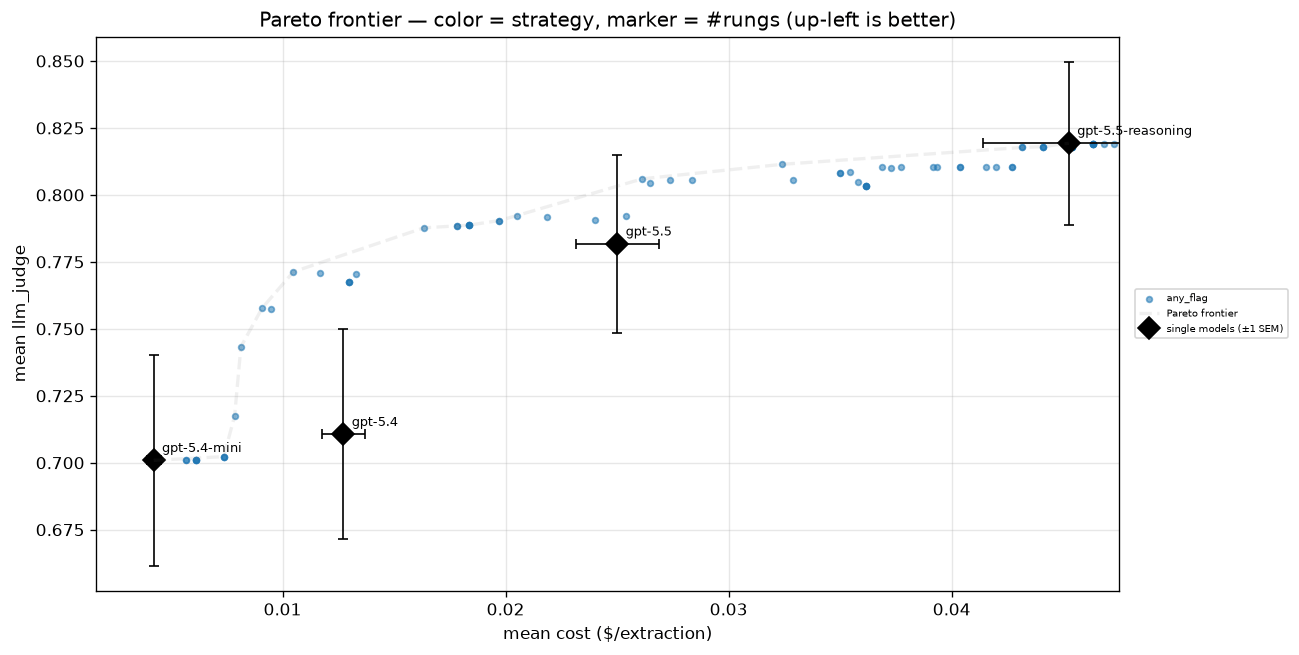
- как это читать:
- чёрные ромбы = четыре модели, запущенные сами по себе (стоимость растёт вместе со
способностями; сильнейшая,
gpt-5.5-reasoning, находится справа вверху: ≈0.81 качества за ≈$0.10/извлечение) - синие точки = каскад при многих порогах gating; пунктирная линия — граница Парето
- граница каскада лежит выше и левее каждой отдельной модели: перебор порога даёт большую часть качества топовой модели за малую долю её стоимости
- дешёвая ступень обрабатывает лёгкие элементы почти бесплатно, и только помеченные элементы платят за модель рассуждений
- чёрные ромбы = четыре модели, запущенные сами по себе (стоимость растёт вместе со
способностями; сильнейшая,
Приложение A: что делает сигнал верификатора хорошим
- каскад хорош ровно настолько, насколько хорош его верификатор; вот что отличает полезный
сигнал от бесполезного:
- Узкий и обоснованный.
- одна проверяемая пара «да/нет» об одном поле относительно источника (например, «отсутствует ли это значение в источнике?»), а не расплывчатое «хорошо ли это извлечение?»
- расплывчатые вопросы дают вязкие, некалиброванные оценки
- Плохо = TRUE, с явными критериями.
- формулируйте каждый вопрос так, чтобы случай эскалации был случаем
true, и указывайте, что значатtrue/false
- формулируйте каждый вопрос так, чтобы случай эскалации был случаем
- По полям, затем агрегируйте через
max.- флаг по полю локализует ошибку и остаётся разреженным и сильным
max(«любой флаг сработал») гарантирует, что один уверенный красный флаг приводит к эскалации, вместо того чтобы усредниться в молчание
- Независимый и дешёвый.
- выделенный верификатор (здесь TypeSafe), судящий вывод, ловит собственные слепые зоны экстрактора
- он должен быть дешёвым, иначе экономии не остаётся
- Разделяющий / калиброванный.
- хороший сигнал высок на настоящих ошибках и низок на верных, поэтому один порог чисто разделяет принять и эскалировать
- именно это разделение толкает кривую Парето вверх и влево
- Узкий и обоснованный.