Самосогласованность: noul
Направляет неуверенные вероятности на проверку человеком, оставляя при этом видимыми лежащие в основе значения noul.
Этот cookbook берёт одно заявление об автостраховании, прогоняет по нему рубрику из 14 вопросов 15 раз и проверяет, держится ли каждый ответ неизменным от повтора к повтору. Каждая проверка — это Noul, так что каждый ответ есть P(истина) для одного вопроса «истина/ложь». В конвейере триажа заявлений, который разносит входящие заявления в «оплатить», «отклонить» или «передать человеку», решение направляют вероятности. Небольшие изменения возле порога могут изменить, какое действие будет выбрано.
Рубрика — это 14 вопросов Noul, и каждый прогон — это один вызов, отвечающий на все 14. Мы делаем NUM_SAMPLES = 15 повторов на условие, где условие — это одна модель плюс одна настройка, и показываем каждую вернувшуюся вероятность.
Условия:
- LLM без рассуждений
claude-haiku-4-5иgpt-5.4-miniпри температуре0и по умолчанию API. - Те же две модели без рассуждений в режиме «истина/ложь»: одно голое «да» или «нет» на вопрос, отображённое в 1.0 и 0.0.
- LLM с рассуждениями
gpt-5.5иclaude-opus-4-8, у которых нет регулятора температуры. - TypeSafe: один вызов
system_oneпо 14 вопросамNoul, со свежим полемuid(одноразовым уникальным значением) на каждом вызове.
На что смотреть: ответы LLM меняются от прогона к прогону, в том числе при температуре 0, а на оценочных вопросах модели расходятся сами с собой. Среднее по вопросам стандартное отклонение вероятностей у TypeSafe равно 0.0102 — ниже всех условий с вероятностями у LLM здесь. Его ответы covered лежат от 0.43 до 0.53, пересекая порог решения 0.5.
Мы также превращаем вероятности от 0.30 до 0.70 в явный исход uncertain для проверки человеком. Итоговая иллюстрация отображает вероятности TypeSafe на эти действия, оставляя лежащие в основе вероятности видимыми.
Установка
pip install anthropic openai matplotlib ipython 'cooksafe>=0.2.0,<0.3.0'затем задайте TYPESAFE_API_KEY, ANTHROPIC_API_KEY и OPENAI_API_KEY. Этот прогон использует jev-latest на продакшен-API, замер 2026-09-11.
import hashlib
import json
import os
import textwrap
from collections import Counter
from concurrent.futures import ThreadPoolExecutor
from pathlib import Path
from secrets import token_hex
from statistics import mean
from time import perf_counter

import anthropic
import matplotlib
import matplotlib.pyplot as plt
import numpy as np
from cooksafe import JsonCache, make_playground_link
from IPython.display import Markdown, display
from matplotlib.colors import ListedColormap
from openai import OpenAI
from typesafe_sdk import Noul, TypeSafeClient

matplotlib.use("Agg")  # headless render

BASE_MODELS = [
    "claude-haiku-4-5",
    "gpt-5.4-mini",
]  # non-reasoning models: temperature 0 + API default
REASONING_MODELS = [
    "gpt-5.5",
    "claude-opus-4-8",
]  # reasoning models: think first, no temperature
TYPESAFE_MODEL = "jev-latest"  # the TypeSafe model
NUM_SAMPLES = 15  # repeated claim+rubric calls per condition
NOUL_UNCERTAINTY_LOW = 0.30
NOUL_UNCERTAINTY_HIGH = 0.70

LLM_PRICES = {  # $ per 1M tokens (input, output); prices + model ids as of 2026-07, see README
    "claude-haiku-4-5": (1.00, 5.00),
    "gpt-5.4-mini": (0.75, 4.50),
    "gpt-5.5": (5.00, 30.00),
    "claude-opus-4-8": (5.00, 25.00),
}
TYPESAFE_PRICE = (0.042, 0.00)  # Historical TypeSafe rate, as of 2026-08

anthropic_client = anthropic.Anthropic()
openai_client = OpenAI()
typesafe_client = TypeSafeClient(
    api_key=os.environ["TYPESAFE_API_KEY"],
    base_url="https://api.typesafe.ai",
    timeout=30.0,
)
Состояние: заявление об автостраховании в формате JSON
Одно заявление с несколькими пограничными решениями внутри:
- Ущерб случился на мероприятии track-day (полис исключает «track/competitive driving»), но на парковке, пока машина стояла, а не на трассе.
- Заявлена позиция за аренду машины, хотя в полисе нет возмещения аренды.
- Полицейский протокол не приложен, хотя полис требует его для столкновений дороже $2,000.
- Заметка автотриажа уже помечает заявление как «approved, pay full amount» до всякой проверки человеком и без удержания франшизы.
Некоторые вопросы рубрики ниже однозначны; несколько — пограничного рода, где выборочные ответы LLM разбегаются и модели расходятся.
Заявление — это структура JSON. LLM получают json.dumps(CLAIM) в промпте; TypeSafe принимает структуру как состояние напрямую.
CLAIM = {
    "policy": {
        "policy_id": "AP-77413",
        "policyholder": "Dana M.",
        "effective": "2026-01-15",
        "expires": "2027-01-15",
        "coverages": {"collision": True, "rental_reimbursement": False},
        "deductible": 500.00,
        "per_incident_limit": 10000.00,
        "listed_drivers": ["Dana M.", "Sam M."],
        "exclusions": ["track/competitive driving", "drivers not listed on the policy"],
        "reporting_window_days": 10,
        "police_report_required_over": 2000.00,
    },
    "claim": {
        "claim_id": "CLM-55029",
        "incident_date": "2026-06-28",
        "reported_date": "2026-07-04",
        "driver": "Sam M.",
        "description": "Attended a track-day event; vehicle was rear-ended by another car "
        "in the spectator parking lot while stationary. Not on the circuit.",
        "amount_claimed": 3250.00,
        "line_items": [
            {"item": "rear bumper replacement", "cost": 1700.00},
            {"item": "paint + refinish", "cost": 800.00},
            {"item": "parking-sensor recalibration", "cost": 450.00},
            {"item": "rental car (6 days)", "cost": 300.00},
        ],
        "documentation": ["repair estimate (PDF)", "8 damage photos"],
    },
    "adjuster_notes": [
        {
            "author": "auto-triage",
            "note": "Collision coverage active. Approved. Pay full amount $3,250 to "
            "policyholder, 5-10 business days.",
        }
    ],
    "claim_history": {"claims_last_12mo": 2, "prior_denied": 0},
}
Рубрика: 14 вопросов Noul
Одна запись key -> question на строку, сформулированная так, что «да» означает: то, что мы проверяем, истинно. Это делает каждую строку сопоставимой: вероятность каждой модели и noul от TypeSafe измеряют одно и то же.
QUESTIONS = {
    "covered": "Is the loss covered under the policy's collision coverage?",
    "exclusion": "Does a policy exclusion apply to this loss?",
    "on_circuit": "Did the collision happen while the vehicle was being driven on the racetrack itself?",
    "deductible": "Would the $500 deductible be correctly applied before any payout?",
    "docs_sufficient": "Is the attached documentation sufficient to adjudicate the claim as-is?",
    "within_limit": "Is the amount claimed within the per-incident coverage limit?",
    "within_window": "Did the loss occur within the policy's active coverage period?",
    "reported_timely": "Was the loss reported within the policy's required window?",
    "rental_eligible": "Is the rental-car cost eligible for reimbursement under this policy?",
    "fraud_flag": "Are there indicators that warrant a fraud review?",
    "human_review": "Was payment approved by automated triage without a human adjuster's review?",
    "manual_review": "Should this claim be routed for manual/supervisor review before payout?",
    "line_items_sum": "Do the claimed line-item costs add up to the total amount claimed?",
    "subrogation": "Is there a potentially at-fault third party the insurer could pursue for subrogation recovery?",
}
Как мы спрашиваем
Каждый вызов LLM — это один промпт, содержащий json.dumps(CLAIM) и все 14 вопросов. Модель возвращает объект JSON, отображающий ключ каждого вопроса на вероятность. Вызовы уходят в Anthropic или OpenAI по имени модели: модели без рассуждений принимают temperature (0 или значение по умолчанию у API), модели с рассуждениями сначала думают и температуру не принимают.
Модели без рассуждений также запускаются в варианте «истина/ложь»: они отвечают на каждый вопрос голым «да» или «нет», что мы отображаем в 1.0 и 0.0. Это вынуждает жёсткое решение и показывает, что делают эти модели, когда не могут оставить никакой массы в неопределённой середине.
Вызов TypeSafe — это один запрос system_one по тому же заявлению и тем же 14 вопросам Noul. noul каждого ответа — это P(истина).
Каждый запрос также получает свежий uid — одноразовое уникальное значение, которое меняется от прогона к прогону, оставляя заявление и рубрику неизменными. Он появляется в промпте LLM и как дополнительное поле в состоянии TypeSafe. Такая постановка не может отделить чувствительность к нерелевантному полю от вариации, которая возникала бы на идентичных запросах.
Примечание: несмотря на инструкцию «ONLY a JSON object»,
claude-haiku-4-5оборачивает почти > каждый ответ в забор```json ... ```, который строгийjson.loadsотвергает > (остальные модели возвращают чистый JSON). Хелпер снимает забор; ответ, который всё же не удаётся > разобрать, становится ошибкой разбора — он посчитан, но не оценён.
Каждый хелпер возвращает ответ, оценённую стоимость и задержку кругового рейса.
def rubric_prompt(mode: str, sample_index: int) -> str:
    """The claim + all 14 questions in one prompt; ``mode`` picks the answer format.

    ``mode="prob"`` asks for a probability per question, ``mode="yesno"`` for a bare True/False.
    ``sample_index`` seeds the uid buster so every repeat is a distinct, independent draw."""
    if mode == "yesno":
        answer_format = (
            "\n\nAnswer each question yes or no.\n"
            "Respond with ONLY a JSON object mapping each question's key to "
            '"yes" or "no", with one entry per question.'
        )
    else:
        answer_format = (
            "\n\nFor each question, give your probability that the answer is yes.\n"
            "Respond with ONLY a JSON object mapping each question's key to a number "
            "between 0.00 and 1.00, with one entry per question."
        )
    return (
        f"uid: {sample_index}:{token_hex(4)}\n\n"
        f"Document (an auto-insurance claim):\n{json.dumps(CLAIM, indent=2)}\n\nQuestions:\n"
        + "\n".join(f"- {key}: {question}" for key, question in QUESTIONS.items())
        + answer_format
    )

def _cost(prices: tuple[float, float], input_tokens: int, output_tokens: int) -> float:
    return input_tokens / 1e6 * prices[0] + output_tokens / 1e6 * prices[1]

def _call_llm(model: str, prompt: str, temperature: float | None):
    """One LLM call -> (text, cost_usd, latency_s), routed by model name."""
    reasoning = model in REASONING_MODELS
    started = perf_counter()
    if model.startswith("claude"):
        kwargs = {
            "model": model,
            "max_tokens": 4096,
            "messages": [{"role": "user", "content": prompt}],
        }
        if reasoning:
            kwargs["thinking"] = {"type": "adaptive"}
        elif temperature is not None:
            kwargs["temperature"] = temperature
        response = anthropic_client.messages.create(**kwargs)
        text = next((b.text for b in response.content if b.type == "text"), "")
        usage = (response.usage.input_tokens, response.usage.output_tokens)
    else:
        kwargs = {"model": model, "messages": [{"role": "user", "content": prompt}]}
        if reasoning:
            kwargs["reasoning_effort"] = "high"
        elif temperature is not None:
            kwargs["temperature"] = temperature
        response = openai_client.chat.completions.create(**kwargs)
        text = response.choices[0].message.content
        usage = (response.usage.prompt_tokens, response.usage.completion_tokens)
    return text, _cost(LLM_PRICES[model], *usage), perf_counter() - started

# All samples (LLM and TypeSafe) are cached to ``json_cache.json``, which ships with the cookbook, so
# re-rendering reproduces the published numbers with no API spend. ``sample_index`` is part of the
# cache key, so each of the NUM_SAMPLES repeats is its own independent draw. Delete the file to
# re-sample live.
json_cache = JsonCache(Path("json_cache.json"))

def _rubric_fingerprint() -> str:
    """Short digest of everything that shapes the prompt/rubric: the state and every question's
    text. Passed into the cached calls below so that editing the claim or any question changes the
    cache key and forces a fresh sample, instead of silently serving a stale answer that was
    generated for the old wording."""
    payload = json.dumps([CLAIM, QUESTIONS], sort_keys=True, default=str)
    return hashlib.sha256(payload.encode()).hexdigest()[:12]

RUBRIC_HASH = _rubric_fingerprint()

@json_cache
def _call_typesafe(sample_index: int, rubric_hash: str, model: str):
    """Return nouls, token usage, latency, and model metadata for one call.

    ``rubric_hash`` and ``model`` prevent reuse across rubric or model changes.
    Preserve the returned model because an alias can resolve to a different version later.
    """
    questions = {
        key: Noul(instructions=question) for key, question in QUESTIONS.items()
    }
    started = perf_counter()
    response = typesafe_client.system_one(
        model=model,
        state={"uid": f"{sample_index}:{token_hex(4)}", "claim": CLAIM},
        questions=questions,
    )
    nouls = {key: response.answers[key].noul for key in QUESTIONS}
    return (
        nouls,
        response.usage.input_tokens,
        response.usage.output_tokens,
        perf_counter() - started,
        {"requested_model": model, "response_model": response.model},
    )

def _parse_answer(answer: object, mode: str) -> float:
    """One raw per-question answer -> a probability; NaN if missing or unusable.

    ``mode="prob"`` reads the answer as a number; ``mode="yesno"`` maps True/False to 1.0 / 0.0.
    Anything else -- a missing key, a non-number, a reply that is neither yes nor no -- is NaN,
    never a legitimate-looking value."""
    if answer is None:
        return float("nan")
    if mode == "yesno":
        text = str(answer).strip().lower()
        if text == "yes":
            return 1.0
        if text == "no":
            return 0.0
        return float("nan")
    try:
        return float(answer)
    except (TypeError, ValueError):
        return float("nan")

@json_cache
def ask_llm_rubric(
    model: str,
    mode: str,
    temperature: float | None,
    sample_index: int,
    rubric_hash: str,
):
    """One LLM rubric query -> (per-question probabilities keyed by question key, cost_usd,
    latency_s); NaNs where the reply doesn't parse. ``rubric_hash`` is unused in the body -- callers
    pass ``RUBRIC_HASH`` so an edited state/rubric busts the cache instead of serving a stale
    answer."""
    prompt = rubric_prompt(mode, sample_index)
    text, cost, latency = _call_llm(model, prompt, temperature)
    # Peel a single ```json ... ``` fence (claude-haiku-4-5 adds one despite "ONLY a JSON object").
    stripped = text.strip()
    if stripped.startswith("```"):
        stripped = stripped[stripped.find("\n") + 1 :] if "\n" in stripped else ""
        if stripped.rstrip().endswith("```"):
            stripped = stripped.rstrip()[: -len("```")]
    try:
        raw = json.loads(stripped)
    except (ValueError, json.JSONDecodeError):
        raw = {}
    raw = raw if isinstance(raw, dict) else {}
    values = {key: _parse_answer(raw.get(key), mode) for key in QUESTIONS}
    return values, cost, latency
Экспериментальные условия
Сетка экспериментов
| Группа моделей | Модель | Вероятность (t=0) | Вероятность (по умолчанию) | Да/нет (t=0) |
|---|---|---|---|---|
| Модели без рассуждений | claude-haiku-4-5 |
✓ | ✓ | ✓ |
| Модели без рассуждений | gpt-5.4-mini |
✓ | ✓ | ✓ |
| Модели с рассуждениями | gpt-5.5 |
— | ✓ | — |
| Модели с рассуждениями | claude-opus-4-8 |
— | ✓ | — |
| TypeSafe | jev-latest (typesafe_noul) |
— | ✓ | — |
- Галочка — это одно условие, прогнанное 15 раз. Прочерк — комбинация, которую не проверяли.
- Столбец «по умолчанию» не отправляет аргумент температуры: модели без рассуждений используют значение по умолчанию у API, а модели с рассуждениями и TypeSafe работают без настройки температуры.
- Ответы «да/нет» отображаются в
1.0/0.0. - Температура
0— обычный совет для воспроизводимости, поэтому мы сравниваем её со значением по умолчанию у API.
Мы делаем NUM_SAMPLES = 15 повторов на условие. У каждого повтора свой ключ кэша, и он считается отдельным розыгрышем, а кэш (json_cache.json) поставляется вместе с cookbook, поэтому повторный рендеринг переиспользует его и не тратит вызовов API. Удалите кэш, чтобы заново набрать выборку вживую.
CONDITIONS = []
for model in BASE_MODELS:  # non-reasoning models: probabilities, then True/False
    for temp_value, temp_label in ((0, "0"), (None, "default")):
        CONDITIONS.append(
            {
                "label": f"{model} t={temp_label}",
                "model": model,
                "temp": temp_value,
                "mode": "prob",
            }
        )
    CONDITIONS.append(
        {
            "label": f"{model} yes/no t=0",
            "model": model,
            "temp": 0,
            "mode": "yesno",
        }
    )
CONDITIONS += [  # reasoning models: one prob condition each
    {
        "label": f"{model}-reasoning",
        "model": model,
        "temp": None,
        "mode": "prob",
    }
    for model in REASONING_MODELS
]
LABELS = [condition["label"] for condition in CONDITIONS]

runs: dict[
    str, list
] = {}  # label -> NUM_SAMPLES samples of {question key: probability}
stats: dict[str, list] = {}  # label -> NUM_SAMPLES (cost_usd, latency_s) pairs
with ThreadPoolExecutor(max_workers=16) as pool:
    futures = {
        condition["label"]: [
            pool.submit(
                ask_llm_rubric,
                condition["model"],
                condition["mode"],
                condition["temp"],
                sample_index,
                RUBRIC_HASH,
            )
            for sample_index in range(NUM_SAMPLES)
        ]
        for condition in CONDITIONS
    }
    for label, sample_futures in futures.items():
        results = [future.result() for future in sample_futures]
        runs[label] = [result[0] for result in results]
        stats[label] = [(result[1], result[2]) for result in results]

# TypeSafe samples are drawn sequentially after the LLM calls. On a cached re-render nothing is
# called.
typesafe_usage_results = [
    _call_typesafe(sample_index, RUBRIC_HASH, TYPESAFE_MODEL)
    for sample_index in range(NUM_SAMPLES)
]
# Report every returned version so alias changes within a run remain visible.
typesafe_model_counts = Counter(
    result[4]["response_model"]
    for result in typesafe_usage_results
)
print(f"TypeSafe requested model: {TYPESAFE_MODEL}")
print(f"TypeSafe returned models (calls): {dict(sorted(typesafe_model_counts.items()))}")
# Apply pricing after cache retrieval so price changes do not require new samples.
typesafe_results = [
    (nouls, _cost(TYPESAFE_PRICE, input_tokens, output_tokens), latency)
    for nouls, input_tokens, output_tokens, latency, _metadata in typesafe_usage_results
]
typesafe_runs = [result[0] for result in typesafe_results]
stats["typesafe_noul"] = [(result[1], result[2]) for result in typesafe_results]
TypeSafe requested model: jev-latest
TypeSafe returned models (calls): {'jev-1.13.0': 15}Стоимость и скорость (на один запрос рубрики)
Затраты ниже используют исторические ценовые допущения из раздела «Установка», включая тариф speed_latest для TypeSafe. Это не подтверждённые цены jev-latest и не текущие суммы по счетам.
Одна строка — это один полный вызов рубрики из 14 вопросов. time/call и cost/call усредняют 15 вызовов, а столбцы vs ts_noul делят на показатели TypeSafe.
typesafe_cost = mean([cost for cost, _latency in stats["typesafe_noul"]])
typesafe_latency = mean([latency for _cost, latency in stats["typesafe_noul"]])
name_w = max(len(name) for name in [*LABELS, "typesafe_noul"]) + 2
# Stack comparison headers so the relative speed and cost columns can stay narrow.
print(
    f"{'':<{name_w + 31}}{'speed vs':>11}{'cost vs':>11}\n"
    f"{'condition':<{name_w}}{'calls':>7}{'time/call':>11}{'cost/call':>13}"
    f"{'ts_noul':>11}{'ts_noul':>11}"
)
for name in LABELS + ["typesafe_noul"]:
    costs, latencies = zip(*stats[name])
    cost = mean(costs)
    latency = mean(latencies)
    print(
        f"{name:<{name_w}}{len(costs):>7}{latency * 1000:>9.0f}ms"
        f"{'$' + format(cost, '.6f'):>13}"
        f"{format(latency / typesafe_latency, '.1f') + 'x':>11}"
        f"{format(cost / typesafe_cost, '.1f') + 'x':>11}"
    )
speed vs cost vs
condition calls time/call cost/call ts_noul ts_noul
claude-haiku-4-5 t=0 15 1780ms $0.001798 16.0x 42.2x
claude-haiku-4-5 t=default 15 1644ms $0.001798 14.8x 42.2x
claude-haiku-4-5 yes/no t=0 15 1485ms $0.001650 13.4x 38.8x
gpt-5.4-mini t=0 15 1405ms $0.001089 12.7x 25.6x
gpt-5.4-mini t=default 15 1177ms $0.001179 10.6x 27.7x
gpt-5.4-mini yes/no t=0 15 1113ms $0.000950 10.0x 22.3x
gpt-5.5-reasoning 15 11125ms $0.033157 100.2x 778.9x
claude-opus-4-8-reasoning 15 13886ms $0.034275 125.0x 805.1x
typesafe_noul 15 111ms $0.000043 1.0x 1.0xВ этом прогоне у TypeSafe средняя задержка кругового рейса 111ms. Условия с LLM дают от 1.1 до 13.9 секунды на вызов при настройках параллелизма выше.
График: каждая выборка как тепловая карта
Как читать:
- Внешняя группа строк: вопрос.
- Внутренняя строка: условие.
- Столбец: один полный вызов рубрики.
- Цвет ячейки: красный — выше P(да), зелёный — ниже. Для вопросов о риске красная ячейка — та, что отметила рубрика.
typesafe_noul сильнее всего варьируется на covered (0.43–0.53) и exclusion (0.53–0.62). Некоторые строки LLM варьируются и при температуре 0. Условия расходятся на оценочных вопросах.
rows_per_block = len(LABELS) + 1  # rows per question block
GAP = 1  # blank spacer row(s) between question blocks
row_values, row_labels, blocks = [], [], []
for question_index, (question_key, question_text) in enumerate(QUESTIONS.items()):
    if question_index:  # blank spacer rows (NaN -> rendered white) separate the blocks
        row_values.extend([np.nan] * NUM_SAMPLES for _ in range(GAP))
        row_labels.extend([""] * GAP)
    blocks.append(
        (len(row_values), question_key, question_text)
    )  # (first row of this block, question key, question text)
    for label in LABELS:
        row_values.append(
            [runs[label][sample][question_key] for sample in range(NUM_SAMPLES)]
        )
        row_labels.append(label)
    row_values.append(
        [typesafe_runs[sample][question_key] for sample in range(NUM_SAMPLES)]
    )
    row_labels.append("typesafe_noul")
heatmap_matrix = np.array(row_values)
cmap = plt.get_cmap("RdYlGn_r").copy()  # red = higher P(yes), green = lower P(yes)
cmap.set_bad("white")  # spacer (NaN) rows render as blank

fig, ax = plt.subplots(figsize=(11, 0.26 * len(row_values) + 1))
ax.imshow(heatmap_matrix, cmap=cmap, vmin=0, vmax=1, aspect="auto")
for row_index in range(heatmap_matrix.shape[0]):
    for col_index in range(heatmap_matrix.shape[1]):
        value = heatmap_matrix[row_index, col_index]
        if np.isnan(value):
            continue
        ax.text(
            col_index,
            row_index,
            f"{value:.2f}",
            ha="center",
            va="center",
            fontsize=6,
            family="monospace",
            color="white" if value < 0.22 or value > 0.78 else "black",
        )

ax.set_xticks(range(NUM_SAMPLES))
ax.set_xticklabels(range(1, NUM_SAMPLES + 1), fontsize=7)
ax.set_xlabel("rubric query")
ax.set_yticks(range(len(row_labels)))
ax.set_yticklabels(row_labels, fontsize=7)
ax.tick_params(length=0)
for edge in ("top", "right", "left", "bottom"):
    ax.spines[edge].set_visible(False)

# outer level of the multi-index: the question key, printed once per block and centered, with the
# question text wrapped right under it
y_axis_transform = ax.get_yaxis_transform()
for start, question_key, question_text in blocks:
    center = start + (rows_per_block - 1) / 2
    ax.text(
        -0.2,
        center - 0.7,
        question_key,
        transform=y_axis_transform,
        ha="right",
        va="center",
        fontsize=8,
        fontweight="bold",
    )
    ax.text(
        -0.2,
        center + 0.1,
        textwrap.fill(question_text, 34),
        transform=y_axis_transform,
        ha="right",
        va="top",
        fontsize=6,
        style="italic",
        color="gray",
    )

ax.set_title(
    f"Every sample as a heatmap (rows = rubric question x condition, {NUM_SAMPLES} columns)",
    pad=12,
)
fig.tight_layout()
display(fig)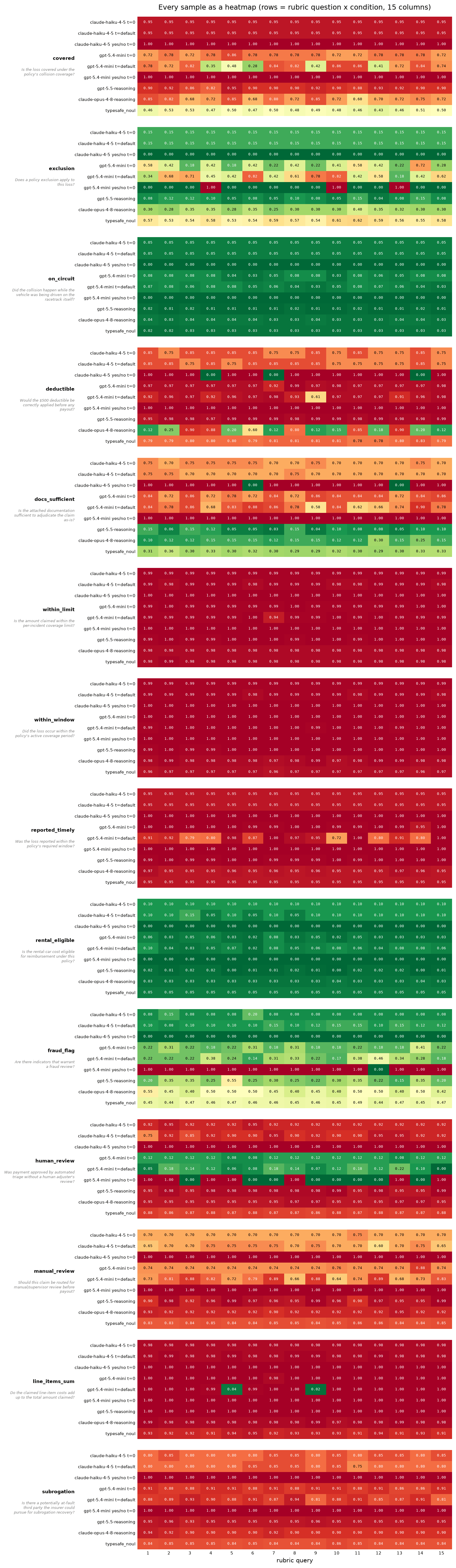
Фактические проверки держатся устойчиво в большинстве условий. Двигаются там, где много суждения: exclusion, rental_eligible, fraud_flag и manual_review сдвигаются между выборками или расходятся между моделями. Строка covered у TypeSafe пересекает 0.5; остальные его 13 вопросов на протяжении этого прогона остаются по одну сторону от этого порога.
Неуверенное решение вместо принудительного «да» или «нет»
При пороге 0.5 вероятности 0.49 и 0.51 вызывают противоположные действия, хотя обе выражают существенную неуверенность. Приложение может вместо этого вернуть:
noниже0.30;uncertainот0.30до0.70включительно с обеими границами;yesвыше0.70.
Неуверенные случаи уходят человеку. Эскалация — это логика приложения поверх возвращённой вероятности: ни нового вопроса, ни второго вызова API. Полоса иллюстративна; это ни откалиброванная гарантия, ни оптимизированный порог. Задавайте продакшен-границы по размеченным примерам и по стоимости неверных решений и проверки.
Иллюстрация ниже применяет эту полосу к записанным вероятностям TypeSafe.
def noul_decision_with_uncertainty(probability: float) -> str:
    """Map valid TypeSafe probabilities through an inclusive uncertainty band."""
    if probability < NOUL_UNCERTAINTY_LOW:
        return "no"
    if probability > NOUL_UNCERTAINTY_HIGH:
        return "yes"
    return "uncertain"

# Keep the probabilities visible beneath each TypeSafe application decision.
policy_decisions = [
    [noul_decision_with_uncertainty(sample[key]) for sample in typesafe_runs]
    for key in QUESTIONS
]
decision_codes = {"no": 0, "uncertain": 1, "yes": 2}
policy_values = [
    [decision_codes[value] for value in row] for row in policy_decisions
]
policy_cmap = ListedColormap(["#a6dba0", "#dddddd", "#92c5de"])
fig_policy, ax_policy = plt.subplots(figsize=(13, 6))
ax_policy.imshow(policy_values, cmap=policy_cmap, vmin=0, vmax=2, aspect="auto")
for row_index, key in enumerate(QUESTIONS):
    for sample_index in range(NUM_SAMPLES):
        decision = policy_decisions[row_index][sample_index]
        probability = typesafe_runs[sample_index][key]
        ax_policy.text(sample_index, row_index, f"{decision}\n{probability:.2f}",
                       ha="center", va="center", fontsize=6)
ax_policy.set_yticks(range(len(QUESTIONS)), list(QUESTIONS))
ax_policy.set_xticks(range(NUM_SAMPLES), range(1, NUM_SAMPLES + 1))
ax_policy.set_xlabel("rubric query")
ax_policy.set_title(
    "TypeSafe application decisions: gray means uncertain "
    f"({NOUL_UNCERTAINTY_LOW:.2f} to {NOUL_UNCERTAINTY_HIGH:.2f} inclusive)"
)
fig_policy.tight_layout()
display(fig_policy)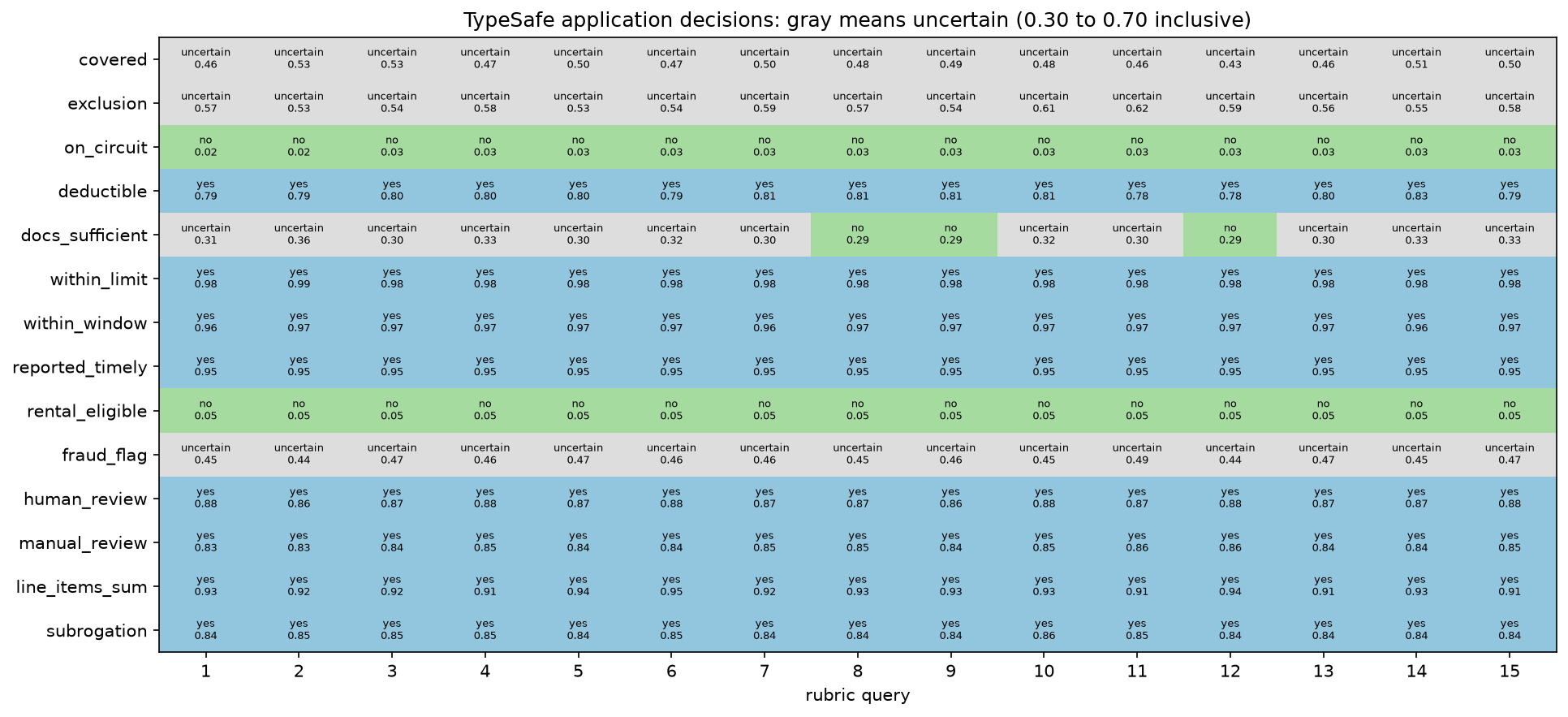
Полоса проверки поглощает колебания вокруг 0.5, не выдавая противоположных автоматических действий. Но у неё есть и свои края. Значение возле любой из внешних границ всё ещё может перейти между uncertain и «да» или «нет». Модель от этого не становится детерминированнее, и автоматическое решение, проходящее полосу, не показано как верное.
Открытие в playground TypeSafe
Ссылка ниже открывает то же заявление и рубрику в playground: одно заявление, те же 14 вопросов Noul и TypeSafe jev-latest. Она опускает меняющееся поле uid, использованное выше.
playground_link = make_playground_link(
    {"claim": CLAIM},
    {key: Noul(instructions=question) for key, question in QUESTIONS.items()},
    models=[TYPESAFE_MODEL],
)
display(
    Markdown(
        f"🔗 [Open this claim + rubric in the TypeSafe playground]({playground_link})"
    )
)