Обнаружение признаков через autoresearch
Запускает цикл autoresearch, который предлагает вопросы TypeSafe, превращает свободный текст в числовые признаки и использует ошибки модели для улучшения обученного с учителем регрессора CatBoost.
Вопросы TypeSafe превращают свободный текст в числовые признаки для обученной с учителем модели CatBoost; используйте цикл autoresearch, чтобы их обнаружить.
CatBoost нужна таблица чисел, а дегустационная заметка — не таблица. Этот cookbook строит таблицу из вопросов о заметке, и ни один из них не написан вручную. Вопросы предлагает LLM, TypeSafe отвечает на них для каждой строки, а CatBoost обучается на ответах. Дальше идёт часть autoresearch: CatBoost сообщает, какие вопросы он использовал и какие строки всё ещё предсказывает неверно, следующий вызов предложения читает этот отчёт, и цикл повторяется.
К концу у вас есть цикл, который можно направить на свой размеченный текст, кривая ошибки на отложенных данных по раундам и таблица того, какие вопросы финальная модель использовала чаще всего.
tasting note
    |
    v
38 TypeSafe answers
    |-- 29 score questions x 2 columns = 58
    |     expected rubric level + answer uncertainty
    `--  9 noul questions  x 1 column  =  9
          probability true
    |
    v
67 numeric columns --> CatBoost --> predicted critic score
                                     held-out RMSE: 1.77 points
Ответ score превращается в два столбца: средний уровень, на который указывает ответ, и то, насколько он разбросан вокруг этого среднего. Ответ noul — это одна вероятность, поэтому он даёт один столбец.
Данные — это 2,000 винных рецензий: на входе дегустационная заметка, на выходе оценка критика по шкале 80–100. RMSE измеряет ошибку предсказания в баллах оценки критика, причём большие промахи весят больше, и меньше — лучше. Каждое число в таблице ниже взято из 800 рецензий, которых не видели ни модель, ни цикл.
| как заметка превращается в оценку | RMSE |
|---|---|
| предсказать среднюю оценку обучающих строк | 3.09 |
| тот же CatBoost, читающий заметку как счётчики слов | 2.47 |
| спросить у TypeSafe саму оценку, перенормированную и сдвинутую | 2.15 |
| 18 вопросов из одного вызова предложения, без цикла | 1.87 |
| 38 вопросов после пяти раундов цикла | 1.77 |
Последние две строки — это цикл. Один вызов предложения, которому пока не на что опираться, даёт 1.87. Ещё четыре раунда чтения своих же худших предсказаний дают 1.77. Большая часть выигрыша — в первом вызове, а сколько добавляют четыре раунда после него, измеряется ниже.
from __future__ import annotations
import json
import os
import random
import textwrap
import urllib.request
from concurrent.futures import ThreadPoolExecutor
from pathlib import Path
from time import perf_counter
from typing import NamedTuple
import matplotlib
import matplotlib.pyplot as plt
import numpy as np
from catboost import CatBoostRegressor
from cooksafe import JsonCache, make_playground_link
from IPython.display import Markdown, display
from typesafe_sdk import Noul, NoulCriteria, Score, TypeSafeClient
matplotlib.use("Agg") # headless render
TYPESAFE_MODEL = "jev-1.12"
FOLDS, REPEATS = 5, 3 # repeats steady the error at this sample size
CATBOOST = dict(
iterations=400,
depth=4,
learning_rate=0.05,
loss_function="RMSE",
verbose=0,
random_seed=0,
thread_count=1,
allow_writing_files=False,
)
client = TypeSafeClient(
# keyless kernels replay the cache
api_key=os.environ.get("TYPESAFE_API_KEY", "cache-only"),
base_url=os.environ.get("TYPESAFE_ENDPOINT"),
timeout=120.0,
)
json_cache = JsonCache(Path("json_cache.json"))
# ----------------------------------------------------------------- the specification
INTENSITY_LEVELS = [
"Not present in this note at all",
"Barely present - mentioned once, in passing",
"Present at a moderate level",
"Present strongly - the note dwells on it",
"Dominant - the note is largely about this",
]
PRESENCE_CRITERIA = NoulCriteria(
true="The note states this or clearly implies it",
false="The note gives no indication of this",
)
# Asking for the score outright: ten quality bands, rescaled onto the 80-100 critic scale.
SCORE_LEVELS = [
"Faulty or unpleasant - the note is mostly criticism",
"Barely acceptable - drinkable, with nothing to recommend it",
"Simple and sound - correct, plain, forgettable",
"Pleasant everyday wine - some appeal, little depth",
"Good - clear varietal character, well made",
"Very good - balanced, with something to say",
"Excellent - complex and structured",
"Outstanding - depth and length, built to age",
"Superb - among the best of its type",
"Profound - the note treats it as exceptional",
]
# Structured output requires every property in `required`, so unused fields come back empty.
PROPOSAL_SCHEMA = {
"type": "object",
"properties": {
"actions": {
"type": "array",
"items": {
"type": "object",
"properties": {
"op": {"type": "string", "enum": ["add", "revise", "drop"]},
"target": {"type": "string"},
"name": {"type": "string"},
"kind": {"type": "string", "enum": ["intensity", "presence"]},
"question": {"type": "string"},
},
"required": ["op", "target", "name", "kind", "question"],
"additionalProperties": False,
},
}
},
"required": ["actions"],
"additionalProperties": False,
}
PROPOSALS = 18 # actions the proposer may return per round
# The one string that knows this is about wine. Point it at your own label and text.
PROPOSER_TASK = f"""You are designing numeric features for a gradient-boosting model that
predicts the score a wine critic gave (an integer from 80 to 100) from the tasting note alone.
The model sees nothing but the features you design.
Return up to {PROPOSALS} actions. Each action is one of:
- {{"op": "add", "target": "", "name": ..., "kind": ..., "question": ...}}
A new feature.
- {{"op": "revise", "target": <name of an existing feature>, "name": ..., "kind": ...,
"question": ...}}
Replace that feature's question with better wording. Use this when a feature measures the
right thing badly: too narrow, too vague, or worded so nearly every note answers the same.
- {{"op": "drop", "target": <name of an existing feature>, "name": "", "kind": "intensity",
"question": ""}}
Remove a feature that is not earning its place.
`kind` is "intensity" for something with a degree, or "presence" for a yes/no fact.
`question` is what gets asked about one tasting note.
An "intensity" question is graded against this fixed five-level rubric, so word it so that the
levels make sense:
{chr(10).join(f" {i}. {level}" for i, level in enumerate(INTENSITY_LEVELS))}
A "presence" question is answered as the probability that it is true of the note.
Good features can be judged from the note's own words, vary from note to note, and carry
information about quality that the other features do not. Reviewers describe structure, fruit,
oak, length, complexity, and drinkability, and they also signal quality through word choice."""
class Split(NamedTuple):
"""The rows, their labels, and which half the loop is allowed to read."""
notes: list[str]
scores: np.ndarray
dev: np.ndarray
test: np.ndarray
# ----------------------------------------------------------------- the data
WINEMAG_CSV = (
"https://huggingface.co/datasets/GroNLP/ik-nlp-22_winemag/resolve/"
"90eb39f35fc64e556fc17f06d4137a4a69ec3297/train.csv"
)
@json_cache
def load_slice(n_dev: int, n_test: int, seed: int) -> dict:
"""Fetch the pinned CSV and take a seeded sample of note + score, one row per note."""
import csv
import io
request = urllib.request.Request(
WINEMAG_CSV, headers={"User-Agent": "typesafe-cookbook/1.0"}
)
with urllib.request.urlopen(request, timeout=300) as response:
text = response.read().decode()
rows, seen = [], set()
for row in csv.DictReader(io.StringIO(text)): # a few notes repeat verbatim
if not row["description"] or not row["points"] or row["description"] in seen:
continue
seen.add(row["description"])
rows.append((row["description"], float(row["points"])))
random.Random(seed).shuffle(rows)
picked = rows[: n_dev + n_test]
return {"notes": [r[0] for r in picked], "points": [r[1] for r in picked]}
def example_rows(split: Split, out_of_fold: np.ndarray | None, n: int) -> list[int]:
"""Select representative dev rows for a proposer round."""
dev = split.dev
if out_of_fold is None:
ranked = dev[np.argsort(split.scores[dev], kind="stable")]
return [int(ranked[round(q * (len(ranked) - 1))]) for q in np.linspace(0, 1, n)]
error = np.abs(split.scores[dev] - out_of_fold)
order = np.argsort(-error, kind="stable")
worst = [int(dev[i]) for i in order[: n // 2]]
best = [int(dev[i]) for i in order[len(order) - (n - n // 2) :]]
return worst + best
def example_block(
rows: list[int],
split: Split,
out_of_fold: np.ndarray | None,
previous: np.ndarray | None = None,
) -> str:
"""Format selected rows for the proposer."""
if out_of_fold is None:
head = "Example notes, with the score each one was given:"
body = [f"- scored {split.scores[r]:.0f}: {split.notes[r]}" for r in rows]
return head + "\n" + "\n".join(body)
head = (
"Dev notes, worst-predicted first. The first half is where your current questions "
"miss by the most and the second half is where they are already right, so what "
"separates the halves is what the questions have not captured."
)
if previous is not None:
head += (
" Each line also carries what the previous round predicted, so you can see which "
"notes your last batch of questions moved."
)
body = []
for r in rows:
line = f"- scored {split.scores[r]:.0f}, predicted {out_of_fold[r]:.1f}"
if previous is not None:
line += f" (last round {previous[r]:.1f})"
body.append(f"{line}: {split.notes[r]}")
return head + "\n" + "\n".join(body)
def load_split(n_dev: int, n_test: int, seed: int = 0) -> Split:
# keyword, because the cache key is the function name plus how each argument was spelled
data = load_slice(n_dev, n_test, seed=seed)
return Split(
notes=data["notes"],
scores=np.array(data["points"]),
dev=np.arange(n_dev),
test=np.arange(n_dev, n_dev + n_test),
)
# ----------------------------------------------------------------- step 1: propose
def proposal_prompt(examples: str, feedback: str, accepted: list[dict]) -> str:
parts = [PROPOSER_TASK, "\n" + examples]
if accepted:
parts.append(
"\nThe features you have now. `add` must not duplicate one of these; `revise` and "
"`drop` refer to one by name:\n"
+ "\n".join(
f"- {f['name']} ({f['kind']}): {f['question']}" for f in accepted
)
)
if feedback:
parts.append("\nHow the model did with those features:\n" + feedback)
return "\n".join(parts)
@json_cache
def propose(model: str, round_index: int, prompt: str) -> dict:
"""One proposal call. Every number in `prompt` is rounded so a replay hits the cache."""
if model.startswith("claude"):
import anthropic
response = anthropic.Anthropic(
api_key=os.environ.get("ANTHROPIC_API_KEY", "cache-only")
).messages.create(
model=model,
max_tokens=16000,
output_config={
"effort": "medium",
"format": {"type": "json_schema", "schema": PROPOSAL_SCHEMA},
},
messages=[{"role": "user", "content": prompt}],
)
body = next(block.text for block in response.content if block.type == "text")
usage = [response.usage.input_tokens or 0, response.usage.output_tokens or 0]
else:
from openai import OpenAI
response = OpenAI(
api_key=os.environ.get("OPENAI_API_KEY", "cache-only")
).chat.completions.create(
model=model,
reasoning_effort="high",
max_completion_tokens=16000,
response_format={"type": "json_object"},
messages=[
{
"role": "user",
"content": prompt
+ "\n\nReply with JSON matching this schema:\n"
+ json.dumps(PROPOSAL_SCHEMA),
}
],
)
body = response.choices[0].message.content
usage = [response.usage.prompt_tokens, response.usage.completion_tokens]
return {"actions": json.loads(body)["actions"][:PROPOSALS], "usage": usage}
def slug(name: str, taken: set[str]) -> str:
"""Names become question ids and column labels, so keep them plain and unique."""
base = (
"".join(c if c.isalnum() else "_" for c in name.lower()).strip("_") or "feature"
)
candidate, n = base, 2
while candidate in taken:
candidate, n = f"{base}_{n}", n + 1
return candidate
def to_candidates(actions: list[dict], accepted: list[dict], round_index: int) -> tuple:
"""Split a round's actions into screenable candidates and a list of names to drop."""
live = {f["name"] for f in accepted}
drops = [a["target"] for a in actions if a["op"] == "drop" and a["target"] in live]
replacing = {
a["target"] for a in actions if a["op"] == "revise" and a["target"] in live
}
# a revision may keep the name it replaces, since that feature is on its way out
taken, candidates = live - replacing, []
for action in actions:
if action["op"] == "drop":
continue
if action["op"] == "revise" and action["target"] not in live:
continue # a revision of something that is not there
name = slug(action["name"], taken)
taken.add(name)
candidates.append(
{
"id": f"{name}@{round_index}", # unique, so earlier rounds keep their columns
"name": name,
"kind": action["kind"],
"question": action["question"],
"replaces": action["target"] if action["op"] == "revise" else "",
}
)
return candidates, drops
# ----------------------------------------------------------------- step 2: answer
def feature_questions(features: list[dict]) -> dict:
questions = {}
for feature in features:
if feature["kind"] == "intensity":
questions[feature["name"]] = Score(
instructions=feature["question"], criteria=INTENSITY_LEVELS
)
else:
questions[feature["name"]] = Noul(
instructions=feature["question"], criteria=PRESENCE_CRITERIA
)
return questions
@json_cache
def answer(model: str, note: str, features_json: str) -> dict:
"""One request per note; every question of the round rides it. Keeps every probability."""
features = json.loads(features_json)
started = perf_counter()
response = client.system_one(
state=note, questions=feature_questions(features), model=model
)
raw = {}
for feature in features:
got = response.answers[feature["name"]]
if feature["kind"] == "intensity":
raw[feature["name"]] = [
got.probabilities.get(i, 0.0) for i in range(len(INTENSITY_LEVELS))
]
else:
raw[feature["name"]] = [got.noul]
return {
"raw": raw,
"seconds": round(perf_counter() - started, 2),
"input_tokens": response.usage.input_tokens or 0,
"output_tokens": response.usage.output_tokens or 0,
}
def featurize(notes: list[str], features: list[dict]) -> dict:
"""Answer one question set for many notes: one request each, eight in flight."""
payload = json.dumps(features, sort_keys=True)
with ThreadPoolExecutor(max_workers=8) as pool:
results = list(
pool.map(lambda note: answer(TYPESAFE_MODEL, note, payload), notes)
)
return {
f["name"]: np.array([r["raw"][f["name"]] for r in results], dtype=float)
for f in features
}
def encode(feature: dict, probabilities: np.ndarray, mode: str) -> list[tuple]:
"""Turn one question's probabilities into named columns."""
name = feature["name"]
if feature["kind"] == "presence":
return [(name, probabilities[:, 0])] # one number is all there is
levels = np.arange(probabilities.shape[1])
mean = probabilities @ levels
if mode == "mean":
return [(name, mean)]
if mode == "mean_spread":
variance = probabilities @ (levels**2) - mean**2
return [(name, mean), (f"{name}_sd", np.sqrt(np.clip(variance, 0, None)))]
return [(f"{name}_p{i}", probabilities[:, i]) for i in levels]
def design(features: list[dict], answers_for: dict, mode: str) -> tuple:
"""Stack every feature's columns into one matrix, plus a label per column."""
columns, labels = [], []
for feature in features:
for label, column in encode(feature, answers_for[feature["id"]], mode):
columns.append(column)
labels.append(label)
return np.column_stack(columns), labels
def plain(features: list[dict]) -> list[dict]:
"""What goes on the wire and into the cache key: no id, no bookkeeping."""
return [
{"name": f["name"], "kind": f["kind"], "question": f["question"]}
for f in features
]
# ----------------------------------------------------------------- step 3: fit
def rmse(y: np.ndarray, p: np.ndarray) -> float:
return float(np.sqrt(np.mean((y - p) ** 2)))
def spearman(a: np.ndarray, b: np.ndarray) -> float:
"""Rank correlation: does the model order the wines the way the critic did?"""
ranks = (
np.argsort(np.argsort(a)).astype(float),
np.argsort(np.argsort(b)).astype(float),
)
return float(np.corrcoef(*ranks)[0, 1])
def folds(y: np.ndarray, k: int, seed: int) -> list[np.ndarray]:
"""Label-stratified k-fold: sort by the label with a seeded tiebreak, then deal off the top."""
rng = np.random.default_rng(seed)
order = np.lexsort((rng.random(len(y)), y))
return [np.sort(order[i::k]) for i in range(k)]
def cross_validate(X: np.ndarray, y: np.ndarray) -> tuple[np.ndarray, float]:
out_of_fold = np.zeros((REPEATS, len(y)))
for repeat in range(REPEATS):
for fold in folds(y, FOLDS, seed=repeat):
train = np.setdiff1d(np.arange(len(y)), fold)
model = CatBoostRegressor(**CATBOOST).fit(X[train], y[train])
out_of_fold[repeat, fold] = model.predict(X[fold])
scores = [rmse(y, out_of_fold[repeat]) for repeat in range(REPEATS)]
return out_of_fold.mean(axis=0), float(np.mean(scores))
def importances(X: np.ndarray, y: np.ndarray) -> np.ndarray:
return CatBoostRegressor(**CATBOOST).fit(X, y).get_feature_importance()
def paired_gain(y: np.ndarray, before: np.ndarray, after: np.ndarray) -> tuple:
"""Bootstrap the paired held-out RMSE change."""
squared = ((y - before) ** 2, (y - after) ** 2)
rng = np.random.default_rng(0)
drawn = []
for _ in range(2000):
rows = rng.integers(0, len(y), len(y))
drawn.append(
np.sqrt(squared[1][rows].mean()) - np.sqrt(squared[0][rows].mean())
)
drawn = np.array(drawn)
return (
rmse(y, after) - rmse(y, before),
float(np.percentile(drawn, 2.5)),
float(np.percentile(drawn, 97.5)),
)
def fit_predict(X: np.ndarray, split: Split) -> np.ndarray:
model = CatBoostRegressor(**CATBOOST).fit(X[split.dev], split.scores[split.dev])
return model.predict(X[split.test])
def fit_predict_text(split: Split) -> np.ndarray:
"""The reference arm: the same model, handed the note instead of the columns."""
from catboost import Pool
raw = np.array([[note] for note in split.notes], dtype=object)
model = CatBoostRegressor(**CATBOOST).fit(
Pool(raw[split.dev], split.scores[split.dev], text_features=[0])
)
return model.predict(Pool(raw[split.test], text_features=[0]))
def evaluate(
features: list[dict], answers_for: dict, split: Split, mode: str
) -> tuple[np.ndarray, float]:
"""Cross-validated error on the dev rows for one candidate question set."""
X, _ = design(features, answers_for, mode)
return cross_validate(X[split.dev], split.scores[split.dev])
def swap_in(accepted: list[dict], feature: dict) -> list[dict] | None:
"""The accepted set with `feature` in place of the one it revises, or None if it is gone."""
at = next(
(i for i, f in enumerate(accepted) if f["name"] == feature["replaces"]), None
)
if at is None:
return None
trial = list(accepted)
trial[at] = {k: feature[k] for k in ("id", "name", "kind", "question")}
return trial
def try_change(
trial: list[dict],
accepted: list[dict],
cv: float,
answers_for: dict,
split: Split,
mode: str,
tolerance: float,
) -> tuple[list[dict], float, str, bool]:
"""Refit with the change and keep it only if the dev error improves. No API calls."""
_, cv_trial = evaluate(trial, answers_for, split, mode)
if cv_trial <= cv + tolerance:
return trial, cv_trial, f"CV {cv:.3f} -> {cv_trial:.3f}", True
return accepted, cv, f"would cost {cv_trial - cv:+.3f}", False
def owner_of(label: str, features: list[dict]) -> dict:
"""Which feature a column label belongs to - encodings suffix the name."""
exact = next((f for f in features if f["name"] == label), None)
if exact:
return exact
return next(f for f in features if label.startswith(f["name"] + "_"))
def importance_per_feature(
features: list[dict], labels: list[str], column_importances: np.ndarray
) -> dict:
"""Sum each question's CatBoost column importances.
Intensity questions can produce multiple model columns. Combining their normalized
importances gives one percentage share per question.
"""
total = {f["name"]: 0.0 for f in features}
for label, column_importance in zip(labels, column_importances):
total[owner_of(label, features)["name"]] += float(column_importance)
return total
def feedback_for(
history: list[float],
accepted: list[dict],
answers_for: dict,
split: Split,
mode: str,
out_of_fold: np.ndarray,
previous: np.ndarray | None,
) -> str:
"""The scoreboard the next proposal call reads. The notes themselves arrive separately,
through `example_block`. Numbers are rounded before they enter the prompt."""
X, labels = design(accepted, answers_for, mode)
dev, scores = split.dev, split.scores
by_name = importance_per_feature(accepted, labels, importances(X[dev], scores[dev]))
lines = ["Cross-validated RMSE in points so far, lower is better:"]
lines += [f" round {i + 1}: {v:.2f}" for i, v in enumerate(history)]
if previous is not None:
now, before = np.abs(scores[dev] - out_of_fold), np.abs(scores[dev] - previous)
better, worse = int((now < before - 0.1).sum()), int((now > before + 0.1).sum())
lines.append(
f"\nAgainst the previous round, {better} of the {len(dev)} dev notes are now "
f"predicted better by more than 0.1 points and {worse} are predicted worse."
)
lines.append(
"\nYour features, with importance as a percentage of the total and the spread of the "
"column across the dev rows. Low importance or low spread means the question is not "
"doing much; revise or drop it."
)
for feature in sorted(accepted, key=lambda f: -by_name.get(f["name"], 0.0)):
column = encode(feature, answers_for[feature["id"]], mode)[0][1]
lines.append(
f" {feature['name']} ({feature['kind']}): "
f"{by_name.get(feature['name'], 0.0):.1f}% importance, "
f"spread {column[dev].std():.2f}"
)
return "\n".join(lines)
# ----------------------------------------------------------------- the loop itself
class Discovery(NamedTuple):
"""Artifacts returned by the discovery loop."""
accepted: list[dict] # the question set it ended with
answers_for: dict # feature id -> (rows x levels) probabilities
snapshots: list[list[dict]] # the set as it stood at the end of each round
history: list[float] # dev CV error after each round
batches: list[tuple] # what each round sent, for the request table
journal: list[tuple] # every action and what became of it
def run_loop(
split: Split,
proposer: str,
rounds: int,
examples: int,
mode: str,
min_spread: float,
tolerance: float,
) -> Discovery:
"""Run the propose, answer, fit, and feedback loop."""
shown = example_rows(split, None, examples) # round 1 has nothing predicted yet
out_of_fold = previous = None
got_from = Discovery([], {}, [], [], [], [])
accepted, answers_for = got_from.accepted, got_from.answers_for
snapshots, history = got_from.snapshots, got_from.history
batches, journal = got_from.batches, got_from.journal
feedback = ""
for round_index in range(1, rounds + 1):
block = example_block(shown, split, out_of_fold, previous)
actions = propose(
proposer, round_index, proposal_prompt(block, feedback, accepted)
)["actions"]
keep, drops = to_candidates(actions, accepted, round_index)
if keep: # one request per row, carrying every question this round proposed
batches.append((round_index, plain(keep)))
answers = featurize(split.notes, plain(keep))
for feature in keep:
answers_for[feature["id"]] = answers[feature["name"]]
for (
feature
) in keep: # an add goes in; importance says later whether it earned it
if feature["replaces"]:
continue
column = encode(feature, answers_for[feature["id"]], mode)[0][1]
flat = float(column[split.dev].std()) < min_spread
journal.append(
(round_index, "flat" if flat else "add", feature["name"], "")
)
if not flat:
accepted.append(
{k: feature[k] for k in ("id", "name", "kind", "question")}
)
_, cv = evaluate(accepted, answers_for, split, mode)
trial_args = (answers_for, split, mode, tolerance)
for feature in [f for f in keep if f["replaces"]]: # every revision is tried
trial = swap_in(accepted, feature)
if trial is None: # it revises something an earlier round already dropped
journal.append(
(round_index, "stale", feature["name"], "target is gone")
)
continue
accepted[:], cv, note, took = try_change(trial, accepted, cv, *trial_args)
what = "revise" if took else "reject"
journal.append(
(
round_index,
what,
feature["name"],
f"was {feature['replaces']}, {note}",
)
)
for name in drops: # and so is every drop
trial = [f for f in accepted if f["name"] != name]
if not trial:
continue
accepted[:], cv, note, took = try_change(trial, accepted, cv, *trial_args)
journal.append((round_index, "drop" if took else "keep", name, note))
previous, (out_of_fold, cv) = (
out_of_fold,
evaluate(accepted, answers_for, split, mode),
)
history.append(cv)
snapshots.append(list(accepted))
feedback = feedback_for(
history, accepted, answers_for, split, mode, out_of_fold, previous
)
# next round reads the rows these questions get most wrong, and as many they get right
shown = example_rows(split, out_of_fold, examples)
report(round_index, keep, drops, journal, accepted, cv)
return got_from
def report(
round_index: int,
keep: list[dict],
drops: list[str],
journal: list[tuple],
accepted: list[dict],
cv: float,
) -> None:
"""One block per round: the counts, the names it added, then everything with a number."""
revised = sum(1 for f in keep if f["replaces"])
print(
f"round {round_index}: {len(keep) - revised} add, {revised} revise, "
f"{len(drops)} drop"
)
this_round = [j for j in journal if j[0] == round_index]
added = [name for _, what, name, _ in this_round if what == "add"]
if added:
print(
textwrap.fill(
", ".join(added),
88,
initial_indent=" added ",
subsequent_indent=" " * 10,
)
)
for _, what, name, note in this_round: # everything carrying a number of its own
if what != "add":
print(f" {what:<7}{name:<34}{note}")
print(f" -> {len(accepted)} features, dev CV RMSE {cv:.3f}\n")
# ----------------------------------------------------------------- asking for the score
@json_cache
def ask_score(model: str, note: str) -> dict:
"""One `Score` over ten quality bands, read as a level and rescaled to 80-100."""
response = client.system_one(
state=note,
questions={
"quality": Score(
instructions=(
"Judging only by what this tasting note says, how good is the wine?"
),
criteria=SCORE_LEVELS,
)
},
model=model,
)
got = response.answers["quality"]
top = len(SCORE_LEVELS) - 1
expected = sum(k * v for k, v in got.probabilities.items())
return {
# level 0 is the bottom of the critic's scale, level 9 the top
"expected": 80.0 + 20.0 * expected / top,
"picked": 80.0 + 20.0 * got.score / top,
"input_tokens": response.usage.input_tokens or 0,
"output_tokens": response.usage.output_tokens or 0,
}
# ----------------------------------------------------------------- charts
SURFACE, INK, INK2, MUTED = "#fcfcfb", "#0b0b0b", "#52514e", "#898781"
GRID, AXIS, BLUE, ORANGE = "#e1e0d9", "#c3c2b7", "#2a78d6", "#eb6834"
def style(ax) -> None:
ax.set_facecolor(SURFACE)
for side in ("top", "right"):
ax.spines[side].set_visible(False)
for side in ("left", "bottom"):
ax.spines[side].set_color(AXIS)
ax.tick_params(colors=MUTED, labelcolor=INK2, labelsize=9)
ax.set_axisbelow(True)
def polarity(feature: dict, answers_for: dict, split: Split) -> float:
"""Rank correlation between a question's answer and the critic score, on the dev rows.
Positive means a higher answer goes with a better review, negative the opposite. It is
what orders the rows of the feature map, so the map reads as a gradient that flips.
"""
column = encode(feature, answers_for[feature["id"]], "mean")[0][1]
return spearman(column[split.dev], split.scores[split.dev])
def reviews_heatmap(
plt,
questions: list[dict],
answers_for: dict,
split: Split,
rows: tuple,
):
"""Compare held-out reviews across the discovered questions, best-signal first.
Rows arrive sorted from the questions that rise with the score to the ones that fall with
it, so a row above the divider shades left to right and a row below it shades right to
left.
"""
def value_of(feature: dict, row: int) -> float:
return float(encode(feature, answers_for[feature["id"]], "mean")[0][1][row])
signs = [polarity(question, answers_for, split) for question in questions]
flip = next((i for i, s in enumerate(signs) if s < 0), len(questions))
raw = np.array(
[[value_of(question, row) for row in rows] for question in questions]
)
normalized = np.array(
[
values / (4 if question["kind"] == "intensity" else 1)
for question, values in zip(questions, raw)
]
)
cmap = matplotlib.colors.LinearSegmentedColormap.from_list(
"typesafe_heat", [SURFACE, "#f7c7ad", ORANGE]
)
fig, ax = plt.subplots(
figsize=(9.5, 1.8 + 0.58 * len(questions)), facecolor=SURFACE
)
image = ax.imshow(normalized, aspect="auto", cmap=cmap, vmin=0, vmax=1)
row_labels = []
for question, sign in zip(questions, signs):
kind = "score" if question["kind"] == "intensity" else "noul"
prefix = f"{sign:+.2f} ({kind}) "
lines = textwrap.wrap(
" ".join(question["question"].split()),
width=52,
max_lines=2,
placeholder="...",
break_long_words=False,
break_on_hyphens=False,
)
row_labels.append(prefix + (f"\n{' ' * len(prefix)}").join(lines))
column_labels = [
f"#{i}\n{split.scores[row]:.0f} points\n{' '.join(split.notes[row].split())[:15]}..."
for i, row in enumerate(rows, 1)
]
ax.set_yticks(np.arange(len(questions)), row_labels)
ax.set_xticks(np.arange(len(rows)), column_labels)
ax.tick_params(
axis="x", top=True, labeltop=True, bottom=False, labelbottom=False, pad=8
)
ax.tick_params(axis="y", labelsize=8.5)
for side in ax.spines.values():
side.set_visible(False)
ax.set_xticks(np.arange(-0.5, len(rows), 1), minor=True)
ax.set_yticks(np.arange(-0.5, len(questions), 1), minor=True)
ax.grid(which="minor", color=SURFACE, linewidth=2)
ax.tick_params(which="minor", bottom=False, left=False)
for i, question in enumerate(questions):
for j, value in enumerate(raw[i]):
label = (
f"{value:.1f}" if question["kind"] == "intensity" else f"{value:.2f}"
)
color = SURFACE if normalized[i, j] > 0.58 else INK2
ax.text(j, i, label, ha="center", va="center", color=color, fontsize=8)
# the line where the questions stop rising with the score and start falling with it
if 0 < flip < len(questions):
ax.axhline(flip - 0.5, color=INK, linewidth=1.2)
ax.annotate(
"a higher answer means a worse review, below this line",
(len(rows) - 0.5, flip - 0.5),
xytext=(-4, 5),
textcoords="offset points",
va="bottom",
ha="right",
color=INK2,
fontsize=8.5,
)
colorbar = fig.colorbar(image, ax=ax, fraction=0.025, pad=0.025)
colorbar.set_ticks([0, 0.5, 1])
colorbar.set_label("normalized answer", color=INK2, fontsize=8.5)
colorbar.ax.tick_params(labelsize=8, colors=INK2)
fig.suptitle(
"Every question, on five held-out reviews from worst to best",
x=0.01,
y=0.995,
ha="left",
color=INK,
fontsize=11,
)
fig.text(
0.01,
0.972,
"sorted by how the answer moves with the score, so each row above the line shades "
"left to right and each row below it shades the other way",
color=MUTED,
fontsize=9,
)
fig.text(
0.01,
0.005,
"Row labels lead with the rank correlation between that question's answer and the "
"critic score. Cell text is each question's native scale: score 0-4, noul 0-1.",
color=MUTED,
fontsize=8.5,
)
return fig
def rounds_chart(
plt, curve: list[tuple], history: list[float], n_test: int, gain: tuple
):
"""Dev error and held-out error per round. The trend is the point, not the gap."""
rounds = list(range(1, len(curve) + 1))
values = [v for _, v in curve]
fig, ax = plt.subplots(figsize=(7, 3.9), facecolor=SURFACE)
style(ax)
ax.grid(axis="y", color=GRID, linewidth=0.8)
# each dev fold trains on four fifths of the rows, so the dev line sits the higher of the two
ax.fill_between(rounds, history, values, color=GRID, alpha=0.75, linewidth=0)
ax.plot(
rounds,
history,
marker="o",
color=BLUE,
linewidth=2,
linestyle="--",
label="dev, cross-validated - what the loop optimises",
)
ax.plot(
rounds,
values,
marker="o",
color=ORANGE,
linewidth=2,
label="held out - what that actually buys",
)
# label each point on the outside of the pair, so neither line crowds its own numbers
for x, dev_value, test_value in zip(rounds, history, values):
for value, other in ((dev_value, test_value), (test_value, dev_value)):
ax.annotate(
f"{value:.2f}",
(x, value),
textcoords="offset points",
xytext=(0, 8 if value >= other else -16),
ha="center",
color=INK2,
fontsize=8.5,
)
ax.set_xticks(
rounds, [f"round {x}\n{n} features" for x, (n, _) in zip(rounds, curve)]
)
ax.set_ylabel("RMSE in points (lower is better)", color=INK2, fontsize=9)
# tight around the two lines: the whole finding lives inside 0.15 of a point
low, high = min(values + history), max(values + history)
ax.set_ylim(low - 0.10, high + 0.05)
difference, low_ci, high_ci = gain
ax.set_title(
f"{len(rounds)} rounds of the loop, scored on {n_test} held-out reviews",
loc="left",
color=INK,
fontsize=11,
pad=20,
)
# the number the chart is really about: is the held-out move bigger than the noise?
ax.text(
0,
1.015,
f"round 1 to round {len(rounds)}, held out: {difference:+.3f} points, "
f"95% CI [{low_ci:+.3f}, {high_ci:+.3f}]",
transform=ax.transAxes,
color=MUTED,
fontsize=9,
)
ax.legend(frameon=False, labelcolor=INK2, fontsize=9, loc="lower left")
return figУстановка
pip install anthropic openai catboost numpy matplotlib ipython 'cooksafe>=0.2.0,<0.3.0'затем задайте TYPESAFE_API_KEY и ANTHROPIC_API_KEY. Каждый вызов API кэшируется в
json_cache.json, который поставляется вместе с cookbook, поэтому повторный рендеринг
воспроизводит эти числа, ничего не вызывая. Удалите его, чтобы перезапустить вживую. Числа
получены из TypeSafe jev-1.12 и claude-sonnet-5 2026-08-03. У propose() есть вторая
ветка для gpt-5.6-luna, которая не запускалась.
Первая ячейка с кодом — это вся реализация: вызовы API, кодировки, метрики, стиль графиков. Она здесь, чтобы этот файл запускался сам по себе, а сайт документации её сворачивает. Пропустите её при первом чтении — рецепт начинается под ней.
N_DEV, N_TEST = 1200, 800  # the loop reads dev labels only; test is scored once
ROUNDS = 5  # a round answers questions for all 2,000 rows: 2,000 requests
PROPOSER = "claude-sonnet-5"  # or "gpt-5.6-luna"; the cache holds the Anthropic run
EXAMPLES = 60  # dev notes the proposer reads per round, half of them its worst misses
MIN_SPREAD = 0.05  # a column this flat cannot separate anything, so it is not kept
CHANGE_TOLERANCE = 0.0  # a revision or drop has to improve dev error, not just not hurt
ENCODING = "mean_spread"  # a score answer becomes two columns: its mean and spread

split = load_split(N_DEV, N_TEST, seed=0)
NOTES, SCORES, DEV, TEST = split.notes, split.scores, split.dev, split.test

print(
    f"{len(DEV)} dev rows, {len(TEST)} held out; scores run "
    f"{SCORES.min():.0f}-{SCORES.max():.0f}, mean {SCORES.mean():.2f}, sd {SCORES.std():.2f}"
)
print(f"\none of the notes:\n{NOTES[0]}")
1200 dev rows, 800 held out; scores run 80-98, mean 88.73, sd 3.17
one of the notes:
A Champagne that is very much wine. The structure and the richness are just right for a food wine, showing ripe acidity, flavors of plums and apricots, and balancing these primary fruits with a dense, complex structure that takes in yeast, maturity and a tight apple skin finish.Цикл снова и снова читает одни и те же 1,200 из 2,000 строк (dev-строки) и оставляет вопрос, если он помогает предсказывать эти 1,200 оценок. Оценка на тех же строках в основном измеряла бы, насколько хорошо цикл подогнался под них, поэтому остальные 800 отложены и оцениваются один раз, в конце.
Два типа вопросов
Предлагаемый вопрос бывает одного из двух видов, и вид определяет, какое число вернётся.
intensityстановитсяScore, для всего, что имеет степень. Его пять уровней напечатаны ниже, а столбец — это средний уровень, поэтому заметка, которая находится между «умеренно» и «сильно», выходит между ними.presenceстановитсяNoul, для факта «да/нет», например названа ли ошибка. Столбец — это та самая вероятность.
Метод
questions <- {}
repeat for each round:
    notes  <- round 1 ? 60 dev notes across the score range
                      : the 30 worst-predicted dev notes + the 30 best,
                        each with its score, this prediction and the last
    actions <- LLM(brief, questions, notes, importance and error so far)
    answers[q] <- TypeSafe(note, all new questions of this round) for every row
    for each added q:      keep it unless its column is flat
    for each revised q:    refit; keep the change only if dev error drops
    for each dropped q:    refit; drop it only if dev error drops
    out_of_fold <- k-fold CatBoost on the columns   # judges, and picks next round's notes
Ни один вопрос не отсеивается до того, как на него ответили. Все вопросы раунда уходят в одном запросе, поэтому ещё один вопрос не стоит дополнительного запроса. Вопрос, который касается одной строки из десяти, будет выглядеть бесполезным среди 60 заметок, которые читает предлагающий, и всё равно окажется самым полезным столбцом в наборе.
k-fold означает разбиение dev-строк на k частей и предсказание каждой части моделью, обученной на остальных частях. Эти предсказания делают три работы: судят каждую правку и удаление, выбирают заметки, которые читает следующий раунд, и сообщают предлагающему, какие из его вопросов помогли — по тому, насколько они сдвинулись с предыдущего раунда.
print("every intensity question is graded on these five levels:\n")
for i, level in enumerate(INTENSITY_LEVELS):
    print(f"  {i}. {level}")
print("\nevery presence question is judged true or false against these:\n")
print(f"  true:  {PRESENCE_CRITERIA['true']}")
print(f"  false: {PRESENCE_CRITERIA['false']}")
print("\nthe brief the proposer works from:\n")
print("\n".join(PROPOSER_TASK.splitlines()[:6]) + "\n  ...")
every intensity question is graded on these five levels:
0. Not present in this note at all
1. Barely present - mentioned once, in passing
2. Present at a moderate level
3. Present strongly - the note dwells on it
4. Dominant - the note is largely about this
every presence question is judged true or false against these:
true: The note states this or clearly implies it
false: The note gives no indication of this
the brief the proposer works from:
You are designing numeric features for a gradient-boosting model that
predicts the score a wine critic gave (an integer from 80 to 100) from the tasting note alone.
The model sees nothing but the features you design.
Return up to 18 actions. Each action is one of:
...Цикл autoresearch
run_loop выполняет все пять раундов и печатает блок на раунд. Добавленный вопрос
попадает сразу: его ответы уже получены, а важность позже покажет, стоило ли спрашивать.
Правка или удаление отнимают столбец, который модель уже использует, поэтому каждое
сначала пробуется: переобучить с изменением и оставить его, только если dev-ошибка
падает. Переобучение не стоит вызовов API, поэтому попробовать изменение и отвергнуть его
бесплатно.
run = run_loop(
    split, PROPOSER, ROUNDS, EXAMPLES, ENCODING, MIN_SPREAD, CHANGE_TOLERANCE
)
accepted, answers_for = run.accepted, run.answers_for
snapshots, history = run.snapshots, run.history
round 1: 18 add, 0 revise, 0 drop
added complexity, fruit_intensity, tannin_structure, acidity_intensity,
oak_intensity, finish_length, balance_harmony, aging_potential,
positive_superlative_language, negative_critical_language,
drinkability_easiness, body_richness, sweetness_level, texture_descriptors,
earthy_savory_notes, flaw_or_defect_mentioned,
single_vineyard_or_prestige_signal, varietal_blend_detail
-> 18 features, dev CV RMSE 1.903
round 2: 5 add, 3 revise, 3 drop
added power_concentration_language, flavor_distinctiveness, generic_fruit_language,
candied_artificial_flavor, rustic_authentic_character
reject oak_dominance was oak_intensity, would cost +0.005
revise negative_critical_language was negative_critical_language, CV 1.897 -> 1.894
revise single_vineyard_or_prestige_signalwas single_vineyard_or_prestige_signal, CV 1.894 -> 1.881
keep finish_length would cost +0.009
keep texture_descriptors would cost +0.001
keep varietal_blend_detail would cost +0.023
-> 23 features, dev CV RMSE 1.881
round 3: 7 add, 2 revise, 1 drop
added elegance_finesse_language, minerality_precision_language,
hedged_qualified_praise, underripe_green_character,
reviewer_overall_verdict_strength, unusual_or_funky_descriptor_valence,
botrytis_or_special_winemaking_signal
revise negative_critical_language was negative_critical_language, CV 1.868 -> 1.864
revise finish_quality was finish_length, CV 1.864 -> 1.861
keep candied_artificial_flavor would cost +0.014
-> 30 features, dev CV RMSE 1.861
round 4: 5 add, 2 revise, 3 drop
added excess_or_imbalance_signal, descriptive_detail_density,
critic_enthusiasm_confidence, savory_food_wine_seriousness,
note_overall_tone_positivity
revise rustic_authentic_character was rustic_authentic_character, CV 1.843 -> 1.838
reject hedged_qualified_praise was hedged_qualified_praise, would cost +0.014
keep botrytis_or_special_winemaking_signalwould cost +0.011
keep candied_artificial_flavor would cost +0.009
keep unusual_or_funky_descriptor_valencewould cost +0.010
-> 35 features, dev CV RMSE 1.838
round 5: 4 add, 2 revise, 8 drop
added structural_seriousness, youthful_tension_signal, surface_prettiness_vs_depth,
price_value_signal
reject unconventional_character_as_virtuewas rustic_authentic_character, would cost +0.010
revise flavor_distinctiveness was flavor_distinctiveness, CV 1.849 -> 1.843
keep candied_artificial_flavor would cost +0.002
keep botrytis_or_special_winemaking_signalwould cost +0.003
keep hedged_qualified_praise would cost +0.006
keep excess_or_imbalance_signal would cost +0.005
drop underripe_green_character CV 1.843 -> 1.840
keep unusual_or_funky_descriptor_valencewould cost +0.002
keep texture_descriptors would cost +0.001
keep generic_fruit_language would cost +0.000
-> 38 features, dev CV RMSE 1.840Направить на свои данные
PROPOSER_TASK — единственная строка, упоминающая вино, а featurize() принимает любой
список строк. Правка этого брифа меняет промпт предложения, а промпт — часть ключа кэша,
поэтому следующий запуск снова вызывает API для каждого раунда.
Число запросов растёт со строками, а не с вопросами: один запрос на строку за раунд, поэтому 100,000 строк — это 100,000 запросов за раунд. Правка считается новым вопросом, поэтому она стоит ещё одного прохода по каждой строке. Поднимайте пул воркеров медленно. Восьми уже достаточно, чтобы упереться в лимит запросов на общем ключе.
Что видят вопросы
Пять отложенных рецензий, по одной на каждую четверть диапазона оценок, против пятнадцати из 38 вопросов: восемь лучших score-вопросов по важности плюс семь лучших noul.
Затем эти пятнадцать строк сортируются по тому, в какую сторону ответ движется с оценкой критика. Вопросы, ответ которых растёт с оценкой, идут первыми; вопросы, ответ которых падает с ней, идут после разделителя. Поэтому, двигаясь слева направо, от худшей рецензии к лучшей, ответы над разделителем должны подниматься, а ответы под ним — спадать.
X, labels = design(accepted, answers_for, ENCODING)
column_importances = importances(X[DEV], SCORES[DEV])
# an encoding gives a feature more than one column, so add a feature's columns back up
feature_importances = importance_per_feature(accepted, labels, column_importances)
ranked = sorted(accepted, key=lambda f: -feature_importances[f["name"]])
score_questions = [f for f in ranked if f["kind"] == "intensity"][:8]
noul_questions = [f for f in ranked if f["kind"] == "presence"][:7]
# ordered by which way the answer moves with the score, so the map flips halfway down
heatmap_questions = sorted(
    score_questions + noul_questions,
    key=lambda f: -polarity(f, answers_for, split),
)
ordered_test = TEST[np.argsort(SCORES[TEST], kind="stable")]
positions = np.linspace(0, len(ordered_test) - 1, 5).round().astype(int)
review_rows = tuple(ordered_test[positions])

print("the five held-out heatmap columns:\n")
for i, row in enumerate(review_rows, 1):
    excerpt = " ".join(NOTES[row].split())
    print(f"  {i}. {SCORES[row]:.0f} points: {excerpt[:100]}...")

fig = reviews_heatmap(plt, heatmap_questions, answers_for, split, review_rows)
display(fig)
plt.close(fig)
the five held-out heatmap columns:
1. 80 points: Raw cherry and plum aromas are resiny and suggest wet cement. This is shearing and so jacked up with...
2. 86 points: A slight spritz brightens the mouthfeel of this lemony wine. Aromas are a bit musky, but flavors of ...
3. 89 points: This is a European-style Syrah, cofermented with 2% Viognier. It's soft and round, medium in body, a...
4. 91 points: From the producer's dry-farmed estate vineyard, and supported by small amounts of Merlot and Caberne...
5. 97 points: A thoroughly elegant, serious and yet immensely enjoyable wine that stays lively many days after ope...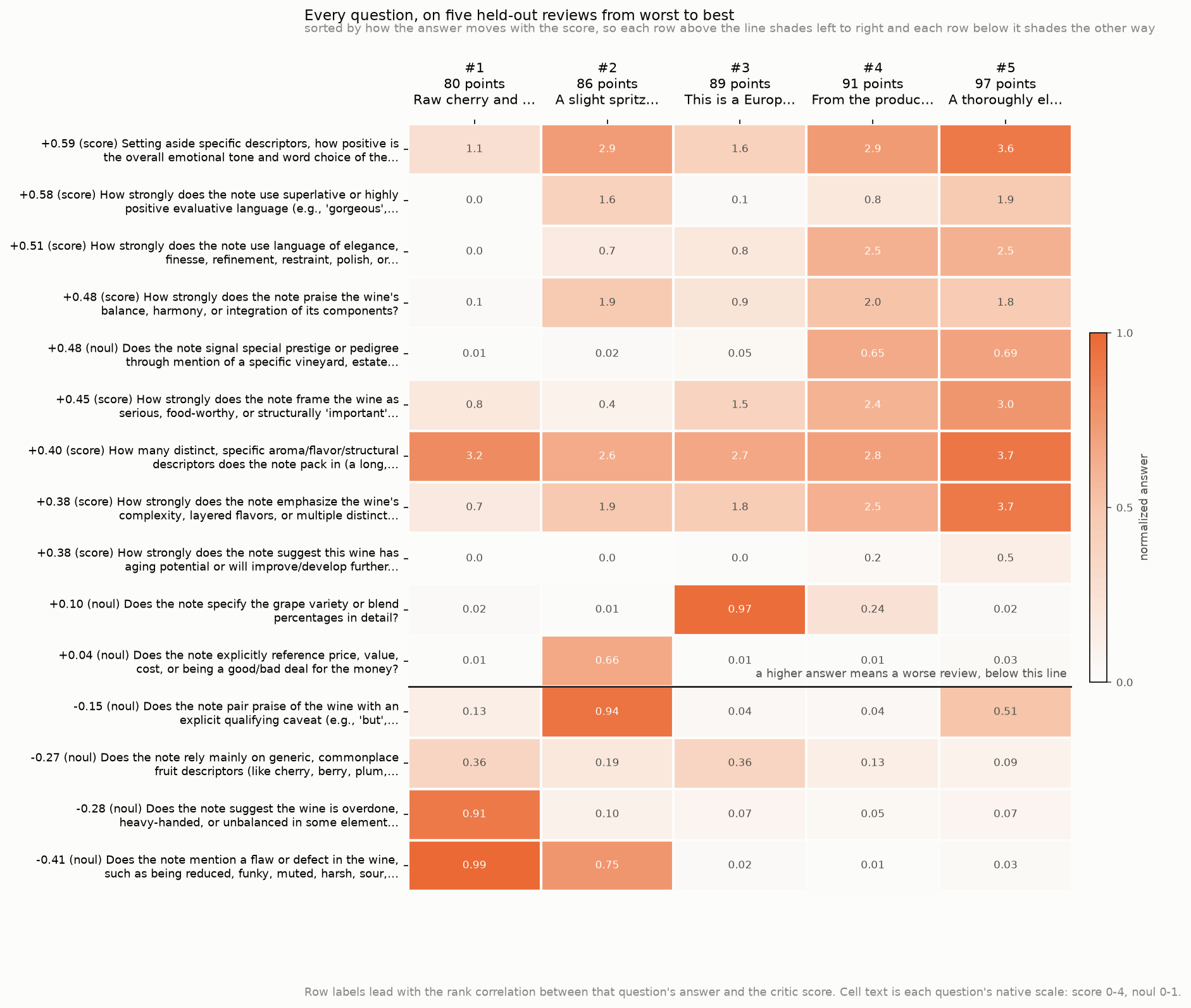
Таблица с начала страницы, посчитанная. Все пять подходов оцениваются один раз на одних и
тех же 800 отложенных строках, и первые три пропускают обнаружение признаков. Один
предсказывает среднее dev-оценок и вообще ничего не читает из заметки. Один передаёт
заметку тому же CatBoost через его обработку text_features, которая превращает её в
счётчики слов. Один спрашивает у TypeSafe саму оценку.
Третий — это один Score на строку по десяти полосам качества, от «faulty or
unpleasant» до «profound». Десять потому, что десять уровней — это максимум, который
принимает вопрос Score — одиннадцать возвращается как ошибка сервера. Уровень 0
отображается в 80 баллов, а уровень 9 — в 100. Растянуть полосы по шкале так — самого по
себе недостаточно, потому что ничто в вопросе не говорит, где на ней на самом деле
находятся оценки этого издания. Поэтому каждый ответ затем сдвигается на единую поправку,
измеренную по dev-оценкам. Эта поправка напечатана в метке строки, и это единственное, что
этот сокращённый путь узнаёт из оценок.
Spearman — это ранговая корреляция, где 1.0 поставило бы отложенные вина ровно в порядок критика. Строка со счётчиками слов — это собственная обработка текста CatBoost, а не настроенный конвейер текстовой регрессии. Всё это один набор данных и один запуск цикла.
predicted = fit_predict(X, split)
text_predicted = fit_predict_text(split)

# ask TypeSafe for the score itself, one request per row
with ThreadPoolExecutor(max_workers=8) as pool:
    direct = list(pool.map(lambda note: ask_score(TYPESAFE_MODEL, note), NOTES))
asked = np.array([d["expected"] for d in direct])
shift = float(SCORES[DEV].mean() - asked[DEV].mean())  # one number, from the dev labels

# what one proposal call gets you, before any feedback: the set round 1 ended with
first_round, _ = design(snapshots[0], answers_for, ENCODING)

print(f"{'arm':<46}{'RMSE':>7}{'spearman':>10}")
for label, p in (
    ("predict the mean of the dev rows", np.full(len(TEST), SCORES[DEV].mean())),
    ("the note as word counts, same CatBoost", text_predicted),
    (f"ask for the score itself, shifted {shift:+.2f}", asked[TEST] + shift),
    (
        f"{len(snapshots[0])} questions from round 1, no loop",
        fit_predict(first_round, split),
    ),
    (f"{len(accepted)} questions after all {ROUNDS} rounds", predicted),
):
    print(f"{label:<46}{rmse(SCORES[TEST], p):>7.3f}{spearman(SCORES[TEST], p):>10.3f}")
arm RMSE spearman
predict the mean of the dev rows 3.088 -0.014
the note as word counts, same CatBoost 2.466 0.605
ask for the score itself, shifted -1.71 2.145 0.761
18 questions from round 1, no loop 1.869 0.778
38 questions after all 5 rounds 1.772 0.799Помогли ли раунды autoresearch?
Обе линии показывают ошибку набора вопросов в конце каждого раунда, начиная с первого предложения. Пунктирная линия — это кросс-валидированная dev-ошибка, число, по которому принимается каждое решение о принятии или отклонении. Сплошная линия оценивает тот же набор вопросов на отложенных строках, которые цикл никогда не читает. Каждая точка — это набор в том виде, в каком он был к закрытию раунда, поэтому раунд, который только поправил или удалил вопрос, всё равно двигает обе линии. Карта признаков говорит, что измеряют вопросы; ошибка же говорит, сделали ли раунды после первого предложения предсказания хоть немного лучше.
Ось плотная: всё на ней укладывается в пятую часть балла, а все сокращённые пути из таблицы выше находятся далеко за её верхом. dev-линия идёт выше отложенной линии на всём протяжении, и это эффект размера обучения. Каждый dev-фолд обучается на четырёх пятых dev-строк, тогда как отложенное число берётся из модели, получившей все 1,200. Обе линии движутся вместе, поэтому dev-число, по которому рулит цикл, отслеживает отложенное число, которого он никогда не видит. Интервал под заголовком получен пересэмплированием отложенных строк, поэтому он говорит, больше ли переход от раунда 1 к раунду 5, чем шум в 800 строках.
curve, per_round = [], []
for features in snapshots:
    X_round, _ = design(features, answers_for, ENCODING)
    per_round.append(fit_predict(X_round, split))
    curve.append((len(features), rmse(SCORES[TEST], per_round[-1])))

# the same held-out rows resampled 2,000 times, both arms scored on each resample
gain = paired_gain(SCORES[TEST], per_round[0], per_round[-1])
print(
    f"round 1 -> round {ROUNDS} on the held-out rows: {gain[0]:+.3f} points, "
    f"95% CI [{gain[1]:+.3f}, {gain[2]:+.3f}]"
)

fig = rounds_chart(plt, curve, history, len(TEST), gain)
display(fig)
plt.close(fig)
round 1 -> round 5 on the held-out rows: -0.097 points, 95% CI [-0.147, -0.050]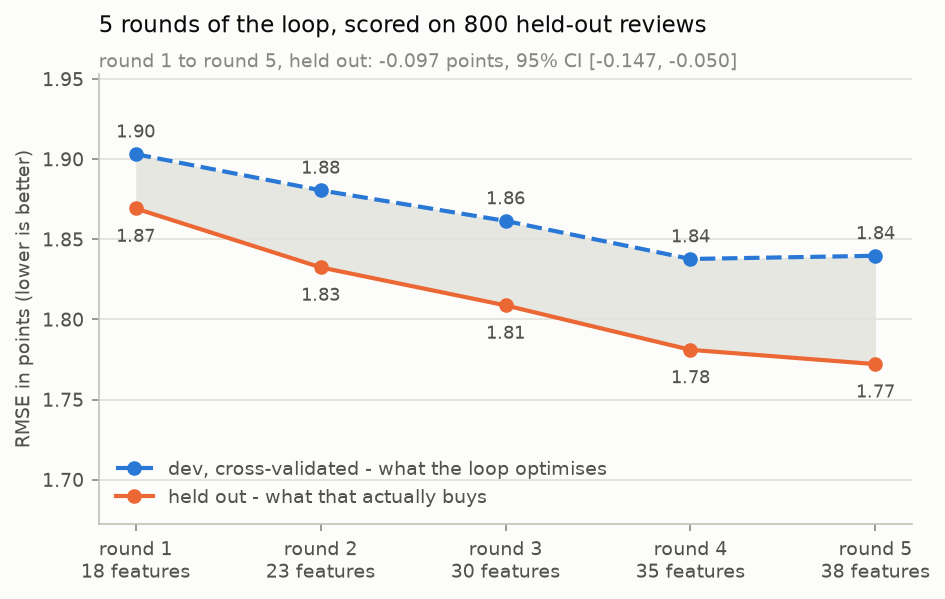
Отложенная линия падает сильнее, чем dev-линия. Раунд 1 написал свои вопросы без обратной связи, на которую можно опереться, и четыре раунда после него стоят 0.10 балла на отложенных строках, 95% CI [-0.147, -0.050].
Раунд 5 предложил четыре добавления, две переформулировки и восемь удалений и дал первое dev-число, которое не улучшилось. О 245-символьной заметке можно спросить лишь столько, и к раунду 5 предложения перешли от добавления вопросов к их удалению.
kinds = {f["name"]: f["kind"] for f in accepted}
print("feature importance share: % of total CatBoost importance across all questions")
print(f"{'feature':<38}{'asked as':<10}{'importance share':>16}")
for name, importance_share in sorted(feature_importances.items(), key=lambda p: -p[1])[
    :12
]:
    kind = "score" if kinds[name] == "intensity" else "noul"
    print(
        f"{name[:36]:<38}{kind:<10}{importance_share:>8.1f}%  "
        f"{'#' * round(importance_share)}"
    )
counts = f"{sum(1 for k in kinds.values() if k == 'intensity')} score"
counts += f", {sum(1 for k in kinds.values() if k == 'presence')} noul"
print(f"\nthe {len(accepted)} questions the loop kept: {counts}")
top = max(feature_importances, key=feature_importances.get)
print(
    f'the question behind the top row:\n  {top}: "{owner_of(top, accepted)["question"]}"'
)
feature importance share: % of total CatBoost importance across all questions
feature asked as importance share
note_overall_tone_positivity score 17.4% #################
savory_food_wine_seriousness score 8.7% #########
positive_superlative_language score 8.4% ########
single_vineyard_or_prestige_signal noul 7.2% #######
descriptive_detail_density score 5.7% ######
elegance_finesse_language score 5.0% #####
complexity score 5.0% #####
aging_potential score 5.0% #####
balance_harmony score 2.9% ###
drinkability_easiness score 2.9% ###
critic_enthusiasm_confidence score 2.7% ###
flavor_distinctiveness score 2.6% ###
the 38 questions the loop kept: 29 score, 9 noul
the question behind the top row:
note_overall_tone_positivity: "Setting aside specific descriptors, how positive is the overall emotional tone and word choice of the note taken as a whole (warm, admiring language throughout vs. flat, neutral, or lukewarm phrasing)?"importance share — это важность признаков CatBoost, нормированная так, что все 38
вопросов в сумме дают 100%. Это не доля строк, не доля вопросов и не доля точности
предсказания. Вопрос score владеет двумя столбцами, средним и разбросом, поэтому две его
столбцовые важности складываются обратно, прежде чем печатается процент.
note_overall_tone_positivity даёт 17.4% от общего. Четвёртая строка — это noul: называет
ли заметка один виноградник или другой сигнал престижа — это факт «да/нет», поэтому его
так и спросили.
Дальнейшие шаги
Этот прогон держит цикл небольшим. Прямые расширения:
- Отсеивать кандидата до того, как платить за ответ на него. Относитесь к самому предложенному вопросу как к state и задайте о нём noul: можно ли ответить на него по исходному тексту, означает ли он одно и то же при своих критериях, применим ли он к большинству строк, будет ли он различаться по строкам. Отправляйте только те вопросы, которые проходят все четыре с достаточной уверенностью.
- Отсекать коррелированные признаки. Измерьте корреляцию между закодированными столбцами на dev-строках, сгруппируйте почти-дубликаты и оставьте из каждого кластера самый ясный или самый важный вопрос.
- Добавить простые базовые линии. Сравните TF-IDF, счётчики символов и другие структурные признаки сами по себе, затем добавьте их к обнаруженным столбцам, чтобы измерить вклад каждого.
- Смешивать семейства предлагающих. Генерируйте партии кандидатов с помощью Anthropic, OpenAI, Google Gemini и открытых моделей, затем объединяйте и удаляйте дубликаты, прежде чем что-либо из них дойдёт до TypeSafe. Разные семейства должны расширять поиск сильнее, чем повторные вызовы одного предлагающего.
- Сравнивать предсказательные модели и методы. Попробуйте линейную регрессию или elastic-net, регрессор опорных векторов, случайные леса и перекалибровку там, где нижележащий выход вероятностный. Проверьте, помогают ли обнаруженные признаки вне CatBoost.
- Добавить базовую линию на эмбеддингах. Эмбеддинг превращает заметку в несколько сотен
чисел без привязанного вопроса:
sentence-transformers/all-MiniLM-L6-v2работает локально,text-embedding-3-smallот OpenAI — это хостинговый вызов. Добавьте один к обнаруженным столбцам и измерьте, несёт ли он что-то, чего они не несут. - Согласовать валидацию с развёртыванием. Используйте хронологические разбиения при предсказании будущего, групповые разбиения, когда связанные строки должны оставаться вместе, и держите финальный тестовый набор нетронутым как обнаружением признаков, так и выбором модели.
- Останавливаться на плато. Завершайте цикл, когда кросс-валидированный RMSE перестаёт улучшаться в течение фиксированного числа раундов или когда достигает бюджета вопросов или запросов.
- Запускать более долгий поиск в режиме Goal агента. Дайте ему явную метрику, бюджет и правило остановки, затем позвольте предлагать, оценивать и уточнять больше раундов.
- Проверять стабильность. Повторяйте обнаружение на разных сидах или срезах данных и оставляйте вопросы, которые остаются полезными, а не те, чья важность держится на одном разбиении.
Открыть в playground
Эта ссылка для общего доступа содержит одну дегустационную заметку плюс все вопросы, с которыми цикл в итоге закончил.
playground_link = make_playground_link(
    NOTES[0], feature_questions(accepted), models=[TYPESAFE_MODEL]
)
display(
    Markdown(
        f"🔗 [Open the note + questions in the TypeSafe playground]({playground_link})"
    )
)