Cascada de SDE
Usa una cascada de extracción de datos estructurados de 2 etapas (mini → verificar → razonar) para obtener casi toda la calidad de un modelo de razonamiento grande a una fracción del costo.
- Panorama general
- los modelos de razonamiento grandes extraen bien los datos estructurados, pero son lentos y caros
- los modelos pequeños son baratos, pero cometen errores
- una cascada consigue casi toda la calidad a una fracción del costo
- los modelos que usamos, y su precio ($ por 1M de tokens, entrada / salida; tarifas estándar
consultadas el 15 de septiembre de 2026):
- escalón 0 (mini):
gpt-5.4-minia $0.75 / $4.50 - escalón 1 (razonamiento):
gpt-5.5a $5.00 / $30.00 (unas 7 veces la mini) - verificador: TypeSafe
jev-1.12a $0.042 / $0.00 (los tokens de salida son gratis; precios publicados de Jev)
- escalón 0 (mini):
- Algoritmo
- Extrae con un modelo barato/pequeño.
- Verifica con las primitivas de TypeSafe: una pregunta de sí/no (“pregunta Noul”) por
campo
- (p. ej. “¿este valor está ausente en la fuente?”, “¿se tomó de texto no relacionado?”), cada una devuelve P(algo está mal).
- Escala a un modelo de razonamiento caro si se dispara una señal del verificador; si no, conserva la respuesta barata.
- Este cookbook
- recorre un ejemplo real de principio a fin y luego muestra el equilibrio a lo largo de 100 prompts
- nota: los dos escalones de extracción usan OpenAI en modo texto
- no usamos salidas estructuradas, llamadas a herramientas ni modo json, porque:
- un error al seguir el esquema no es el error que esperamos que cometa un LLM (es fácil crear datos sintéticos para esto)
- si un LLM sí falla al seguir el esquema, casi siempre está muy confundido, así que la decodificación restringida no arregla el problema de fondo
- ¡aun así te animamos a probarlos!
Configuración
- instala las dependencias (el cliente verificador de TypeSafe se sirve desde el índice de paquetes de TypeSafe):
pip install openai datasets jsonschema ipython 'cooksafe>=0.2.0,<0.3.0'- luego define
OPENAI_API_KEYyTYPESAFE_API_KEYen tu entorno
import json
import os
from pathlib import Path

import jsonschema
from cooksafe import JsonCache, make_playground_link
from datasets import load_dataset
from IPython.display import Markdown, display
from openai import OpenAI
from typesafe_sdk import Noul, NoulCriteria, TypeSafeClient

MINI = "gpt-5.4-mini"  # rung 0: cheap + fast
REASONING = "gpt-5.5"  # rung 1: strong, run with reasoning_effort="high"
TS_MODEL = "jev-1.12"  # the TypeSafe verifier model
FIRE_T = 0.7  # escalate if any per-field P(wrong) exceeds this; also the "<== FIRES" display marker

oai = OpenAI()

ts = TypeSafeClient(api_key=os.environ["TYPESAFE_API_KEY"], timeout=30.0)
Paso 1: los datos
Elegimos un dataset de Hugging Face llamado scrapegraphai
SCRAPEGRAPHAI_REVISION = "4bb9fba1dff9181c5acdb60a5a26fea62fa54fe9"
row = load_dataset(
    "scrapegraphai/scrapegraphai-100k",
    revision=SCRAPEGRAPHAI_REVISION,
    split="train",
)[516]
schema = json.loads(row["schema"])
prompt = row["prompt"]
content = row["content"]

print(
    f"""
PROMPT
===========
{prompt}

SCHEMA
===========
{json.dumps(schema, indent=2)}

CONTENT
===========
{content}
""".strip()
)
PROMPT
===========
Find registration open date fall semester for New York University in New York, NY for the 2024-2025 school year.
SCHEMA
===========
{
"properties": {
"registration_open_date": {
"description": "The date that registration opens for the fall semester. MUST be in the format mm/dd/yyyy. For example, for a college in the 2024-2025 school year, it might be something like 09/05/2024. Return a blank string if you are unsure.",
"title": "Registration Open Date",
"type": "string"
},
"description": {
"description": "A brief description of the registration open date. For example, 'Registration opens for the fall semester'.",
"title": "Description",
"type": "string"
}
},
"required": [
"registration_open_date",
"description"
],
"title": "RegistrationOpen",
"type": "object"
}
CONTENT
===========
Skip to content Skip to current page navigation
[ ](https://www.nyu.edu/)
Search Site
[ ](https://www.nyu.edu/)
* [ Academics](https://www.nyu.edu/academics.html)
* [ Admissions](https://www.nyu.edu/admissions.html)
* [ Research](https://www.nyu.edu/research.html)
* [ University Life](https://www.nyu.edu/life.html)
* [ About](https://www.nyu.edu/about.html)
All NYU
# Mobile Navigation
[ ](https://www.nyu.edu/)
Search Site
* [Academics](https://www.nyu.edu/academics.html)
* [Admissions](https://www.nyu.edu/admissions.html)
* [Research](https://www.nyu.edu/research.html)
* [University Life](https://www.nyu.edu/life.html)
* [About](https://www.nyu.edu/about.html)
All NYU
Info for
* Back to main menu
* Info for
* [Students](https://www.nyu.edu/students.html)
* [Faculty](https://www.nyu.edu/faculty.html)
* [Alumni](https://www.nyu.edu/alumni.html)
* [Employees](https://www.nyu.edu/employees.html)
* [Community](https://www.nyu.edu/community.html)
[Log In](http://home.nyu.edu/)
Info for
* [Students](https://www.nyu.edu/students.html)
* [Faculty](https://www.nyu.edu/faculty.html)
* [Alumni](https://www.nyu.edu/alumni.html)
* [Employees](https://www.nyu.edu/employees.html)
* [Community](https://www.nyu.edu/community.html)
[Log In](https://home.nyu.edu/)
Search Site Search
# Events Calendar
Search Events
Apply Reset
* [About the Events Calendar ](https://www.nyu.edu/employees/resources-and-services/media-and-communications/digital-communications/university-events-calendar.html)
* [Events Calendar Tutorial ](https://www.nyu.edu/employees/resources-and-services/media-and-communications/digital-communications/university-events-calendar/tutorials.html)
* [Report issue or provide feedback ](https://nyu.service-now.com/sp?id=sc_cat_item&sys_id=7698dd2a98bcf4004c8c03063d84e274)
Search Filters Calendar
New York University
Equal Opportunity and Non-Discrimination at NYU - New York University is committed to maintaining an environment that encourages and fosters respect for individual values and appropriate conduct among all persons. In all University spaces--physical and digital--programming, activities, and events are carried out in accordance with applicable law as well as University policy, which includes but is not limited to its Non-Discrimination and Anti-Harassment Policy.
Unless otherwise noted, all content copyright New York University. All rights reserved.
* [Search](https://search.nyu.edu/)
* [Campus Map](https://www.nyu.edu/map.html)
* [Events](https://events.nyu.edu/)
* [Contact Us](https://www.nyu.edu/contact-us.html)
* [Give](https://www.nyu.edu/about/giving.html)
* [Copyright & Fair Use](https://www.nyu.edu/copyright-and-fair-use.html)
* [Privacy](https://www.nyu.edu/privacy.html)
* [Accessibility](https://www.nyu.edu/accessibility.html)
* [Feedback](https://www.nyu.edu/#feedback.html)
* [New York Campus](https://www.nyu.edu/)
* [Abu Dhabi Campus](https://nyuad.nyu.edu/)
* [Shanghai Campus](https://shanghai.nyu.edu/)
* [](https://facebook.com/)
* [](https://linkedin.com/)
* [](https://x.com/)
* [](https://instagram.com/)
* [](https://youtube.com/)- Esta fila es una página del calendario de eventos de NYU (“Fall 2024 Census Date”):
- el esquema pide solo dos campos:
registration_open_dateydescription - el scraping del prompt solo capturó la navegación del calendario y texto de relleno: no hay fecha de inscripción ni descripción
- fíjate en que el campo
descriptiondel esquema incluso trae un valor de ejemplo (“Registration opens for the fall semester”) dentro de la descripción del propio campo
- el esquema pide solo dos campos:
- así que un extractor bien comportado debería negarse a inventar los campos que la página no contiene
- ¡veamos si el modelo pequeño hace lo correcto!
Paso 2: extrae con el modelo mini (modo texto)
- nota:
gpt-5.4-minies muy estocástico con esta entrada; incluso contemperature=0inventa unadescriptiondistinta casi en cada ejecución. Para que este recorrido sea reproducible fijamos a mano la única fabricación canónica que explica el resto de este notebook (y que el verificador marca con P(wrong) > 0.8). Un pipeline real simplemente tomaría directamenteextract(MINI, prompt, schema, content, temperature=0).
EXTRACT_SYSTEM = (
    "You extract structured data from documents. Return only values supported by the text. "
    "Follow any value format specified by the schema or its field descriptions."
)

# LLM and TypeSafe calls are cached to ``json_cache.json``, which ships with the cookbook, so
# re-rendering reproduces the published results with no API spend; delete the file to re-run live.
json_cache = JsonCache(Path("json_cache.json"))

@json_cache
def extract(
    model: str,
    prompt: str,
    schema: dict,
    content: str,
    *,
    reasoning_effort: str | None = None,
    temperature: float | None = None,
) -> dict:
    user = (
        f"{prompt}\n\nReturn ONLY a JSON object matching this JSON Schema:\n"
        f"{json.dumps(schema, indent=2)}\n\nDocument:\n{content}"
    )
    kwargs = {
        "model": model,
        "messages": [
            {"role": "system", "content": EXTRACT_SYSTEM},
            {"role": "user", "content": user},
        ],
    }
    if reasoning_effort:
        kwargs["reasoning_effort"] = reasoning_effort
    if temperature is not None:
        kwargs["temperature"] = temperature
    text = oai.chat.completions.create(**kwargs).choices[0].message.content
    # The prompt asks for ONLY a JSON object, so parse the reply as-is -- no regex fishing a
    # substring out of a malformed reply. If ``json.loads`` fails, treat it as an empty extraction
    # (the record-level analog of NaN): every field reads as absent, which the verifier flags and the
    # gate escalates -- the safe direction. Schema-following errors are rare here (see the overview).
    try:
        return json.loads(text)
    except (ValueError, json.JSONDecodeError):
        return {}

# Hard-coded canonical fabrication (see note above); a real pipeline would use extract(MINI, prompt, schema, content, temperature=0).
mini_record = {
    "registration_open_date": "",
    "description": "Registration opens for the fall semester",
}
print("mini extraction:\n", json.dumps(mini_record, indent=2))

# The record is a perfect fit for the JSON Schema -- and still wrong. Schema validation is necessary
# but not sufficient: it catches structural errors, never semantic ones. That gap is the whole point.
print("\nschema-valid:", jsonschema.Draft202012Validator(schema).is_valid(mini_record))
mini extraction:
{
"registration_open_date": "",
"description": "Registration opens for the fall semester"
}
schema-valid: True- El registro es válido según el esquema (la línea de arriba imprime
True), y aun así es incorrecto:registration_open_datequeda en blanco, lo que coincide con la página: no indica ninguna fecha- pero
descriptionestá fabricado: la página nunca describe una fecha de inscripción, así que mini inventa una verosímil. Puede repetir el propio ejemplo del esquema, “Registration opens for the fall semester”, o narrar “…was not found in the document” - una comprobación de JSON Schema no puede ver esto. Un modelo barato produce fabricaciones seguras de sí mismas y conformes al esquema de este tipo, y detectarlas es tarea de un verificador semántico
Paso 3: verifica con TypeSafe
- el verificador es TypeSafe; para cada campo construimos una pregunta
Noul:- un sí/no acotado, formulado de modo que
true= algo está mal (escalar)
- un sí/no acotado, formulado de modo que
- TypeSafe devuelve un
noulcalibrado =P(true)por pregunta, en una sola llamada a system_one - el conjunto de preguntas:
- una cabecera holística
__overall__::judge(“¿debería escalarse este registro?”). La calculamos y mostramos para contrastar un juicio de todo el registro con las cabeceras por campo, pero la compuerta del Paso 4 no la usa: el escalado lo guía la batería por campo. - una batería por campo
- los campos no vacíos reciben el conjunto completo de cabeceras
- los campos vacíos (null / “” / []) reciben solo la cabecera
absence_wrong
- (el pipeline completo también tiene una cabecera
spuriouspara contenedores enteros y un score dedifficultygeneral; no se muestran aquí, para mantener este recorrido en las dos cabeceras que gobiernan la compuerta)
- una cabecera holística
- La forma TypeSafe: descomposición
- Fíjate en que todo está descompuesto programáticamente; esa es la forma TypeSafe.
- La descomposición maximiza la inteligencia de cada prompt y hace que el algoritmo sea ajustable e interpretable.
-

# metric -> (question, NoulCriteria)
MAIN_QUESTIONS = {
    "name_desc_mismatch": (
        "Does the `extracted_field` fail to match the field at `path` or the `description` in the "
        "`field_spec`? If the `description` is empty, judge against the `path` alone.",
        NoulCriteria(
            true="the `extracted_field` does not match the field name or its `description`",
            false="the `extracted_field` matches the field name and `description`",
        ),
    ),
    "type_mismatch": (
        "Does the `extracted_field` violate the `type` declared in the `field_spec`?",
        NoulCriteria(
            true="the `extracted_field` violates the declared `type`",
            false="the `extracted_field` conforms to the declared `type`",
        ),
    ),
    "unreasonable": (
        "Is the `extracted_field` one that a reasonable person would not have extracted for this "
        "`field_spec`?",
        NoulCriteria(
            true="a reasonable person would not have extracted this value",
            false="the extraction is reasonable",
        ),
    ),
    "hallucinated": (
        "Is the `extracted_field` unsupported by, or absent from, the source text?",
        NoulCriteria(
            true="the `extracted_field` is a hallucination -- not supported by, or absent "
            "from, the source text",
            false="the `extracted_field` is supported by the source text",
        ),
    ),
    "off_target": (
        "Does the source text fail to genuinely report the thing the `field_spec` describes, so the "
        "value was pulled from incidental text?",
        NoulCriteria(
            true="the source does not genuinely provide this field -- the value was pulled "
            "from incidental text",
            false="the source genuinely reports this field",
        ),
    ),
    "incomplete": (
        "Does the `extracted_field` fail to capture a value the source supports (note whether the "
        "`field_spec` is `required`)?",
        NoulCriteria(
            true="the field is wrongly empty, null, or missing a value the source supports",
            false="the field captures the value the source supports",
        ),
    ),
    "format_violation": (
        "Does the `extracted_field` violate the format or constraints implied by the `description`, "
        "the schema `type`, and the extraction instructions (e.g. date format, units, enum membership)?",
        NoulCriteria(
            true="the `extracted_field` violates the implied format or constraints",
            false="the `extracted_field` satisfies the format and constraints",
        ),
    ),
}
ABSENCE_QUESTION = (
    "The `extracted_field` is empty, null, or an empty collection. Does the source text contain the "
    "information the `field_spec` describes, making the empty result wrong?"
)
ABSENCE_CRITERIA = NoulCriteria(
    true="a value was wrongly omitted", false="returning nothing is correct"
)

# The pipeline also asks one holistic, whole-record head: "should this be escalated?"
OVERALL_JUDGE = (
    "Is this extracted record an incorrect extraction -- some value unsupported by the source or "
    "not conforming to the schema, required information missing or wrong, or some field hallucinated -- "
    "so it should be escalated to a smarter model?"
)
OVERALL_JUDGE_CRITERIA = NoulCriteria(
    true="the record is an incorrect extraction",
    false="the record is a correct extraction",
)

def is_empty(v) -> bool:
    return v is None or (isinstance(v, (str, list, dict)) and len(v) == 0)

def field_spec(name: str) -> dict:
    """Minimal spec pulled from the schema (unwrapping anyOf/null for optional fields)."""
    p = schema["properties"][name]
    branches = p.get("anyOf") or []
    typ = p.get("type") or next(
        (b["type"] for b in branches if b.get("type") != "null"), "unknown"
    )
    return {
        "path": name,
        "type": typ,
        "description": p.get("description", ""),
        "required": name in schema.get("required", []),
    }

def build_questions(record: dict) -> dict[str, Noul]:
    """The verify question set: one holistic ``__overall__::judge`` head plus a per-field battery,
    keyed ``field::metric`` (mirrors build_verify_prompts)."""
    questions: dict[str, Noul] = {
        "__overall__::judge": Noul(
            instructions=OVERALL_JUDGE, criteria=OVERALL_JUDGE_CRITERIA
        ),
    }
    for name, value in record.items():
        spec = field_spec(name)
        if is_empty(value):
            questions[f"{name}::absence_wrong"] = Noul(
                instructions={
                    "field_spec": spec,
                    "extracted_field": value,
                    "main_question": ABSENCE_QUESTION,
                },
                criteria=ABSENCE_CRITERIA,
            )
            continue
        for metric, (question, criteria) in MAIN_QUESTIONS.items():
            if metric == "type_mismatch" and spec["type"] == "unknown":
                continue
            questions[f"{name}::{metric}"] = Noul(
                instructions={
                    "field_spec": spec,
                    "extracted_field": value,
                    "main_question": question,
                },
                criteria=criteria,
            )
    return questions

@json_cache
def verify(record: dict) -> dict[str, float | str]:
    """Run the whole Noul battery over a record in one TypeSafe call; return ``{field::metric: P(true)}``."""
    state = {
        "system_message": EXTRACT_SYSTEM,
        "instruction": "Extract the structured record from this document",
        "source_text": row["content"],
        "schema": schema,
        "extraction": record,
    }
    questions = build_questions(record)
    answers = ts.system_one(state=state, questions=questions, model=TS_MODEL).answers
    return {qid: ans.noul for qid, ans in answers.items()} | {
        "playground_link": make_playground_link(state, questions)
    }
Ejecuta toda la batería sobre la extracción de mini
checks = verify(mini_record)
playground_link = checks.pop("playground_link")
display(
    Markdown(
        f"🔗 [Open this verification in the TypeSafe playground]({playground_link})"
    )
)

print(f"{'qid':<40}{'P(wrong)':>9}")
print("-" * 50)
for fld, p in sorted(checks.items(), key=lambda c: -c[-1]):
    flag = "  <== FIRES" if p > FIRE_T else ""
    print(f"{fld:<40}{p:>9.2f}{flag}")
qid P(wrong)
--------------------------------------------------
description::hallucinated 0.95 <== FIRES
description::off_target 0.85 <== FIRES
description::unreasonable 0.58
__overall__::judge 0.56
description::incomplete 0.16
registration_open_date::absence_wrong 0.14
description::format_violation 0.10
description::name_desc_mismatch 0.08
description::type_mismatch 0.02- TypeSafe concentra la señal en los campos que de verdad están mal.
- Nuestros resultados están calibrados: altos en el campo que está mal, bajos en el campo correcto, medios en un campo que parece raro sin estar claramente mal
- Esto es lo que te da un verificador typesafe frente a un juicio contundente de “¿está bien todo esto?”
Paso 4: la compuerta de escalado
- ahora condicionamos con
any_flag: escala si cualquier bandera de campo superaFIRE_T(0.7, definido arriba y compartido con el marcador<== FIRESdel Paso 3) - esta es una compuerta tipo
max(escala si cualquier campo se dispara), no una media, así que una bandera roja con confianza basta en vez de diluirse en un promedio
# any_flag is a per-field gate: the holistic __overall__ head is shown above but not part of it
fired = {
    qid: p
    for qid, p in checks.items()
    if not qid.startswith("__overall__") and p > FIRE_T
}
escalate = bool(fired)

print(
    f"any_flag gate (threshold {FIRE_T}): {'ESCALATE' if escalate else 'ACCEPT cheap result'}"
)
for qid, p in sorted(fired.items(), key=lambda c: -c[1]):
    print(f"  fired: {qid}  (P={p:.2f})")
any_flag gate (threshold 0.7): ESCALATE
fired: description::hallucinated (P=0.95)
fired: description::off_target (P=0.85)Paso 5: escala al modelo de razonamiento
Como se disparó una señal, pagamos por el modelo fuerte (gpt-5.5, reasoning_effort="high")
final_record = (
    extract(REASONING, prompt, schema, content, reasoning_effort="high")
    if escalate
    else mini_record
)

print("mini      :", json.dumps(mini_record))
print("reasoning :", json.dumps(final_record))
print("\nfield-level diff (mini -> final):")
for name in mini_record:
    if mini_record[name] != final_record.get(name):
        print(f"  {name}: {mini_record[name]!r}  ->  {final_record.get(name)!r}")
mini : {"registration_open_date": "", "description": "Registration opens for the fall semester"}
reasoning : {"description": "", "registration_open_date": ""}
field-level diff (mini -> final):
description: 'Registration opens for the fall semester' -> ''- La mejora
- El modelo de razonamiento descarta la
descriptionfabricada y devuelve"" - Reconoció que la página nunca describe una fecha de inscripción y se negó a inventarla
- La cascada convirtió una fabricación segura y válida según el esquema en un campo vacío honesto
- Y solo gastó dólares de modelo de razonamiento en este único elemento porque el verificador se lo indicó
- El modelo de razonamiento descarta la
Paso 6: cómo se ve esto en 100 prompts
- Estos son resultados internos de TypeSafe, producidos con el método general de arriba:
- el mismo bucle
extract → verify → escalate,gpt-5.4-mini → gpt-5.5-reasoning, compuertaany_flagsobre las cabeceras por campo, ejecutado sobre 100 prompts de scrapegraphai - la extracción del escalón barato de cada elemento la puntúa TypeSafe; el umbral de la compuerta (“cut”) se barre de 0→1, y cada configuración resultante se grafica en el espacio (costo, calidad)
- el gráfico es una instantánea histórica; sus costos no se han recalculado con la tarifa actual de Jev indicada arriba
- el mismo bucle
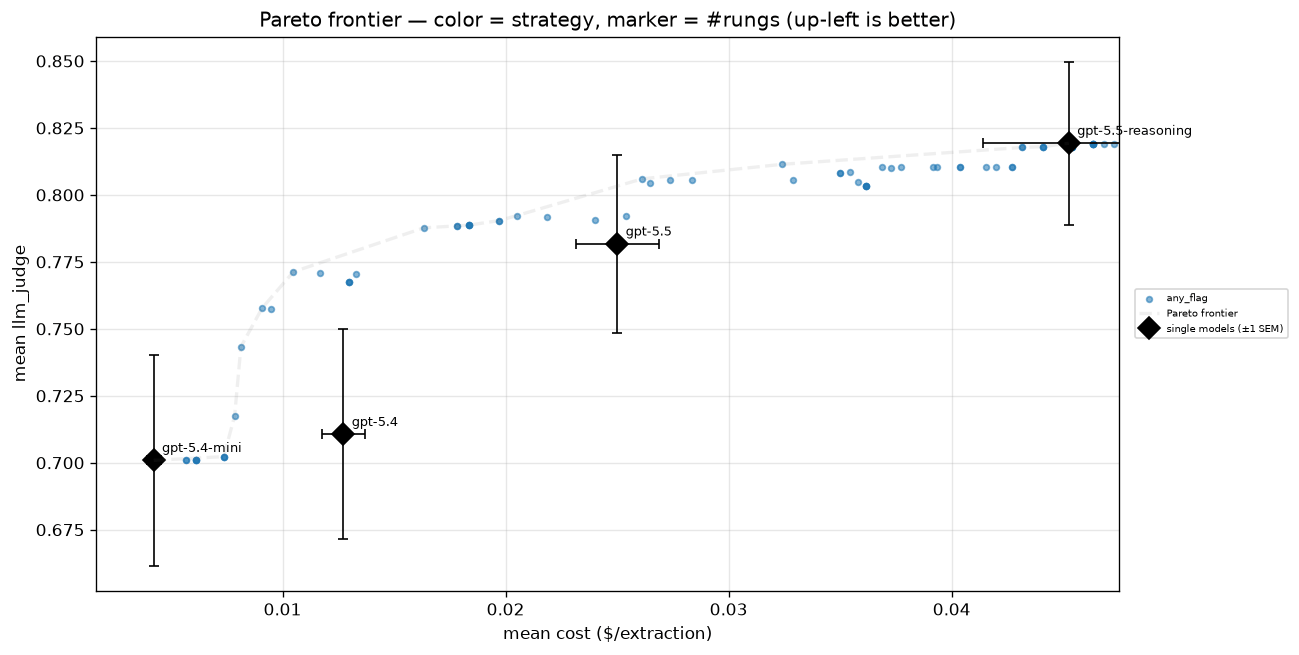
- cómo leerlo:
- rombos negros = los cuatro modelos ejecutados por su cuenta (el costo sube con la capacidad;
el más fuerte,
gpt-5.5-reasoning, está arriba a la derecha con ≈0.81 de calidad por ≈$0.10/extracción) - puntos azules = la cascada con muchos umbrales de compuerta; la línea discontinua es la frontera de Pareto
- la frontera de la cascada queda arriba y a la izquierda de cada modelo por separado: barrer la compuerta te da casi toda la calidad del mejor modelo a una fracción de su costo
- el escalón barato resuelve los elementos fáciles casi gratis, y solo los elementos marcados pagan por el modelo de razonamiento
- rombos negros = los cuatro modelos ejecutados por su cuenta (el costo sube con la capacidad;
el más fuerte,
Apéndice A: qué hace buena a una señal de verificador
- la cascada es tan buena como su verificador; esto separa una señal útil de una inútil:
- Acotada y anclada.
- una comprobación de sí/no verificable sobre un campo frente a la fuente (p. ej. “¿este valor está ausente en la fuente?”), no un vago “¿es buena esta extracción?”
- las preguntas vagas dan puntuaciones blandas y sin calibrar
- Malo = TRUE, con criterios explícitos.
- formula cada pregunta de modo que el caso de escalar sea el caso
true, y declara qué significantrue/false
- formula cada pregunta de modo que el caso de escalar sea el caso
- Por campo y luego agrega con
max.- una bandera por campo localiza el error y se mantiene dispersa y fuerte
max(“cualquier bandera se dispara”) asegura que una bandera roja con confianza escale, en lugar de diluirse en un promedio
- Independiente y barata.
- un verificador dedicado (aquí, TypeSafe) que juzga la salida detecta los puntos ciegos del propio extractor
- tiene que ser barato, o no quedan ahorros por capturar
- Separadora / calibrada.
- una buena señal es alta en errores reales y baja en aciertos, así que un único umbral separa limpiamente aceptar de escalar
- esa separación es lo que empuja la curva de Pareto arriba y a la izquierda
- Acotada y anclada.