再ランキング
再ランキング
40 件の CLERC 法律クエリに対して 30 パッセージの BM25 候補リストを作り、クエリと候補の各ペアに 1 問の TypeSafe 質問を使って、top-1 精度を 5% から 18% に、top-10 精度を 38% から 62% に引き上げます。
何千もの文書があり、ある特定の質問に答える 1 つを見つける必要があるとします。 では、どうやってそれを見つけるのでしょう。
まず、キーワードマッチングのような素早い方法で、何千もの候補を もっともらしい候補の短いリストに絞り込みます。これを高速検索と呼びます。
高速検索はそれに向いていますが、候補リスト上のどの候補が正しいかまでは分かりません。 そこで再ランキングの出番です。候補リスト上の各候補をクエリに対して 直接スコアリングし、最も良いものを先頭に置きます。
以下の両方のステップを、CLERC データセットの 3,565 件の裁判所意見のパッセージに対して実行します。BM25 が 40 件のクエリそれぞれについて 30 候補の高速検索の候補リストを作り、次に TypeSafe が各候補リストを 再ランキングします。再ランキングにより、正しいパッセージが 1 位になるのはクエリの 18% で、 高速検索だけの場合の 5% から上昇します。
この過程で、次のことを学びます:
- 高速検索が何をするか、なぜそれだけでは答えにならないか
- 再ランキングとは何か、高速検索のステップの後にどう位置づけられるか
- TypeSafe がクエリに対して 1 つの候補をどうスコアリングし、それが結果をどれだけ改善するか
自分で試す
TypeSafe プレイグラウンドでクエリ・候補・再ランキングの質問を開く
何千もの文書から 1 つをどう見つけるか
文書の山と、クエリ、つまり探しているものを説明するテキストの断片があるとします。 その山のどこかに、それに答える 1 つの文書があります。
すべての文書をクエリと 1 つずつ突き合わせる方法は機能しますが、文書 1 つにつき 1 回の比較で、 何百万もの文書はクエリごとに何百万回もの比較を意味します。2 段階のアプローチで 性能を改善できます。
- 山全体に対して実行できるほど速い方法で、山を有望な候補の短いリストに 絞り込みます。
- その短いリストにより精度の高いステップを適用し、正確な正解を見つけます。

この cookbook はその構成を、裁判所意見のデータセットで検証します。 以下に示す再ランキングの例で行います。
高速検索とは何か
高速検索とは、大きなコーパス内のすべての文書とクエリを比較し、順位付けされた候補リストを 素早く返せる任意の方法です。一般的な方法には、BM25 のようなキーワード検索や、 パッセージを意味で比較する密な埋め込みがあります。システムはしばしば両方の 方法を組み合わせます。
ここでの最初のステップは BM25 のみで、ほかに何も使いません。BM25 は共有される単語でパッセージを順位付けします。 このステップを単純に保つことで、cookbook の狙いである再ランキングに 注意を向けられます。高速検索の方法の選択は本筋ではありません。再ランキングが見るのは、 候補リストに入ったパッセージだけです。
再ランキングとは何か
再ランキングは、高速検索がすでに作った候補リストを受け取り、より良い順序に並べ替えます。 クエリをコーパス全体と一度に比較するのではなく、 クエリを候補リスト上の各候補と個別に比較し、 そのスコアで候補リストを並べ替えます。
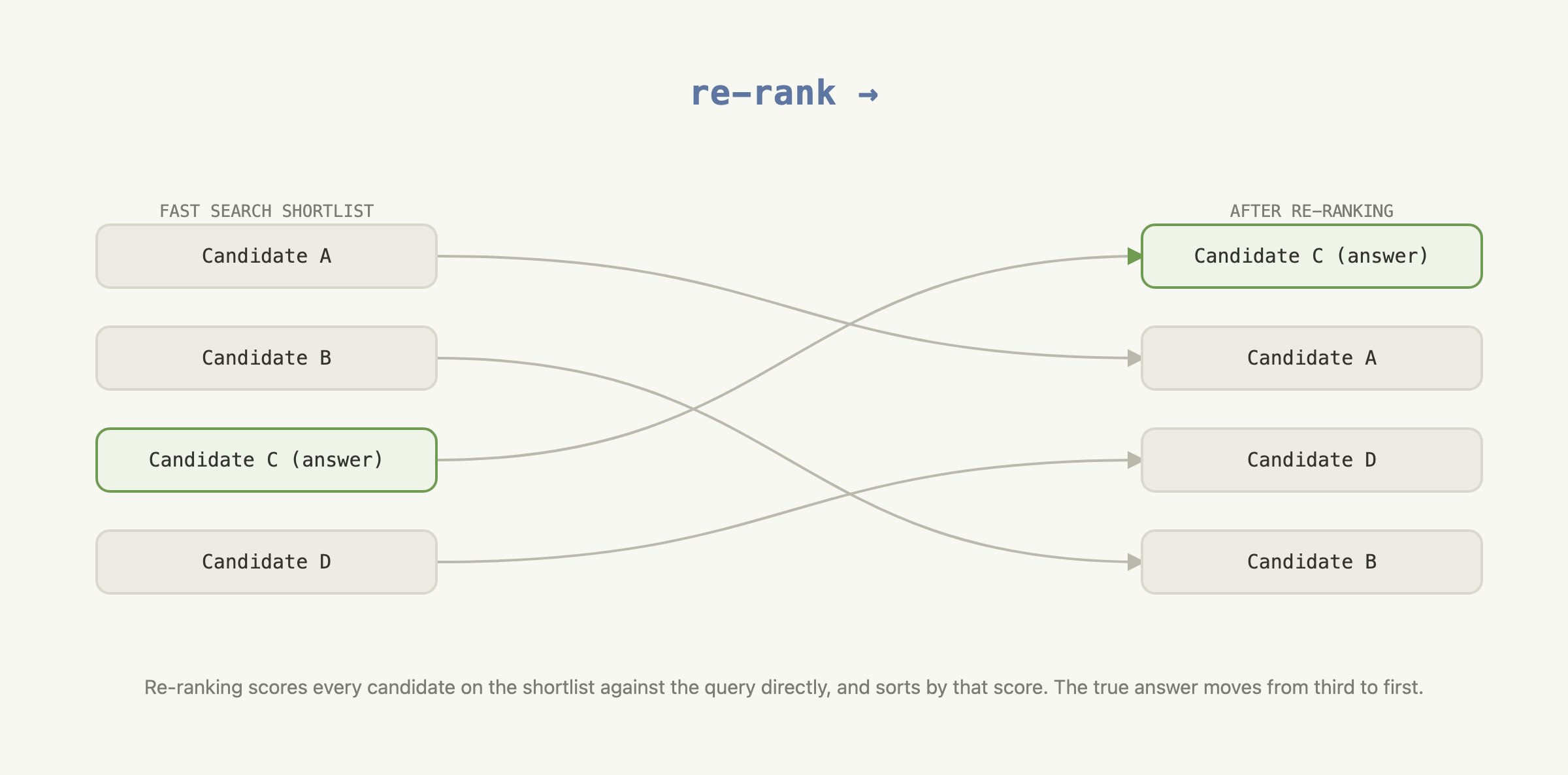
スコアは言語モデルから得ることもできます。クエリと 1 つの候補を一緒に与え、 その候補がクエリにどれだけよく答えるかを尋ねます。すると再ランキングは、候補の言い回しが クエリと異なっていても、候補リスト上の最良の一致を見つけられます。
TypeSafe による再ランキング
再ランカーは、クエリと候補の各ペアに対して比較可能なスコアを必要とします。汎用の 言語モデルでもこれらのスコアを出せますし、候補リスト全体を直接順位付けすることもできます。 しかしペアごとの独立したスコアリングでは、スコアの尺度を定義し、すべての候補に同じ基準を 適用するようモデルに促す必要があります。同じペアでも呼び出しを繰り返すと異なるスコアが 出ることがあり、汎用の生成は、1 つの数値だけを必要とするタスクに時間とコストを 加えてしまいます。
TypeSafe が返すもの
TypeSafe では、スコアリングのリクエストをはい/いいえの質問のままにできます。
Could this candidate passage be from the cited precedent?単純なはい/いいえでは 30 個の候補を順位付けするのに十分ではありません。代わりに Noul は
0 から 1 の間の数値を返します。これは
noul と呼ばれます。noul は、答えが「はい」である確からしさを TypeSafe が
推定したものです。
質問の criteria が何を真とし何を偽とするかを定義します。TypeSafe はそれを すべてのクエリ・候補ペアに適用し、noul を直接返します。その noul が、アプリケーションが 並べ替えに使うスコアです。汎用モデル向けにスコアの尺度を発明する必要はなく、 TypeSafe はこの反復的なスコアリングをより速く、安く、一貫して行うように作られています。
簡略化した擬似コードでは、TypeSafe のスコアリング呼び出し 1 回は次のようになります。
question = Noul(
    instructions="Is this candidate the cited case?",
    criteria=NoulCriteria(
        true="The candidate states the specific rule the query cites.",
        false="The candidate is only on a similar topic.",
    ),
)
response = client.system_one(state={...}, questions={"is_cited_source": question})
response.answers["is_cited_source"].noul  # -> 0.87
TypeSafe はクエリと 1 つの候補をその質問に照らして一緒に読み、 noul を返します。
これを使って、候補リストの各候補に対して同じ質問を実行し、各呼び出しが返す noul で候補リストを並べ替え、最も高いものを先頭にすることで、 候補リストを再ランキングできます。
nouls = {candidate: ask_typesafe(query, candidate) for candidate in shortlist}
reranked = sorted(shortlist, key=lambda c: nouls[c], reverse=True)  # highest noul first
以下の図は、候補ごとに 1 回のリクエストを行うことで、候補リストを並べ替える ためのスコアがどう生成されるかを示します。
flowchart LR
    q["query excerpt<br/><i>one opinion passage,<br/>citation removed</i>"]
    sl["shortlist from fast search<br/><i>30 candidate passages</i>"]
    quest["<b>one Noul</b><br/>could this candidate be<br/>from the cited precedent?<br/><i>criteria fix true and false</i>"]

    %% direction LR inside an LR chart keeps each state beside its noul, two columns,
    %% so the fan-out is four rows tall instead of eight
    subgraph fan["one request per candidate · no request sees another"]
        direction LR
        d1["state<br/>{query, candidate 1}"] --> n1["noul<br/>0.87"]
        d2["state<br/>{query, candidate 2}"] --> n2["noul<br/>0.41"]
        dx["⋮"] --> nx["⋮"]
        d30["state<br/>{query, candidate 30}"] --> n30["noul<br/>0.12"]
    end

    sort["sort by noul,<br/>highest first"]
    out["re-ranked shortlist<br/><i>same 30, better order</i>"]

    q --> fan
    sl --> fan
    quest --> fan
    fan --> sort --> out

    %% the elision is not a node - drop its box so it reads as "and so on"
    classDef elide fill:none,stroke:none
    class dx,nx elide
    linkStyle 2 stroke:none
再ランキングの例
次に、高速検索と再ランキングを、 法律検索データセットである CLERC で実行します。 この例では 3,565 件の裁判所意見のパッセージと 40 件のクエリを使います。
セットアップ
最初のステップは、このチュートリアルが依存するパッケージをインストールします。
bm25sとdatasetsが高速検索の候補リストを作ります。typesafe-sdkとcooksafeが再ランキングと API キャッシュを担当します。matplotlibが結果のグラフを描画します。
pip install bm25s datasets matplotlib 'cooksafe>=0.2.0,<0.3.0'次のブロックは、TypeSafe クライアントと、ウォークスルーの残りが使う定数を
設定します。たとえば、どの TypeSafe モデルを呼び出すか、高速検索が再ランカーに渡す
候補リストの大きさなどです。TypeSafe の呼び出しには TYPESAFE_API_KEY が必要です。
import hashlib
import json
import os
import random
from concurrent.futures import ThreadPoolExecutor
from pathlib import Path

from cooksafe import JsonCache
from IPython.display import display
from typesafe_sdk import Noul, NoulCriteria, TypeSafeClient

TYPESAFE_MODEL = "jev-1.12"
PRICE = (
    0.042,
    0.00,
)  # $ per 1M tokens (input, output); TypeSafe jev-1.12 as of 2026-08
N_ROWS = 170  # CLERC rows pooled into the shared corpus
N_QUERIES = 40  # rows we evaluate
TOP_K = 30  # candidates the shortlist hands to the re-ranker, per query

client = TypeSafeClient(
    api_key=os.environ.get(
        "TYPESAFE_API_KEY", "cache-only"
    ),  # keyless kernels replay the cache
    base_url=os.environ.get("TYPESAFE_ENDPOINT"),
    timeout=120.0,
)
json_cache = JsonCache(Path("json_cache.json"))
高速検索でパッセージを順位付けする
ここで使うデータセットは米国の裁判所意見のコーパスで、170 行をまとめたものです。各 行は次のように構成されます。
- Query:引用を除いた意見の抜粋。
- Gold:除かれた引用が指していたパッセージで、そのクエリに対する 唯一の正解。
- Candidates:コーパス内の他のすべてのパッセージで、それぞれクエリが誤って マッチしうるもの。
170 行のうち 40 行をクエリとして評価するために選びます。残りの 130 行は候補としてだけ 現れます。
次のセルは、上で説明した手法を使って候補リストを作ります。
- コーパスを読み込みます。
- BM25 でコーパスを全クエリに対して順位付けします。
ここではまだ TypeSafe は使いません。これは高速検索のステップだけです。
CLERC_FILE = (
    "https://huggingface.co/datasets/jhu-clsp/CLERC/resolve/main/"
    "teva_train_dir/train_data.jsonl.gz"
)

def cid(text: str) -> str:
    """Corpus id: a content hash, so passages shared across queries dedupe."""
    return hashlib.sha1(text.encode("utf-8")).hexdigest()[:16]

@json_cache
def build_slice(n_rows: int, n_queries: int, seed: int) -> dict:
    """Stream CLERC rows, pool ``n_rows`` of them into a corpus, pick ``n_queries`` to evaluate."""
    from datasets import load_dataset  # heavy import, keep local

    stream = load_dataset("json", data_files=CLERC_FILE, streaming=True, split="train")
    rows = []
    for row in stream:
        if (
            row.get("positive_passages")
            and len(row.get("negative_passages") or []) == 20
        ):
            rows.append(row)
        if len(rows) >= 1000:
            break

    rng = random.Random(seed)
    picked = rng.sample(rows, n_rows)
    corpus, pool = {}, []
    for row in picked:
        gold = row["positive_passages"][0]["text"]
        corpus[cid(gold)] = gold
        for neg in row["negative_passages"]:
            corpus[cid(neg["text"])] = neg["text"]
        pool.append(
            {"qid": str(row["query_id"]), "query": row["query"], "gold": cid(gold)}
        )
    # hold out the first 20 pooled rows; evaluate on the rest
    queries = rng.sample(pool[20:], n_queries)
    # sort the corpus by id so every run — live or cache replay — iterates it identically
    return {"queries": queries, "corpus": dict(sorted(corpus.items()))}

def bm25_rankings(corpus: dict[str, str], queries: dict[str, str], k: int = 100):
    """Rank every passage in the corpus by word overlap with each query."""
    import bm25s

    cids = list(corpus)
    retriever = bm25s.BM25()
    retriever.index(bm25s.tokenize([corpus[c] for c in cids], stopwords="en"))
    qids = list(queries)
    idxs, _ = retriever.retrieve(
        bm25s.tokenize([queries[q] for q in qids], stopwords="en"), k=min(k, len(cids))
    )
    return {q: [cids[i] for i in idxs[row]] for row, q in enumerate(qids)}

def gold_rank(ranked: list[str], gold: str) -> int | None:
    """1-based rank of the gold id, or None if it isn't in the list."""
    return ranked.index(gold) + 1 if gold in ranked else None

SURFACE, INK, INK2, MUTED = "#f8f8f2", "#34342f", "#34342f", "#7c7c77"
GRID, AXIS, BLUE, GREEN = "#d8d8cf", "#d8d8cf", "#5d76a2", "#6f9b52"

def bar_chart(labels: list[str], shares: list[float], title: str) -> None:
    """A small single-series bar chart of shares (0-1, shown as percentages)."""
    import matplotlib.pyplot as plt

    fig, ax = plt.subplots(figsize=(5, 3.2), facecolor=SURFACE)
    ax.set_facecolor(SURFACE)
    for side in ("top", "right"):
        ax.spines[side].set_visible(False)
    for side in ("left", "bottom"):
        ax.spines[side].set_color(AXIS)
    ax.tick_params(colors=MUTED, labelcolor=INK2, labelsize=9)
    ax.set_axisbelow(True)
    ax.grid(axis="y", color=GRID, linewidth=0.8)

    bars = ax.bar(labels, shares, width=0.55, color=[BLUE, GREEN][: len(labels)])
    ax.bar_label(
        bars,
        labels=[f"{s * 100:.0f}%" for s in shares],
        padding=4,
        color=INK,
        fontsize=11,
    )
    ax.set_ylim(0, 1.1)
    ax.set_yticks([0, 0.25, 0.5, 0.75, 1.0])
    ax.set_yticklabels(["0%", "25%", "50%", "75%", "100%"])
    ax.set_ylabel(f"share of {len(queries)} queries", color=INK2, fontsize=9)
    ax.set_title(title, loc="left", color=INK, fontsize=11)
    plt.tight_layout()
    display(fig)
    plt.close(fig)

ds = build_slice(N_ROWS, N_QUERIES, seed=0)
corpus: dict[str, str] = ds["corpus"]
queries = {q["qid"]: q["query"] for q in ds["queries"]}
golds = {q["qid"]: q["gold"] for q in ds["queries"]}

candidates = {q: ranked[:TOP_K] for q, ranked in bm25_rankings(corpus, queries).items()}

in_top_k = sum(golds[q] in candidates[q] for q in queries)
at_rank_1 = sum(candidates[q][0] == golds[q] for q in queries)

bar_chart(
    [f"In top {TOP_K}", "At rank 1"],
    [in_top_k / len(queries), at_rank_1 / len(queries)],
    f"Where the correct passage lands, {len(queries)} queries against {len(corpus):,} candidates",
)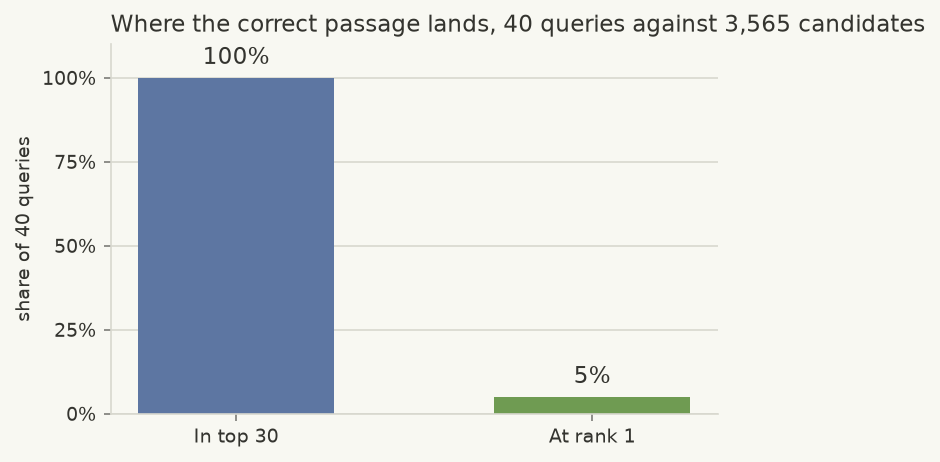
高速検索が正しいパッセージを 1 位にするのはまれ
このグラフは、3,565 個の候補のうち、高速検索が正しいパッセージをどこに置くかを示します。
高速検索は、正解を含む候補リストにコーパスを確実に絞り込みます。 40 件のクエリすべてで正解を含みます。しかしそのパッセージが候補リストの 最上位になることはまれで、わずか 5% です。
以下の再ランキングは、すでに候補リストにある上位 30 候補を並べ替えるだけです。 高速検索が選ばなかったパッセージを加えることはできません。ここでは、候補リストが 40 件の クエリすべてで正しいパッセージを含むので、再ランキングは各パッセージをより良い 位置に置くことに集中できます。
TypeSafe で再ランキングする
再ランキングは、候補リスト上の各候補をそのクエリに対してスコアリングし、そのスコアで 並べ替えます。TypeSafe が各ペアについて尋ねる質問は、その候補が、クエリから除かれた 引用が指すパッセージでありうるかどうかです。
次のセルは以下を行います。
- その質問を定義します。
- 各候補リストで候補ごとに 1 回尋ねます。40 クエリ × 30 候補で合計 1,200 回の 呼び出しを、順番にではなく並行に実行します。
- 各候補リストを、TypeSafe が返すスコアで並べ替え、再ランキング結果を生成します。
is_cited_source = Noul(
    instructions=(
        "The query excerpt comes from a US federal court opinion and was written "
        "immediately around a citation to a precedent; the citation itself has been "
        "removed. Could the candidate passage be from that cited precedent — does it "
        "establish the specific legal proposition the query excerpt invokes at its "
        "citation point?"
    ),
    criteria=NoulCriteria(
        true=(
            "The candidate passage states or establishes the specific rule, standard, "
            "holding, or fact pattern that the query excerpt attributes to its removed "
            "citation."
        ),
        false=(
            "The candidate passage is merely on a similar topic or doctrine; it does not "
            "supply the specific proposition the query excerpt relies on."
        ),
    ),
)

@json_cache
def score_candidate(model: str, query: str, candidate: str, question_json: str) -> dict:
    """One TypeSafe call about one (query, candidate) pair: a noul, plus token usage."""
    # the SDK takes a question as its JSON dict, so the cached string decodes straight in
    question = json.loads(question_json)
    response = client.system_one(
        state={"query_excerpt": query, "candidate_passage": candidate},
        questions={"is_cited_source": question},
        model=model,
    )
    return {
        "noul": response.answers["is_cited_source"].noul,
        "input_tokens": response.usage.input_tokens or 0,
        "output_tokens": response.usage.output_tokens or 0,
    }

# Each of the 40 queries has 30 candidates, so re-ranking every shortlist means 1,200 independent
# calls — cheap enough to fire all at once with a thread pool instead of one after another.
pair_list = [(q, c) for q in queries for c in candidates[q]]
question_json = is_cited_source.model_dump_json(exclude_none=True)
with ThreadPoolExecutor(max_workers=12) as pool:
    results = pool.map(
        lambda p: score_candidate(
            TYPESAFE_MODEL, queries[p[0]], corpus[p[1]], question_json
        ),
        pair_list,
    )
pair_scores = {q: {} for q in queries}
for (q, c), result in zip(pair_list, results):
    pair_scores[q][c] = result

reranked = {
    q: sorted(candidates[q], key=lambda c: -pair_scores[q][c]["noul"]) for q in queries
}

def chart_before_after(
    runs: dict[str, dict[str, list[str]]], thresholds: list[int]
) -> None:
    """Grouped bar chart: how often the correct passage lands in the top N, for each run."""
    import numpy as np
    import matplotlib.pyplot as plt

    labels = list(runs)
    colors = [BLUE, GREEN]

    def share_in_top(rankings, k):
        return sum(
            gold_rank(rankings[q], golds[q]) in range(1, k + 1) for q in queries
        ) / len(queries)

    fig, ax = plt.subplots(figsize=(6.5, 3.6), facecolor=SURFACE)
    ax.set_facecolor(SURFACE)
    for side in ("top", "right"):
        ax.spines[side].set_visible(False)
    for side in ("left", "bottom"):
        ax.spines[side].set_color(AXIS)
    ax.tick_params(colors=MUTED, labelcolor=INK2, labelsize=9)
    ax.set_axisbelow(True)
    ax.grid(axis="y", color=GRID, linewidth=0.8)

    x = np.arange(len(thresholds))
    width = 0.35
    for i, (label, rankings) in enumerate(runs.items()):
        shares = [share_in_top(rankings, k) for k in thresholds]
        offset = (i - (len(labels) - 1) / 2) * width
        bars = ax.bar(x + offset, shares, width * 0.92, color=colors[i], label=label)
        ax.bar_label(
            bars,
            labels=[f"{s * 100:.0f}%" for s in shares],
            padding=3,
            color=INK2,
            fontsize=8.5,
        )

    ax.set_xticks(x, [f"top {k}" for k in thresholds])
    ax.set_ylim(0, 1)
    ax.set_yticks([0, 0.25, 0.5, 0.75, 1.0])
    ax.set_yticklabels(["0%", "25%", "50%", "75%", "100%"])
    ax.set_ylabel(f"share of {len(queries)} queries", color=INK2, fontsize=9)
    ax.set_title(
        "How often the correct passage lands near the top",
        loc="left",
        color=INK,
        fontsize=11,
    )
    ax.legend(frameon=False, labelcolor=INK2, fontsize=9, loc="upper left")
    plt.tight_layout()
    display(fig)
    plt.close(fig)

chart_before_after(
    {"Fast search": candidates, "+ TypeSafe re-rank": reranked}, [1, 5, 10]
)

calls = [pair_scores[q][c] for q in queries for c in pair_scores[q]]
input_tokens = sum(call["input_tokens"] for call in calls)
output_tokens = sum(call["output_tokens"] for call in calls)
cost = input_tokens / 1_000_000 * PRICE[0] + output_tokens / 1_000_000 * PRICE[1]
print(
    f"{len(calls)} TypeSafe calls used {input_tokens:,} input and "
    f"{output_tokens:,} output tokens, costing ${cost:.4f}."
)
1200 TypeSafe calls used 1,536,002 input and 25,200 output tokens, costing $0.0645.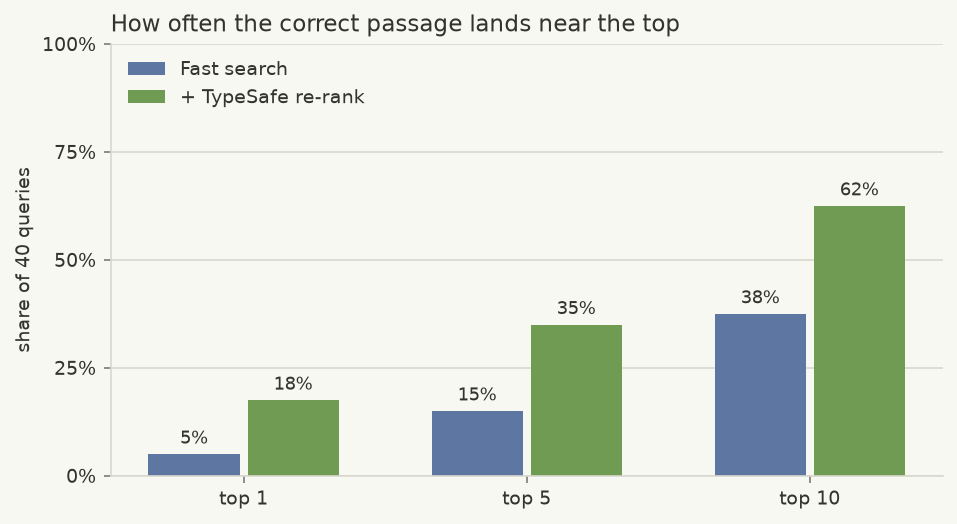
再ランキングが正しい答えを上へ引き上げる
このグラフは、高速検索と、高速検索+再ランキングを 3 つのしきい値で比較します。 再ランキングは、そのすべてで正しいパッセージを先頭に近づけます。
- Top 1 — 5% → 18%
- Top 5 — 15% → 35%
- Top 10 — 38% → 62%
報告したトークン数とコストは、40 件の候補リストを再ランキングするために使った 1,200 回の TypeSafe 呼び出しすべてを対象としています。
各 CLERC 行は、1 つの正解パッセージと 20 の負例パッセージを含みます。このウォークスルーは 170 行のパッセージを 1 つの共有コーパスにまとめます。40 件の評価クエリそれぞれについて、 BM25 はその行に付属する 20 の負例だけでなく、完全なコーパスから 30 個の候補を 選びます。次に TypeSafe がクエリを選択された各候補と照らして読み、 その 30 パッセージを再ランキングします。
このウォークスルーでは、分かりやすさのために 1 ペアにつき 1 問だけ尋ねました。実際のアプリケーションなら、 同じペアについて複数の質問を 1 回の呼び出しで尋ねるでしょう。質問の並列実行の cookbook と、 投機的ファンアウトのパターンを参照してください。
次のステップ
同じ構成要素は TypeSafe のドキュメントの他の場所にも登場します。