自己整合性:choice
自己整合性:choice
モデレーションの意思決定に「不確か」という結果を加え、ラベルの一致率と自動処理の割合を比較します。
この cookbook は 1 件の際どいユーザー投稿を取り上げ、モデレーションのルーブリックを 15 回実行し、
各答えが繰り返しの間で安定しているかを確認します。各チェックは
Choice なので、各答えは固定された集合から選ばれた 1 つのラベルです。モデレーションのパイプラインでは、
そのラベルがルーティングの意思決定になります。削除するか残すか、エスカレーションするか自動解決するか、
脅威・スパム・一般のどのキューに送るか。ラベルが実行ごとに揺らぐと、
同じ投稿が理由もなく別の場所へ振り分けられてしまいます。
ルーブリックは 8 問の Choice 質問で、各実行は 8 問すべてに答える 1 回の呼び出しです。
条件ごとに 15
回の繰り返しを行います。ここで条件とは 1 つのモデルと 1 つの設定の組み合わせです。そして返ってきた
すべてのラベルをプロットします。
条件は次のとおりです。
- 非推論 LLM の
claude-haiku-4-5とgpt-5.4-mini、温度0と API デフォルト。 - 推論 LLM の
gpt-5.5とclaude-opus-4-8。これらには温度の調整機能がありません。 - TypeSafe:8 問の
Choice質問に対する 1 回のsystem_one呼び出しで、毎回新しいuidフィールド (使い捨ての一意な値)を付けます。noul の cookbook と同じ構成です。
注目すべき点:選ばれるラベルは TypeSafe を含め、単一の条件の中でも反転しえます。そして 条件どうしも食い違います。
この実行では、LLM の分布設定は最頻ラベルを 87.5% から 100% の割合で繰り返しました。 TypeSafe は 90.8% です。TypeSafe の平均確率変動は、6 つの LLM 分布条件のうち 5 つより小さくなっています。温度 0 の Haiku だけがより小さく変動します。 確率が近いままだとルーティングが変わりえます。TypeSafe は 8 問のうち 2 問で反転しました。
アプリケーションの意思決定では、最大確率が少なくとも 0.60 であることも求めます。そうでなければ
結果は uncertain となり、人手レビューに回します。すると TypeSafe の一致率は
99.2% に上がり、答えの 74.2% が自動ラベルになります。生の出力を示し、同じしきい値を
LLM の確率条件にも適用して、棄権と変化を可視化します。
セットアップ
pip install anthropic openai matplotlib ipython 'cooksafe>=0.2.0,<0.3.0'次に TYPESAFE_API_KEY、ANTHROPIC_API_KEY、OPENAI_API_KEY を設定します。
この実行では本番 API の jev-latest を使い、2026-09-11 にサンプリングしました。
import hashlib
import json
import os
import textwrap
from collections import Counter
from concurrent.futures import ThreadPoolExecutor
from pathlib import Path
from secrets import token_hex
from statistics import mean

from time import perf_counter

import anthropic
import matplotlib
import matplotlib.pyplot as plt
import numpy as np
from cooksafe import JsonCache, make_playground_link
from IPython.display import Markdown, display
from matplotlib.colors import ListedColormap
from openai import OpenAI
from typesafe_sdk import Choice, TypeSafeClient

matplotlib.use("Agg")  # headless render

BASE_MODELS = [
    "claude-haiku-4-5",
    "gpt-5.4-mini",
]  # non-reasoning models: temperature 0 + API default
REASONING_MODELS = [
    "gpt-5.5",
    "claude-opus-4-8",
]  # reasoning models: think first, no temperature
TYPESAFE_MODEL = "jev-latest"  # the TypeSafe model
NUM_SAMPLES = 15  # repeated post+rubric calls per condition
MIN_CHOICE_PROBABILITY = 0.60  # illustrative automatic-action threshold

LLM_PRICES = {  # $ per 1M tokens (input, output); prices + model ids as of 2026-07, see README
    "claude-haiku-4-5": (1.00, 5.00),
    "gpt-5.4-mini": (0.75, 4.50),
    "gpt-5.5": (5.00, 30.00),
    "claude-opus-4-8": (5.00, 25.00),
}
TYPESAFE_PRICE = (0.042, 0.00)  # Historical TypeSafe rate, as of 2026-08

anthropic_client = anthropic.Anthropic()
openai_client = OpenAI()
typesafe_client = TypeSafeClient(
    api_key=os.environ["TYPESAFE_API_KEY"],
    base_url="https://api.typesafe.ai",
    timeout=30.0,
)
状態:際どいユーザー投稿(JSON)
以下の投稿は、どちらとも取れるように作られています。言葉は感情的で侮辱的で、 一部は特定の人物に、一部は議論とコミュニティに向けられています。そこには オフプラットフォームへの誘い(別サイトへ人を誘導するリンク)、アカウントの過去の警告 1 回、 4 件のユーザー通報が含まれ、脅しめいた言い回しはどこか曖昧です。
ここには単一の明白な答えはなく、それこそが要点です。わずかな言い回しの違いで 同じ投稿がでたらめに別の対応経路へ移るべきではありません。
LLM にはプロンプトで json.dumps(POST) を渡します。TypeSafe には Python の dict を直接渡します。
POST = {
    "post_id": "P-88213",
    "author": {
        "user_id": "u/4471",
        "account_age_days": 38,
        "prior_strikes": 1,
        "followers": 210,
    },
    "context": {
        "surface": "public reply",
        "in_reply_to": "another user defending a game patch",
        "community": "r/gamedebates",
    },
    "content": {
        "text": (
            "Are you seriously this dense? Anyone who defends that patch is a complete clown and "
            "should be embarrassed to even post here. People like you are what's ruining this "
            "community and honestly you need to be dealt with. Come say it to my face, invite's "
            "right here. Keep it up and I'll end your whole channel."
        ),
        "has_link": True,
        "link_domain": "discord.gg",
        "language": "en",
    },
    "reports": {"user_reports": 4, "report_reasons": ["harassment", "spam", "threat"]},
}
ルーブリック:8 問の Choice 質問
各質問には key、1 行の指示、そして固定されたラベル集合があります。1 つの質問の中の
ラベルは相互排他的で(必ず 1 つだけが当てはまります)、それぞれに
短い説明が付きます。TypeSafe は選ばれた choice と、ラベル全体にわたる probabilities
の確率分布を返します。LLM にも同じラベル集合を使うよう求めるので、
すべての行が比較可能になります。
QUESTIONS = {
    "category": (
        "What is the single most applicable content-policy category for this post?",
        {
            "None": "No policy violation of any kind.",
            "Harass": "Insults or demeans a person, with no threat of harm and no protected-class attack.",
            "Hate": "Attacks a person or group over a protected characteristic (race, religion, gender, ...).",
            "Violence": "Makes a credible threat of harm or incites violence against someone.",
            "Spam": "Unsolicited promotion or link spam, with no personal attack.",
            "Sexual": "Sexual or adult content.",
        },
    ),
    "primary_risk": (
        "What is the primary moderation risk that should drive triage for this post?",
        {
            "Harassment": "Personal attack or targeted abuse is the main risk.",
            "Violence": "A threat of harm or intimidation is the main risk.",
            "LinkAbuse": "External-link or off-platform coordination risk is the main risk.",
            "AccountHistory": "Prior account history or repeat behavior is the main risk.",
            "LowRisk": "No meaningful moderation risk is present.",
        },
    ),
    "target": (
        "Who or what is the content primarily directed at?",
        {
            "None": "Not directed at anyone in particular.",
            "Person": "Directed at one specific individual.",
            "Group": "Directed at a protected group or class.",
            "Platform": "Directed at the community or platform itself, not a person.",
        },
    ),
    "action": (
        "What enforcement action should be taken on this post?",
        {
            "Allow": "Leave the post up with no action.",
            "Warn": "Leave the post up but attach a warning label.",
            "Remove": "Remove the post, but do not penalize the account.",
            "Strike": "Remove the post and add a strike to the account.",
            "Escalate": "Take no automated action; hold for a human decision.",
        },
    ),
    "queue": (
        "Which single moderation queue should own this post?",
        {
            "Auto": "Auto-resolve; no human queue needed.",
            "General": "General moderation queue.",
            "Threat": "Threat / violence response queue.",
            "Spam": "Spam and platform-abuse queue.",
            "TSLead": "Trust-and-safety lead / senior queue.",
        },
    ),
    "link_handling": (
        "How should any external link or off-platform invite in the post be handled?",
        {
            "Allow": "Leave the link in place.",
            "RmLink": "Strip or disable the link but keep the post.",
            "Brigade": "Treat the link as coordinated brigading and action it as abuse.",
            "Escalate": "Send the link to a specialist to assess before acting.",
        },
    ),
    "review_path": (
        "Who should make the final call on this post?",
        {
            "Auto": "Automated action; no human review.",
            "Human": "A frontline human moderator makes the call.",
            "Senior": "A senior or specialist reviewer is required.",
            "Legal": "Route to legal or law-enforcement escalation.",
        },
    ),
    "severity": (
        "What is the overall severity of this post?",
        {
            "None": "No violation.",
            "Low": "Rude or dismissive, but essentially harmless.",
            "Medium": "Personal harassment with no clearly credible threat.",
            "High": "Harassment together with a threat that could be read as credible.",
        },
    ),
}
どのように問い合わせるか
各 LLM 呼び出しは、json.dumps(POST)、8 問すべて、そして許されるすべてのラベルを
含む 1 つのプロンプトです。答えの形式は 2 つあります。分布モードでは、モデルは各ラベルに
確率を付けた JSON オブジェクトを質問ごとに返します。単一選択モードでは、
質問ごとに 1 つの裸のラベルを返し、分析ではそのラベルにすべての確率の重みを載せます。
TypeSafe の呼び出しは、同じ投稿と同じ 8 問の Choice 質問に対する 1 回の system_one
リクエストで、質問ごとに 1 つの確率分布を返します。
各クエリには毎回新しい uid も付きます。これは使い捨ての一意な値で、投稿とルーブリックを
変えずに毎回変わります。これは LLM のプロンプトに現れ、また TypeSafe の state に
追加フィールドとして現れます。この設定では、無関係なフィールドへの感度と、
同一のリクエストでも起こる変動とを切り分けられません。
各ヘルパーは、答えと推定コスト、そして往復のレイテンシを返します。
def argmax_label(values: list, labels: list[str]) -> str | None:
    """The label with the most probability mass, or ``None`` if any value is missing or
    non-numeric -- a partially parsed distribution never yields a confident-looking pick."""
    numeric = [_numeric_value(value) for value in values]
    if any(value is None for value in numeric):
        return None
    return labels[int(np.argmax(numeric))]

def choice_decision_with_uncertainty(values: list, labels: list[str]) -> str | None:
    """Abstain below the action threshold; retain invalid results as parse failures."""
    label = argmax_label(values, labels)
    if label is None:
        return None
    probabilities = [float(value) for value in values]
    if any(value < 0 or value > 1 for value in probabilities):
        return None
    return label if max(probabilities) >= MIN_CHOICE_PROBABILITY else "uncertain"

def choice_decision_annotation(values: list, labels: list[str]) -> str:
    """Show the application decision and top probability in a heatmap cell."""
    decision = choice_decision_with_uncertainty(values, labels)
    if decision is None:
        return ""
    probability = max(float(value) for value in values)
    probability_text = f"{probability:.2f}".removeprefix("0")
    return f"{decision} {probability_text}"

def _numeric_value(value: object) -> float | None:
    """A finite numeric value, or ``None`` if the model emitted something unusable."""
    try:
        numeric = float(value)
    except (TypeError, ValueError):
        return None
    return numeric if np.isfinite(numeric) else None

def parse_distribution(raw: object, labels: list[str]) -> list[float]:
    """Map a model's already-parsed per-question reply to per-label probabilities, in label order
    (distribution-mode answers left un-normalized).

    A single-pick reply is a single label string -> all the mass on that exact label; a
    distribution-mode reply is a dict read label by label. Anything that doesn't match a known label
    or isn't a finite number is left NaN -- we report the gap rather than massaging the reply (e.g.
    stripping an echoed description) to make it fit."""
    if isinstance(raw, str):  # single-pick mode: a single chosen label
        if raw in labels:
            return [1.0 if label == raw else 0.0 for label in labels]
        return [float("nan")] * len(labels)
    if not isinstance(raw, dict):
        return [float("nan")] * len(labels)
    return [
        value if (value := _numeric_value(raw.get(label))) is not None else float("nan")
        for label in labels
    ]

def rubric_prompt(mode: str, sample_index: int, rubric_hash: str) -> str:
    """The post + all questions (with their label sets) in one prompt; ``mode`` picks the format.

    ``mode="dist"`` asks for a probability distribution over each question's labels; the single-pick
    mode (``mode="single"``) asks for a single label per question. The uid line combines
    ``rubric_hash`` (which rubric version) with ``sample_index`` and a random token, so every repeat
    is a distinct, independent draw and two different rubrics never share a nonce."""
    lines = []
    for key, (instructions, choices) in QUESTIONS.items():
        labels = "\n".join(f"     {label}: {desc}" for label, desc in choices.items())
        lines.append(f"- {key}: {instructions}\n   labels:\n{labels}")
    exclusivity = (
        "\n\nEach question's labels are mutually exclusive: exactly one applies. If a post could "
        "arguably fit more than one, pick the single most severe / most specific label per the "
        "label descriptions."
    )
    if mode == "single":
        answer_format = (
            "\n\nFor each question, pick exactly ONE label.\nRespond with ONLY a JSON object "
            "mapping each question's key to one of that question's bare labels (the label only, "
            "not its description), with one entry per question."
        )
    else:
        answer_format = (
            "\n\nFor each question, give a probability distribution over that question's labels "
            "(values 0.00-1.00 that sum to 1).\nRespond with ONLY a JSON object mapping each "
            "question's key to an object mapping that question's bare labels (the label only, "
            "not its description) to probabilities, with one entry per question."
        )
    return (
        f"uid: {rubric_hash}:{sample_index}:{token_hex(4)}\n\n"
        f"Document (a reported user post):\n{json.dumps(POST, indent=2)}\n\nQuestions:\n"
        + "\n".join(lines)
        + exclusivity
        + answer_format
    )

def _cost(prices: tuple[float, float], input_tokens: int, output_tokens: int) -> float:
    return input_tokens / 1e6 * prices[0] + output_tokens / 1e6 * prices[1]

def _call_llm(model: str, prompt: str, temperature: float | None):
    """One LLM call -> (text, cost_usd, latency_s), routed by model name."""
    reasoning = model in REASONING_MODELS
    started = perf_counter()
    if model.startswith("claude"):
        kwargs = {
            "model": model,
            "max_tokens": 4096,
            "messages": [{"role": "user", "content": prompt}],
        }
        if reasoning:
            kwargs["thinking"] = {"type": "adaptive"}
        elif temperature is not None:
            kwargs["temperature"] = temperature
        response = anthropic_client.messages.create(**kwargs)
        text = next((b.text for b in response.content if b.type == "text"), "")
        usage = (response.usage.input_tokens, response.usage.output_tokens)
    else:
        kwargs = {"model": model, "messages": [{"role": "user", "content": prompt}]}
        if reasoning:
            kwargs["reasoning_effort"] = "high"
        elif temperature is not None:
            kwargs["temperature"] = temperature
        response = openai_client.chat.completions.create(**kwargs)
        text = response.choices[0].message.content
        usage = (response.usage.prompt_tokens, response.usage.completion_tokens)
    return text, _cost(LLM_PRICES[model], *usage), perf_counter() - started

# All samples (LLM and TypeSafe) are cached to ``json_cache.json``, which ships with the cookbook, so
# re-rendering is instant and reproduces the published numbers with no API spend. ``sample_index``
# seeds the uid buster and is part of the cache key, so each of the NUM_SAMPLES repeats is its own
# entry and its own independent draw, not one draw replayed. Delete ``json_cache.json`` to re-sample
# everything live.
json_cache = JsonCache(Path("json_cache.json"))

def _rubric_fingerprint() -> str:
    """Short digest of everything that shapes the prompt/rubric: the state and every question's
    text and label set. Passed into the cached calls below so that editing the post or any question
    changes the cache key and forces a fresh sample, instead of silently serving a stale answer that
    was generated for the old wording."""
    payload = json.dumps([POST, QUESTIONS], sort_keys=True, default=str)
    return hashlib.sha256(payload.encode()).hexdigest()[:12]

RUBRIC_HASH = _rubric_fingerprint()

@json_cache
def _call_typesafe(sample_index: int, rubric_hash: str, model: str):
    """Return distributions, token usage, latency, and model metadata for one call.

    ``rubric_hash`` and ``model`` prevent reuse across rubric or model changes.
    Preserve the returned model because an alias can resolve to a different version later.
    """
    questions = {
        key: Choice(instructions=instructions, criteria=choices)
        for key, (instructions, choices) in QUESTIONS.items()
    }
    started = perf_counter()
    response = typesafe_client.system_one(
        model=model,
        state={"uid": f"{rubric_hash}:{sample_index}:{token_hex(4)}", "post": POST},
        questions=questions,
    )
    distributions = {}
    for key, (_instructions, choices) in QUESTIONS.items():
        probabilities = dict(response.answers[key].probabilities)
        distributions[key] = [
            probabilities.get(label, float("nan")) for label in choices
        ]
    return (
        distributions,
        response.usage.input_tokens,
        response.usage.output_tokens,
        perf_counter() - started,
        {"requested_model": model, "response_model": response.model},
    )

@json_cache
def ask_llm_rubric(
    model: str,
    mode: str,
    temperature: float | None,
    sample_index: int,
    rubric_hash: str,
):
    """One LLM rubric query -> (per-question label distributions keyed by question key, cost_usd,
    latency_s); NaNs if the reply doesn't parse.

    ``mode="dist"`` parses 8 label distributions; the single-pick mode (``mode="single"``) parses 8
    single labels and puts all the mass on each. ``rubric_hash`` goes into the prompt's uid nonce
    (and so the cache key), so an edited state/rubric busts the cache instead of serving a stale
    answer."""
    prompt = rubric_prompt(mode, sample_index, rubric_hash)
    text, cost, latency = _call_llm(model, prompt, temperature)
    # Peel a single ```json ... ``` fence (claude-haiku-4-5 sometimes adds one despite "ONLY a JSON
    # object").
    stripped = text.strip()
    if stripped.startswith("```"):
        stripped = stripped[stripped.find("\n") + 1 :] if "\n" in stripped else ""
        if stripped.rstrip().endswith("```"):
            stripped = stripped.rstrip()[: -len("```")]
    try:
        raw = json.loads(stripped)
    except (ValueError, json.JSONDecodeError):
        raw = {}
    if not isinstance(raw, dict):
        raw = {}
    distributions = {
        key: parse_distribution(raw.get(key), list(choices))
        for key, (_instructions, choices) in QUESTIONS.items()
    }
    return distributions, cost, latency
実験条件
実験グリッド
| モデル群 | モデル | 分布(t=0) | 分布(デフォルト) | 単一選択(t=0) |
|---|---|---|---|---|
| 非推論モデル | claude-haiku-4-5 |
✓ | ✓ | ✓ |
| 非推論モデル | gpt-5.4-mini |
✓ | ✓ | ✓ |
| 推論モデル | gpt-5.5 |
— | ✓ | — |
| 推論モデル | claude-opus-4-8 |
— | ✓ | — |
| TypeSafe | jev-latest(typesafe_choice) |
— | ✓ | — |
✓は 15 回の繰り返しで検証した条件を表し、—は検証していない組み合わせを 表します。- デフォルト列は温度の引数を送りません。非推論モデルは API の デフォルトを使い、推論モデルと TypeSafe は温度設定なしで実行します。
- 単一選択の条件は、質問ごとに 1 つのラベルを返します。
- 再現性のために一般に推奨される温度
0を、API の デフォルトと比較します。
条件ごとに NUM_SAMPLES = 15 回の繰り返しを取ります。各繰り返しは独自のキャッシュキーを持ち、
独立した試行として数えられます。キャッシュ(json_cache.json)は cookbook に同梱されているので、
再レンダリング時はそれを再利用し、API 呼び出しを消費しません。ライブで再サンプリングするにはキャッシュを削除します。
CONDITIONS = []
for (
    model
) in BASE_MODELS:  # non-reasoning models: dist at t=0 / default, then a single-pick variant
    for temp_value, temp_label in ((0, "0"), (None, "default")):
        CONDITIONS.append(
            {
                "label": f"{model} t={temp_label}",
                "model": model,
                "temp": temp_value,
                "mode": "dist",
            }
        )
    CONDITIONS.append(
        {
            "label": f"{model} single-pick t=0",
            "model": model,
            "temp": 0,
            "mode": "single",
        }
    )
CONDITIONS += [  # reasoning models: one distribution condition each
    {
        "label": f"{model}-reasoning",
        "model": model,
        "temp": None,
        "mode": "dist",
    }
    for model in REASONING_MODELS
]
LABELS = [condition["label"] for condition in CONDITIONS]
TYPESAFE_LABEL = "typesafe_choice"
ALL_LABELS = [*LABELS, TYPESAFE_LABEL]

runs: dict[
    str, list
] = {}  # label -> NUM_SAMPLES samples of {question key: distribution}
stats: dict[str, list] = {}  # label -> NUM_SAMPLES (cost_usd, latency_s) pairs
with ThreadPoolExecutor(max_workers=16) as pool:
    futures = {
        condition["label"]: [
            pool.submit(
                ask_llm_rubric,
                condition["model"],
                condition["mode"],
                condition["temp"],
                sample_index,
                RUBRIC_HASH,
            )
            for sample_index in range(NUM_SAMPLES)
        ]
        for condition in CONDITIONS
    }
    for label, sample_futures in futures.items():
        results = [future.result() for future in sample_futures]
        runs[label] = [result[0] for result in results]
        stats[label] = [(result[1], result[2]) for result in results]

# TypeSafe samples are drawn sequentially, after the LLM pool has closed, so each call's latency is a
# clean round trip rather than one measured under the 16-way LLM thread contention.
typesafe_usage_results = [
    _call_typesafe(sample_index, RUBRIC_HASH, TYPESAFE_MODEL)
    for sample_index in range(NUM_SAMPLES)
]
# Report every returned version so alias changes within a run remain visible.
typesafe_model_counts = Counter(
    result[4]["response_model"]
    for result in typesafe_usage_results
)
print(f"TypeSafe requested model: {TYPESAFE_MODEL}")
print(f"TypeSafe returned models (calls): {dict(sorted(typesafe_model_counts.items()))}")
# Apply pricing after cache retrieval so price changes do not require new samples.
typesafe_results = [
    (distributions, _cost(TYPESAFE_PRICE, input_tokens, output_tokens), latency)
    for distributions, input_tokens, output_tokens, latency, _metadata in typesafe_usage_results
]
typesafe_runs = [result[0] for result in typesafe_results]
stats[TYPESAFE_LABEL] = [(result[1], result[2]) for result in typesafe_results]
TypeSafe requested model: jev-latest
TypeSafe returned models (calls): {'jev-1.13.0': 15}コストと速度(ルーブリッククエリ 1 回あたり)
以下のコストは、セットアップにある過去の価格前提を使っています。TypeSafe については speed_latest
の料金を含みます。これらは検証済みの jev-latest 価格や現在の請求額ではありません。
1 行が 8 問のルーブリック呼び出し 1 回分です。time/call と cost/call は 15 回の呼び出しの
平均で、vs ts_choice 列は TypeSafe の値で割ったものです。LLM は 16 本の
プールで実行します。
typesafe_cost = mean([cost for cost, _latency in stats["typesafe_choice"]])
typesafe_latency = mean([latency for _cost, latency in stats["typesafe_choice"]])
name_w = max(len(name) for name in ALL_LABELS) + 2  # fit the longest condition label
# Stack comparison headers so the relative speed and cost columns can stay narrow.
print(
    f"{'':<{name_w + 31}}{'speed vs':>11}{'cost vs':>11}\n"
    f"{'condition':<{name_w}}{'calls':>7}{'time/call':>11}{'cost/call':>13}"
    f"{'ts_choice':>11}{'ts_choice':>11}"
)
for name in ALL_LABELS:
    costs, latencies = zip(*stats[name])
    cost = mean(costs)
    latency = mean(latencies)
    print(
        f"{name:<{name_w}}{len(costs):>7}{latency * 1000:>9.0f}ms"
        f"{'$' + format(cost, '.6f'):>13}"
        f"{format(latency / typesafe_latency, '.1f') + 'x':>11}"
        f"{format(cost / typesafe_cost, '.1f') + 'x':>11}"
    )
speed vs cost vs
condition calls time/call cost/call ts_choice ts_choice
claude-haiku-4-5 t=0 15 3853ms $0.003498 33.8x 76.1x
claude-haiku-4-5 t=default 15 3860ms $0.003494 33.8x 76.0x
claude-haiku-4-5 single-pick t=0 15 992ms $0.001527 8.7x 33.2x
gpt-5.4-mini t=0 15 2293ms $0.002299 20.1x 50.0x
gpt-5.4-mini t=default 15 1986ms $0.002164 17.4x 47.1x
gpt-5.4-mini single-pick t=0 15 826ms $0.000936 7.2x 20.3x
gpt-5.5-reasoning 15 12978ms $0.041255 113.7x 897.4x
claude-opus-4-8-reasoning 15 10376ms $0.028375 90.9x 617.2x
typesafe_choice 15 114ms $0.000046 1.0x 1.0xこの実行では、typesafe_choice の往復レイテンシの平均は 114ms です。LLM の条件は、
上記の並行設定のもとで 1 回あたり 826ms から 13.0 秒の範囲です。
プロット:各サンプルの意思決定をヒートマップで
読み方:
- 外側の行グループ:質問。
- 内側の行:条件。
- 列:ルーブリック呼び出し 1 回分。
- セルの文字:アプリケーションの意思決定と、最上位ラベルの確率。
- セルの色:その質問内でのラベルの位置。行全体で同じ色なら、 毎回同じ意思決定だったことを意味します。
- 灰色の
uncertain:最大確率が0.60未満なので、そのケースは人手レビューに回ります。 - 斜線の
n/a:返信が使えるラベルに解析できませんでした(解析失敗)。 - 空白の行は単なるスペーサーです。
単一選択の条件は返されたラベルをそのまま使います。不確かさの推定値が得られないからです。
GAP = 1  # blank spacer row(s) between question blocks
HEAT_LABELS = ALL_LABELS
rows_per_block = len(HEAT_LABELS)  # rows per question block
pooled_runs = {
    **runs,
    TYPESAFE_LABEL: typesafe_runs,
}

row_index_values, row_text, row_labels, blocks = [], [], [], []
for question_index, (question_key, (question_text, choices)) in enumerate(
    QUESTIONS.items()
):
    labels = list(choices)
    if question_index:  # blank spacer rows (NaN -> rendered white) separate the blocks
        row_index_values.extend([np.nan] * NUM_SAMPLES for _ in range(GAP))
        row_text.extend([[""] * NUM_SAMPLES for _ in range(GAP)])
        row_labels.extend([""] * GAP)
    blocks.append((len(row_index_values), question_key, question_text))
    for label in HEAT_LABELS:
        values_by_sample = [
            pooled_runs[label][sample][question_key] for sample in range(NUM_SAMPLES)
        ]
        picks = [
            choice_decision_with_uncertainty(values, labels) for values in values_by_sample
        ]
        row_index_values.append(
            [
                10 if pick == "uncertain" else labels.index(pick) if pick in labels else np.nan
                for pick in picks
            ]
        )
        row_text.append(
            [choice_decision_annotation(values, labels) for values in values_by_sample]
        )
        row_labels.append(label)

heatmap_matrix = np.array(row_index_values, dtype=float)
# Reserve gray for abstentions while concrete-label colors remain local to each question.
cmap = ListedColormap([*plt.get_cmap("tab10").colors, "#dddddd"])
cmap.set_bad(
    "white"
)  # NaN cells (spacer rows AND unparseable replies) render white here...

fig, ax = plt.subplots(figsize=(15, 0.33 * len(row_index_values) + 1))
ax.imshow(heatmap_matrix, cmap=cmap, vmin=0, vmax=10, aspect="auto")
for row in range(heatmap_matrix.shape[0]):
    is_spacer_row = row_labels[row] == ""  # blank separator between question blocks
    for col in range(heatmap_matrix.shape[1]):
        label_text = row_text[row][col]
        if label_text:
            ax.text(
                col,
                row,
                label_text,
                ha="center",
                va="center",
                fontsize=5.7,
                family="monospace",
                color="black",
            )
        elif (
            not is_spacer_row
        ):  # ...but an unparseable reply gets a hatched "n/a", not blank white
            ax.add_patch(
                plt.Rectangle(
                    (col - 0.5, row - 0.5),
                    1,
                    1,
                    facecolor="#e8e8e8",
                    edgecolor="#b0b0b0",
                    hatch="////",
                    linewidth=0,
                )
            )
            ax.text(
                col,
                row,
                "n/a",
                ha="center",
                va="center",
                fontsize=5,
                family="monospace",
                color="#b30000",
            )

ax.set_xticks(range(NUM_SAMPLES))
ax.set_xticklabels(range(1, NUM_SAMPLES + 1), fontsize=7)
ax.set_xlabel("rubric query")
ax.set_yticks(range(len(row_labels)))
ax.set_yticklabels(row_labels, fontsize=7)
ax.tick_params(length=0)
for edge in ("top", "right", "left", "bottom"):
    ax.spines[edge].set_visible(False)

# outer level of the multi-index: the question key, printed once per block and centered, with the
# question text wrapped right under it
y_axis_transform = ax.get_yaxis_transform()
for start, question_key, question_text in blocks:
    center = start + (rows_per_block - 1) / 2
    ax.text(
        -0.2,
        center - 0.7,
        question_key,
        transform=y_axis_transform,
        ha="right",
        va="center",
        fontsize=8,
        fontweight="bold",
    )
    ax.text(
        -0.2,
        center + 0.1,
        textwrap.fill(question_text, 34),
        transform=y_axis_transform,
        ha="right",
        va="top",
        fontsize=6,
        style="italic",
        color="gray",
    )

ax.set_title(
    f"Every sample's decision + top probability; gray = uncertain (< {MIN_CHOICE_PROBABILITY:.2f})\n"
    f"(rows = question x condition, {NUM_SAMPLES} columns)",
    pad=12,
)
fig.tight_layout()
display(fig)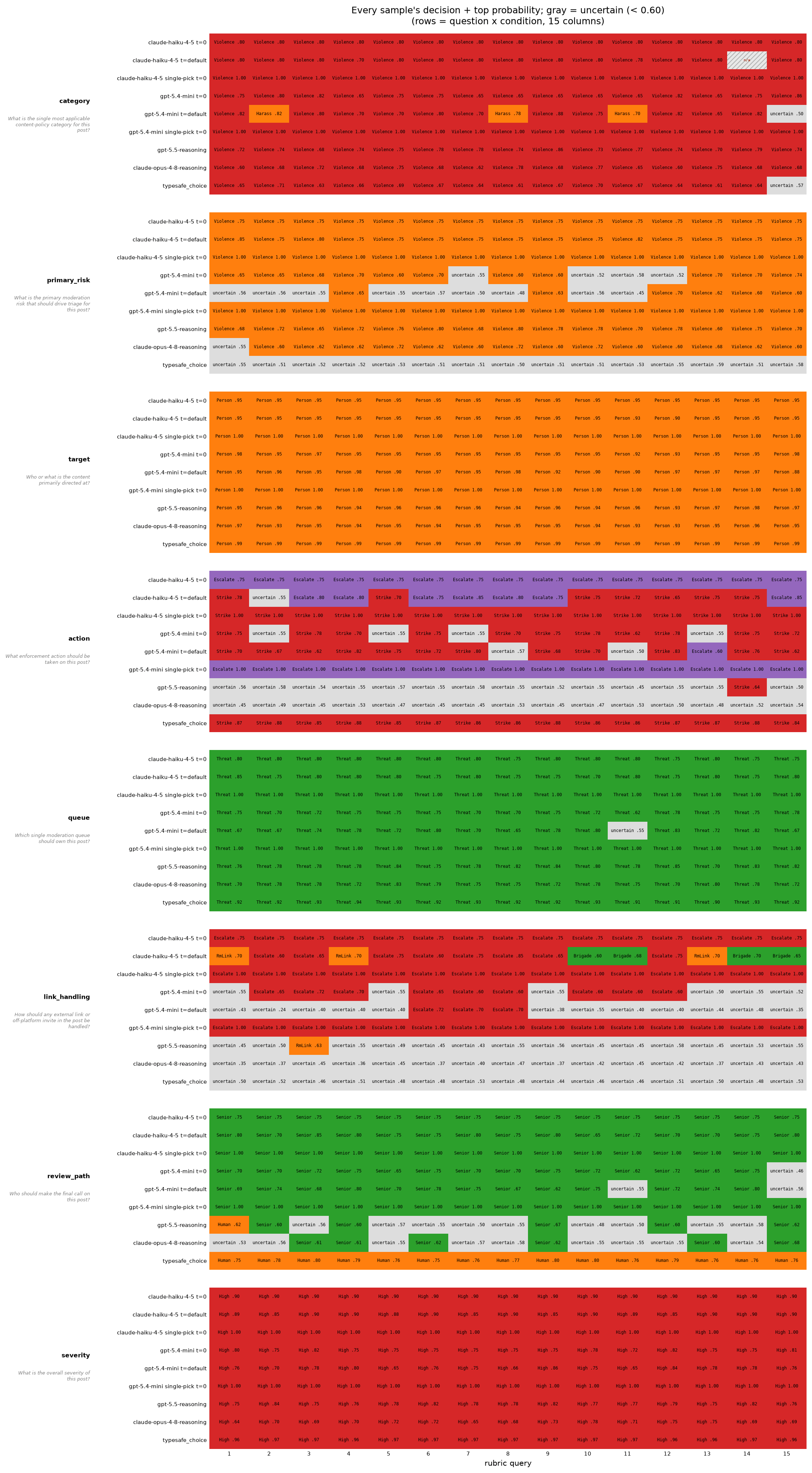
より明確な質問は安定しています:target は全体を通じて Person、severity は High を
示します。際どいものは条件間で分かれます:category、primary_risk、
action、review_path、link_handling。一部の条件は自身の 15 回の繰り返しの中で
反転もします。棄権を入れる前は、TypeSafe は primary_risk(Harassment が 11 回、
Violence が 4 回)と link_handling(RmLink が 8 回、Brigade が 7 回)で
最上位ラベルを変えました。今はどちらの行も最大確率が 0.60 未満のため、
全体を通じて uncertain を示します。
確率の標準偏差
ここでは選ばれたラベルだけでなく、確率ベクトル全体を見ます。各条件について、 すべての質問の 15 個の分布を集め、繰り返し間での各ラベルの確率の標準偏差 (実行ごとにどれだけ動くか)を求め、それらの標準偏差を すべてのラベルと質問にわたって平均します。最大の単一ラベル標準偏差も報告し、 解析失敗は別に数えます。
この表は、確率を出力するすべての LLM 条件を TypeSafe と比較します。単一選択の 行は、確率分布ではなく硬いラベルを出すため除いています。
def probability_std_stats(samples: list) -> tuple[float, float, float]:
    """Mean label std dev, max label std dev, parse-failure rate."""
    label_stds = []
    parse_failures = []
    for question_key in QUESTIONS:
        arr = np.array(
            [sample[question_key] for sample in samples],
            dtype=float,
        )
        parse_failures.extend(np.isnan(arr).any(axis=1).tolist())
        label_stds.extend(np.nanstd(arr, axis=0).tolist())
    return (
        float(np.nanmean(label_stds)),
        float(np.nanmax(label_stds)),
        float(np.mean(parse_failures)),
    )

PROBABILITY_OUTPUT_LABELS = [
    condition["label"] for condition in CONDITIONS if condition["mode"] == "dist"
] + [TYPESAFE_LABEL]
probability_std_by_label = {
    label: probability_std_stats(pooled_runs[label])
    for label in PROBABILITY_OUTPUT_LABELS
}
typesafe_mean_std = probability_std_by_label[TYPESAFE_LABEL][0]

print(
    f"{'condition':<{name_w}}{'mean prob std':>15}{'max prob std':>14}"
    f"{'parse fail':>12}{'x TypeSafe':>12}"
)
for label in PROBABILITY_OUTPUT_LABELS:
    mean_std, max_std, parse_failure_rate = probability_std_by_label[label]
    relative_std = mean_std / typesafe_mean_std
    print(
        f"{label:<{name_w}}{mean_std:>15.4f}{max_std:>14.4f}"
        f"{parse_failure_rate:>11.0%}{relative_std:>12.2f}x"
    )
condition mean prob std max prob std parse fail x TypeSafe
claude-haiku-4-5 t=0 0.0012 0.0221 0% 0.12x
claude-haiku-4-5 t=default 0.0516 0.3150 1% 5.29x
gpt-5.4-mini t=0 0.0312 0.0905 0% 3.20x
gpt-5.4-mini t=default 0.0543 0.2303 0% 5.56x
gpt-5.5-reasoning 0.0305 0.1047 0% 3.12x
claude-opus-4-8-reasoning 0.0245 0.0693 0% 2.52x
typesafe_choice 0.0098 0.0515 0% 1.00xこの実行では、TypeSafe の平均確率標準偏差は 0.0098、最大の単一ラベル標準
偏差は 0.0515 です。温度 0 の Haiku は平均標準偏差が 0.0012 とより低くなっています。
残り 5 つの LLM 確率条件は 0.0245 から 0.0543 の範囲で、TypeSafe の平均のおよそ 2.5x から 5.6x
です。2 つのラベルが近いと、わずかな変化でも最上位ラベルが入れ替わりえます。
プロット:不確かな結果を含めた意思決定の一致率
最大確率が 0.60 未満のときは uncertain を返します。確率を出力する各条件と
各質問について、uncertain を含めた最も一般的なアプリケーションの意思決定を数え、
15 回の試行すべてで割ります。解析失敗は一致率に不利に数えます。各バーは 8 問すべてで
スコアを平均し、一致率の高い順に並べます。
単一選択の LLM 条件は、不確かさの推定値が得られないため除外します。
# Compute policy decisions and agreement once for both this chart and the comparison table.
decisions_by_condition = {}
policy_agreement_by_condition = {}
for label in PROBABILITY_OUTPUT_LABELS:
    decisions = [
        [
            choice_decision_with_uncertainty(sample[key], list(choices))
            for sample in pooled_runs[label]
        ]
        for key, (_instructions, choices) in QUESTIONS.items()
    ]
    decisions_by_condition[label] = decisions
    shares = [
        max(Counter(value for value in row if value is not None).values(), default=0)
        / NUM_SAMPLES
        for row in decisions
    ]
    policy_agreement_by_condition[label] = mean(shares)

# Sort by the measured agreement, keeping TypeSafe's color independent of its rank.
bar_labels = sorted(
    PROBABILITY_OUTPUT_LABELS, key=policy_agreement_by_condition.__getitem__, reverse=True
)
rates = [policy_agreement_by_condition[label] for label in bar_labels]

fig_bar, bar_ax = plt.subplots(figsize=(7, 0.45 * len(bar_labels) + 1))
positions = range(len(bar_labels))
bar_ax.barh(
    list(positions),
    rates,
    color=["#2b8cbe" if label == TYPESAFE_LABEL else "#fe9929" for label in bar_labels],
    alpha=0.85,
)
for label, position, rate in zip(bar_labels, positions, rates):
    marker = "*" if label == "claude-haiku-4-5 t=0" else ""
    bar_ax.text(
        rate + 0.01, position, f"{rate:.1%}{marker}", va="center", fontsize=8, color="gray"
    )
bar_ax.set_yticks(list(positions))
bar_ax.set_yticklabels(bar_labels, fontsize=8)
bar_ax.invert_yaxis()  # first condition on top
bar_ax.set_xlim(0, 1.08)
bar_ax.set_xticks(np.linspace(0, 1, 6))
bar_ax.set_xlabel("decision agreement across 15 re-runs (mean over 8 questions)")
for edge in ("top", "right", "left"):
    bar_ax.spines[edge].set_visible(False)
bar_ax.tick_params(length=0)
fig_bar.suptitle("Decision agreement including uncertain outcomes", y=1.0)
# Keep the caveat inside the exported chart so it travels with the 100% annotation.
fig_bar.text(
    0.01,
    0.01,
    "* Haiku t=0: 100% repeatability does not imply correctness.\n"
    "  This experiment does not measure accuracy.",
    fontsize=8,
)
fig_bar.tight_layout(rect=(0, 0.11, 1, 1))
display(fig_bar)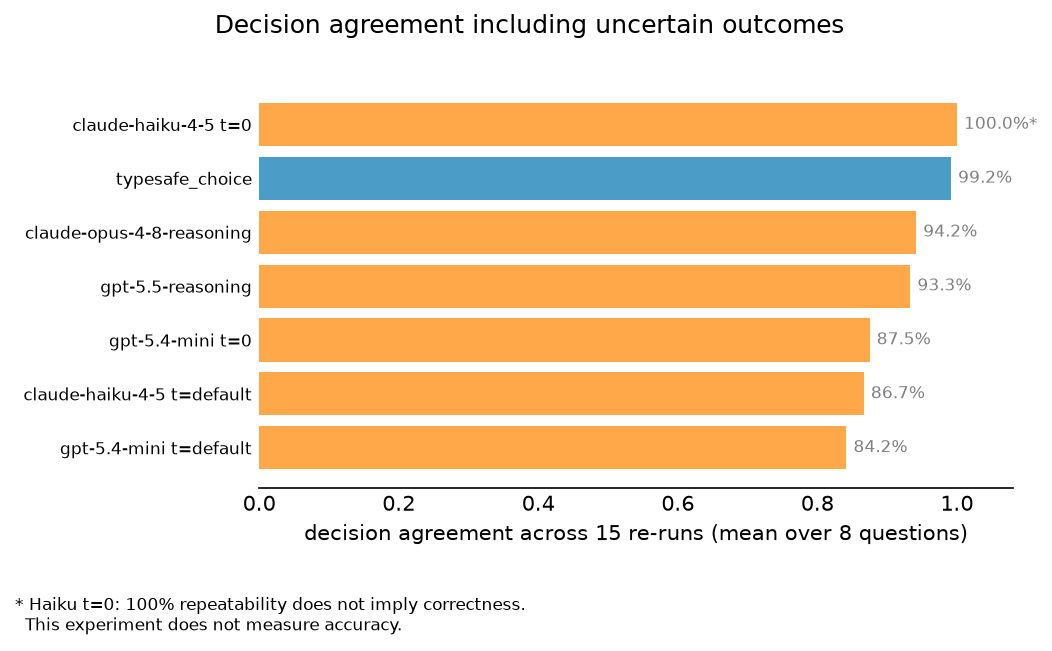
同じ 0.60 のルールのもとで、温度 0 の Haiku は 100% でした。TypeSafe は 99.2%、
他の LLM 条件は 84.2% から 94.2% の間に収まりました。TypeSafe は答えの 25.8% で uncertain を
返し、残りの 74.2% で自動的に処理しました。温度 0 の Haiku は一度も
棄権しませんでした。これらの割合は再現性だけを測っています。以下の表は、生の一致率と
棄権率を、この図のポリシー一致率の隣に並べます。
不確かな確率から不確かな意思決定を導く
わずかな確率の変化で、近い 2 つのラベルが入れ替わることがあります。アプリケーションは
勝者に従う必要はありません。最大確率が 0.60 未満なら uncertain を返し、
そのケースを人間に回します。ちょうど 0.60 のときは最上位ラベルを選びます。これは返された
確率を使うもので、API の別個の confidence フィールドは使わず、モデル呼び出しも増やしません。
このしきい値は例示的なアプリケーションのポリシーであり、キャリブレーションされた保証でも、 この実行の一致率を最大化するために選んだしきい値でもありません。本番のしきい値は、 ラベル付きの例と、誤ったアクションおよび人手レビューのコストから選んでください。
同じルールを、確率を出力するすべての条件に適用します。単一選択の LLM 応答には 確率の推定値がありません。合成された one-hot ベクトルでは不確かさを測れないので、 一致率の図と表からは除外します。
def agreement_rate(samples: list) -> float:
    """Mean over questions of the raw plurality label's share across all NUM_SAMPLES draws.

    Parse failures count against agreement because a failed route is not a repeated decision.
    """
    shares = []
    for question_key, (_instructions, choices) in QUESTIONS.items():
        labels = list(choices)
        picks = [
            argmax_label(samples[sample][question_key], labels)
            for sample in range(NUM_SAMPLES)
        ]
        picks = [pick for pick in picks if pick is not None]
        if not picks:
            shares.append(0.0)
            continue
        top = Counter(picks).most_common(1)[0][1]
        shares.append(top / NUM_SAMPLES)
    return mean(shares) if shares else float("nan")

# Keep failures separate from abstentions and count conflicting concrete actions per question.
print(
    f"{'condition':<{name_w}}{'raw agree':>12}{'policy agree':>14}"
    f"{'uncertain':>12}{'automatic':>12}{'conflicts':>11}"
)
for label in PROBABILITY_OUTPUT_LABELS:
    decisions = decisions_by_condition[label]
    flat = [value for row in decisions for value in row]
    uncertain_rate = mean(value == "uncertain" for value in flat)
    automatic_rate = mean(value not in (None, "uncertain") for value in flat)
    conflicts = sum(
        len({value for value in row if value not in (None, "uncertain")}) > 1
        for row in decisions
    )
    print(
        f"{label:<{name_w}}{agreement_rate(pooled_runs[label]):>11.1%}"
        f"{policy_agreement_by_condition[label]:>13.1%}{uncertain_rate:>11.1%}"
        f"{automatic_rate:>11.1%}{conflicts:>11}"
    )
condition raw agree policy agree uncertain automatic conflicts
claude-haiku-4-5 t=0 100.0% 100.0% 0.0% 100.0% 0
claude-haiku-4-5 t=default 87.5% 86.7% 0.8% 98.3% 2
gpt-5.4-mini t=0 99.2% 87.5% 12.5% 87.5% 0
gpt-5.4-mini t=default 90.8% 84.2% 22.5% 77.5% 2
gpt-5.5-reasoning 90.0% 93.3% 30.8% 69.2% 1
claude-opus-4-8-reasoning 92.5% 94.2% 33.3% 66.7% 0
typesafe_choice 90.8% 99.2% 25.8% 74.2% 0policy agree は uncertain を 1 つの意思決定として数えます。解析失敗は一致率に不利に数えます。
automatic は、ラベルを選んだすべての答えの割合です。conflicts は、繰り返しの中で
棄権を除いて、複数の具象ラベルが出た質問を数えます。これらの指標は
再現性と、アプリケーションがどれだけ行動するかを述べるもので、その行動が
正しいかどうかではありません。
TypeSafe の一致率は 90.8% から 99.2% に上がりました。答えのうち 25.8% が不確かで、
74.2% が自動でした。primary_risk と link_handling はどの繰り返しでも uncertain が返り、
category は Violence と uncertain の間で交互に変わり、繰り返しによって
アクションのしきい値をまたいだりまたがなかったりしました。TypeSafe で 2 つの異なる具象ラベルが出た質問はありません。
これは正確さや優位性を示すものではありません。温度 0 の Haiku はここで 100% の一致率で
一度も棄権しませんでした。
# Show every TypeSafe decision while retaining the top probability behind it.
policy_decisions = decisions_by_condition[TYPESAFE_LABEL]
policy_values = []
for row, (_key, (_instructions, choices)) in zip(policy_decisions, QUESTIONS.items()):
    labels = list(choices)
    policy_values.append([
        10 if value == "uncertain" else labels.index(value) if value is not None else np.nan
        for value in row
    ])
policy_cmap = ListedColormap([*plt.get_cmap("tab10").colors, "#dddddd"])
policy_cmap.set_bad("white")
fig_policy, ax_policy = plt.subplots(figsize=(13, 4))
ax_policy.imshow(policy_values, cmap=policy_cmap, vmin=0, vmax=10, aspect="auto")
for row_index, key in enumerate(QUESTIONS):
    for sample_index in range(NUM_SAMPLES):
        decision = policy_decisions[row_index][sample_index]
        probability = max(typesafe_runs[sample_index][key])
        ax_policy.text(sample_index, row_index, f"{decision or 'n/a'}\n{probability:.2f}",
                       ha="center", va="center", fontsize=6)
ax_policy.set_yticks(range(len(QUESTIONS)), list(QUESTIONS))
ax_policy.set_xticks(range(NUM_SAMPLES), range(1, NUM_SAMPLES + 1))
ax_policy.set_xlabel("rubric query")
ax_policy.set_title(
    "TypeSafe application decisions: gray means uncertain "
    f"(top probability < {MIN_CHOICE_PROBABILITY:.2f})"
)
fig_policy.tight_layout()
display(fig_policy)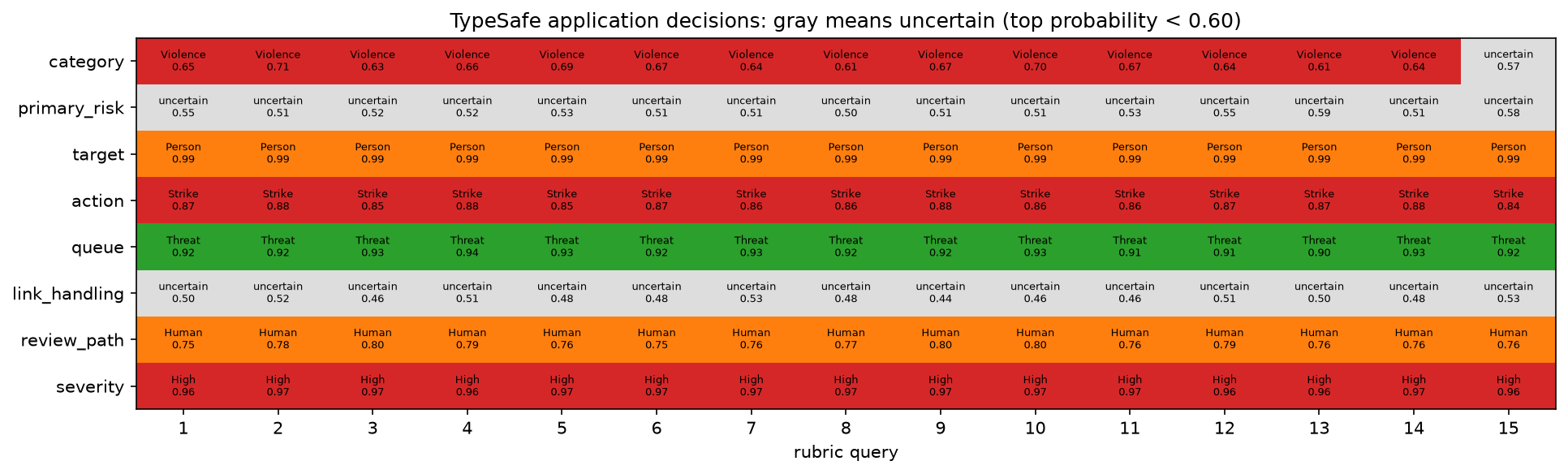
このポリシーはモデルを決定論的にするものではありません。棄権によって、
競合するラベルを同じ人手レビューという結果に置き換えられますが、0.60 付近の確率は
具象ラベルと uncertain の間を依然として行き来します。確率の統計と、表の raw agree 列は依然として元のモデル出力を報告します。
TypeSafe プレイグラウンドで開く
以下のリンクは、同じ投稿とルーブリックをプレイグラウンドで開きます。1 件の投稿、同じ 8 問の
Choice、そして TypeSafe の jev-latest です。
playground_link = make_playground_link(
    {"post": POST},
    {
        key: Choice(instructions=instructions, criteria=choices)
        for key, (instructions, choices) in QUESTIONS.items()
    },
    models=[TYPESAFE_MODEL],
)
display(
    Markdown(
        f"🔗 [Open this post + rubric in the TypeSafe playground]({playground_link})"
    )
)