Extração de datas
Extrai datas absolutas e relativas pedindo ao TypeSafe as partes nomeadas num documento e depois resolvendo-as e validando-as em código com revisão baseada na confiança.
Lê as partes de uma data no texto com o TypeSafe e depois resolve-as para um date em código.
A função que vais construir aqui, extract_date(document, role), recebe um documento e uma frase que nomeia a data que queres, como «o prazo para devolver o formulário», e devolve um date com uma confiança. Assinala uma leitura de baixa confiança, e também uma cujas partes não somam uma data de todo, incluindo uma data que o documento nunca indica. A data pode estar escrita por extenso («14 de agosto de 2027») ou expressa em relação a hoje («amanhã», «próxima quinta-feira»).
O TypeSafe responde a perguntas Choice sobre a data numa só chamada: que tipo de data é, e que mês, dia, ano ou dia da semana o texto nomeia. O código transforma essas respostas num date. O modelo lê o que o texto diz e nunca faz as contas do calendário.
As células abaixo executam essa função sobre quatro documentos curtos, imprimem cada data com a sua confiança e dividem os resultados entre os que o código aceita e os que uma pessoa deve ver.
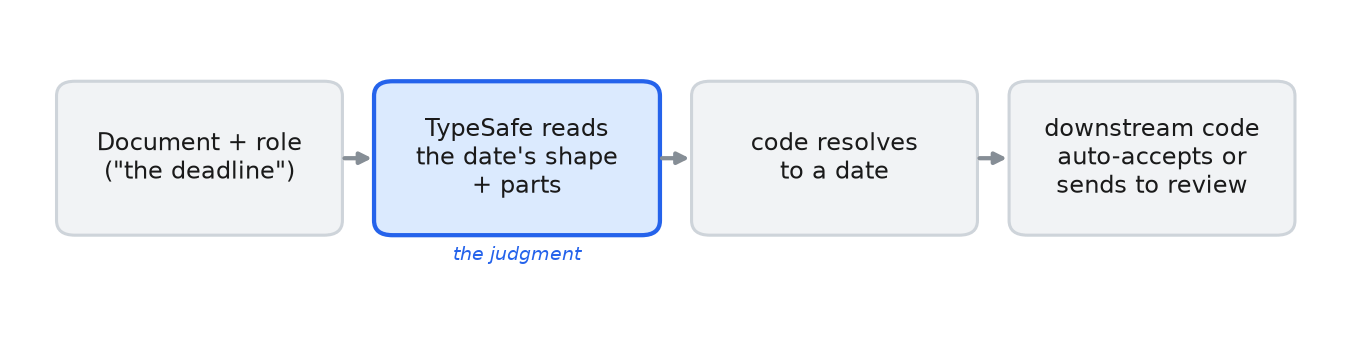
O TypeSafe lê como a data está escrita e que partes o texto nomeia. O código transforma essas respostas num date, contando a partir de hoje quando a data é relativa, e ou a aceita ou a envia para revisão.
Configuração
pip install ipython 'cooksafe>=0.2.0,<0.3.0'depois define TYPESAFE_API_KEY.
import os
from datetime import date, timedelta
from pathlib import Path

from cooksafe import JsonCache, make_playground_link
from IPython.display import Markdown, display
from typesafe_sdk import Choice, TypeSafeClient

TYPESAFE_MODEL = "jev-1.12"
TODAY = date(
    2026, 7, 30
)  # fixed reference "today" so relative dates resolve reproducibly
REVIEW_BELOW = 0.60  # gate: a date below this confidence is flagged for a human

MONTHS = {
    "January": 1,
    "February": 2,
    "March": 3,
    "April": 4,
    "May": 5,
    "June": 6,
    "July": 7,
    "August": 8,
    "September": 9,
    "October": 10,
    "November": 11,
    "December": 12,
}
WEEKDAYS = [
    "Monday",
    "Tuesday",
    "Wednesday",
    "Thursday",
    "Friday",
    "Saturday",
    "Sunday",
]
YEAR_WINDOW = list(range(1900, 2051))  # 1900..2050

# Cached to json_cache.json (shipped with the cookbook, so re-rendering replays the published
# results with no API spend); delete it to re-run live.
json_cache = JsonCache(Path("json_cache.json"))
# The demo cells below run when this file is executed as the cookbook; the constants and the pure
# resolve/assemble code stay importable, so the calendar math can be unit-tested on its own.
if __name__ == "__cookbook__":
client = TypeSafeClient(
api_key=os.environ.get(
"TYPESAFE_API_KEY", "cache-only"
), # cached re-renders need no key
base_url=os.environ.get("TYPESAFE_BASE_URL"),
timeout=30.0,
)As perguntas
Sete perguntas Choice saem numa só chamada. mode diz como a data está escrita: absolute para uma data que nomeia um mês, relative para uma escrita em relação a hoje, e none quando o documento não indica a data de todo.
As outras seis leem as peças. Uma data absoluta precisa de month, day e year. Uma relativa precisa de day_anchor: hoje, amanhã, depois de amanhã, ou um dia da semana com nome. Quando nomeia um dia da semana, weekday e week_offset dizem qual e em que semana. O código lê apenas as peças que mode pede.
year lista uma opção por ano, de 1900 a 2050, mais duas saídas. none significa que o texto não indica nenhum ano e o código preenche um. out_of_range significa que o texto indica um ano fora da lista, e o código assinala isso em vez de adivinhar. Se uma lista tão longa te incomoda, extrai primeiro do texto os números que pareçam anos e oferece ao modelo apenas esses.
def date_questions(role: str) -> dict[str, Choice]:
    """Seven typed choices that read a date's shape and parts off the text -- no math."""
    absent = "The document does not state this, or it is not this kind of date."
    return {
        "mode": Choice(
            instructions=(
                f"How is {role} written? 'absolute' = a calendar date naming a month (e.g. "
                "'August 14', 'the 3rd of March'); 'relative' = given relative to today (today, "
                "tomorrow, the day after tomorrow, or a named weekday such as 'next Thursday'); "
                "'none' = the document does not state this date."
            ),
            criteria={"absolute": None, "relative": None, "none": None},
        ),
        "month": Choice(
            instructions=f"If {role} is an absolute calendar date, which month is it in?",
            criteria={m: None for m in MONTHS} | {"none": absent},
        ),
        "day": Choice(
            instructions=f"If {role} is an absolute calendar date, which day of the month (1-31)?",
            criteria={str(d): None for d in range(1, 32)} | {"none": absent},
        ),
        "year": Choice(
            instructions=(
                f"If {role} is an absolute calendar date, which year? Pick 'none' if the document "
                "states no year (code infers it), or 'out_of_range' if a year is stated but not "
                "in the list."
            ),
            criteria={str(y): None for y in YEAR_WINDOW}
            | {
                "out_of_range": "A year is stated for this date but is outside the listed range.",
                "none": "No year is stated for this date.",
            },
        ),
        "day_anchor": Choice(
            instructions=(
                f"If {role} is relative to today, which day is it? 'today', 'tomorrow', "
                "'day_after' (the day after tomorrow), or 'weekday' (a named day of the week)."
            ),
            criteria={
                "today": None,
                "tomorrow": None,
                "day_after": None,
                "weekday": None,
                "none": absent,
            },
        ),
        "weekday": Choice(
            instructions=f"If {role} names a day of the week, which one?",
            criteria={w: None for w in WEEKDAYS} | {"none": absent},
        ),
        "week_offset": Choice(
            instructions=(
                f"If {role} names a weekday, which week is it in? 'next' for 'next Thursday' or "
                "'Thursday next week'; 'current' for 'this Thursday'; 'none' for a bare weekday "
                "with no qualifier (just 'Thursday' / 'on Thursday')."
            ),
            criteria={"current": None, "next": None, "none": absent},
        ),
    }
Resolve-o em código
read_parts faz a chamada. assemble transforma as respostas num date: preenche o ano quando o texto não indica nenhum, e calcula a que dia aponta um dia da semana com nome. Ambas contam a partir de TODAY, que está fixado para que as datas relativas saiam iguais em cada execução. assemble também reporta a confiança mais baixa entre as partes que usou, por isso uma resposta fraca em qualquer uma das partes pode enviar a data inteira para revisão.
«Próxima quinta-feira» pode significar dois dias diferentes, por isso o código decide qual. Um dia da semana sem qualificador significa o próximo a partir de hoje. next significa a semana de calendário seguinte, e current significa esta semana.
@json_cache
def read_parts(document: str, role: str) -> dict:
    """One TypeSafe call -> {part: {choice, confidence}} for the seven questions."""
    answers = client.system_one(
        state=document, questions=date_questions(role), model=TYPESAFE_MODEL
    ).answers
    return {
        part: {"choice": ans.choice, "confidence": ans.confidence}
        for part, ans in answers.items()
    }

def resolve_weekday(today: date, weekday: str, week_offset: str) -> date:
    """Which date a named weekday points to, by our stated convention: a bare weekday is the next
    occurrence on or after today; 'next' is the following calendar week; 'current' is this week."""
    w = WEEKDAYS.index(weekday)
    this_monday = today - timedelta(days=today.weekday())
    if week_offset == "next":
        return this_monday + timedelta(days=7 + w)
    if week_offset == "current":
        return this_monday + timedelta(days=w)
    return today + timedelta(days=(w - today.weekday()) % 7)

def assemble(parts: dict, today: date = TODAY) -> dict:
    """Resolve the parts TypeSafe read into a concrete date, in code. Confidence is the weakest of
    the parts the shape actually used."""
    mode = parts["mode"]["choice"]
    confs = [parts["mode"]["confidence"]]

    def result(resolved: date | None, note: str) -> dict:
        usable = [c for c in confs if c is not None]
        confidence = min(usable) if usable else None
        needs_review = (
            resolved is None or confidence is None or confidence < REVIEW_BELOW
        )
        return {
            "date": resolved,
            "confidence": confidence,
            "needs_review": needs_review,
            "note": note,
        }

    if mode == "none":
        return result(None, "no such date stated")

    if mode == "absolute":
        month, day, year = (
            parts["month"]["choice"],
            parts["day"]["choice"],
            parts["year"]["choice"],
        )
        confs += [
            parts["month"]["confidence"],
            parts["day"]["confidence"],
            parts["year"]["confidence"],
        ]
        if "none" in (month, day) or not day.isdigit() or month not in MONTHS:
            return result(None, "absolute date incomplete")
        if (
            year == "out_of_range"
        ):  # a year is stated but off the list -> flag, don't guess
            return result(None, f"year outside {YEAR_WINDOW[0]}-{YEAR_WINDOW[-1]}")
        if (
            year == "none"
        ):  # no year stated -> infer this year, bumped to next if well past
            try:
                resolved = date(today.year, MONTHS[month], int(day))
            except (
                ValueError
            ):  # e.g. February 30 -- an inconsistent read, not a real date
                return result(None, f"impossible date: {month} {day}")
            if resolved < today - timedelta(days=31):
                resolved = date(today.year + 1, MONTHS[month], int(day))
            return result(resolved, "")
        try:  # a stated, in-range year
            return result(date(int(year), MONTHS[month], int(day)), "")
        except ValueError:
            return result(None, f"impossible date: {year}-{month}-{day}")

    if mode == "relative":
        anchor = parts["day_anchor"]["choice"]
        confs.append(parts["day_anchor"]["confidence"])
        if anchor == "today":
            return result(today, "")
        if anchor == "tomorrow":
            return result(today + timedelta(days=1), "")
        if anchor == "day_after":
            return result(today + timedelta(days=2), "")
        if anchor == "weekday":
            weekday, offset = parts["weekday"]["choice"], parts["week_offset"]["choice"]
            confs += [
                parts["weekday"]["confidence"],
                parts["week_offset"]["confidence"],
            ]
            if weekday not in WEEKDAYS:
                return result(None, "relative weekday not read")
            return result(resolve_weekday(today, weekday, offset), "")
        return result(None, "relative day not read")

    return result(None, f"unrecognized mode: {mode}")

def extract_date(document: str, role: str) -> dict:
    return assemble(read_parts(document, role))
Executa-o
Seis perguntas em quatro documentos curtos: duas datas de um contrato que indica os seus anos, um prazo de formulário escrito sem ano, um inquérito que encerra «hoje», uma revisão marcada para «próxima quinta-feira» e uma data que o formulário nunca menciona. Todas se resolvem em relação a TODAY = 2026-07-30, uma quinta-feira.
CONTRACT = "This agreement is effective January 1, 2025 and expires December 31, 2027."
FORM = "Please return the signed form by August 14."
SURVEY = "Heads up - the customer survey closes today at 5pm."
REVIEW = "Let's schedule the design review for next Thursday."

# (document, question phrase, expected date) -- the expected value is only for the scorecard.
EXAMPLES = [
    (CONTRACT, "the date the agreement takes effect", date(2025, 1, 1)),
    (CONTRACT, "the date the agreement expires", date(2027, 12, 31)),
    (FORM, "the deadline to return the form", date(2026, 8, 14)),
    (FORM, "the date of the kickoff call", None),
    (SURVEY, "the date the survey closes", date(2026, 7, 30)),
    (REVIEW, "the date of the design review", date(2026, 8, 6)),
]

if __name__ == "__cookbook__":
    print(f"{'':3}{'question':<38}{'expected':<12}{'got':<12}{'conf':>6}  flags")
    print("-" * 84)
    for document, role, expected in EXAMPLES:
        r = extract_date(document, role)
        got = r["date"].isoformat() if r["date"] else "none"
        exp = expected.isoformat() if expected else "none"
        mark = "OK" if r["date"] == expected else "XX"
        conf = f"{r['confidence']:.2f}" if r["confidence"] is not None else " n/a"
        flags = "  <== review" if r["needs_review"] else ""
        if r["note"]:
            flags += f"  ({r['note']})"
        print(f"{mark:<3}{role:<38}{exp:<12}{got:<12}{conf:>6}{flags}")
question expected got conf flags
------------------------------------------------------------------------------------
OK the date the agreement takes effect 2025-01-01 2025-01-01 0.97
OK the date the agreement expires 2027-12-31 2027-12-31 0.91
OK the deadline to return the form 2026-08-14 2026-08-14 0.95
OK the date of the kickoff call none none 0.46 <== review (absolute date incomplete)
OK the date the survey closes 2026-07-30 2026-07-30 0.94
OK the date of the design review 2026-08-06 2026-08-06 0.92O contrato indica os seus dois anos, por isso vieram do texto. O formulário não indica ano, por isso o código preencheu 2026: pega no ano atual e passa para o seguinte apenas quando a data já passou há mais de um mês. «hoje» e «próxima quinta-feira» passaram pela mesma função que as datas escritas por extenso.
A chamada de arranque é a que o formulário nunca menciona. Há uma data nesse formulário, só que não esta, e a nota absolute date incomplete significa que mode voltou como absolute sem um mês que o acompanhasse. A data voltou vazia, a confiança marca 0.46 e a linha fica assinalada para uma pessoa.
A confiança para encaminhar
Cada resposta volta com uma confiança calibrada, e a confiança de uma data é a mais baixa entre as partes que entraram nela. Uma data abaixo de REVIEW_BELOW = 0.60 vai para uma pessoa, e também uma data que o código não conseguiu sequer montar. O resto passa diretamente.
if __name__ == "__cookbook__":
    confident = [
        (doc, role)
        for doc, role, _ in EXAMPLES
        if not extract_date(doc, role)["needs_review"]
    ]
    review = [
        (doc, role)
        for doc, role, _ in EXAMPLES
        if extract_date(doc, role)["needs_review"]
    ]
    print(f"auto-accept ({len(confident)}):")
    for _doc, role in confident:
        print(f"  - {role}")
    print(f"\nsend to review ({len(review)}):")
    for _doc, role in review:
        r = extract_date(_doc, role)
        print(
            f"  - {role}  (conf {r['confidence']:.2f} / {r['note'] or 'low confidence'})"
        )
auto-accept (5):
- the date the agreement takes effect
- the date the agreement expires
- the deadline to return the form
- the date the survey closes
- the date of the design review
send to review (1):
- the date of the kickoff call (conf 0.46 / absolute date incomplete)Abre-o no playground do TypeSafe
O link abaixo contém a mensagem «próxima quinta-feira» e as mesmas perguntas que o código envia. Abre-o para ver as respostas e as suas confianças, e para alterar a redação sem escrever código.
if __name__ == "__cookbook__":
    playground_link = make_playground_link(
        REVIEW, date_questions("the date of the design review"), models=[TYPESAFE_MODEL]
    )
    display(
        Markdown(
            f"🔗 [Open this document + questions in the TypeSafe playground]({playground_link})"
        )
    )